As ruling camp delays basic digital asset law, opposition pushes to scrap taxation and scholars warn equity caps are unconstitutional [Crypto Briefing]
- Input
- 2026-03-25 16:53:19
- Updated
- 2026-03-25 16:53:19
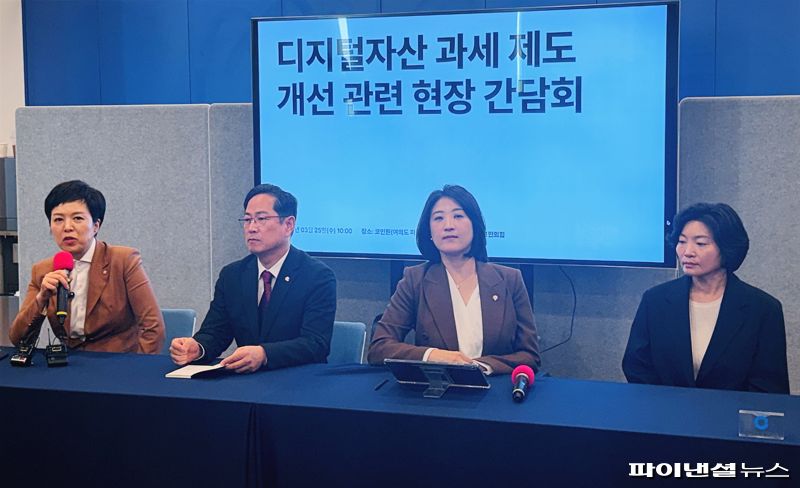
According to The Financial News, as talks on the government and ruling camp’s second-phase legislation for the Digital Asset Basic Act have been delayed, the People Power Party (PPP), the largest opposition party, has launched a legislative push to abolish taxation on capital gains from virtual assets. At the same time, academics have warned that a plan under review by the government and ruling party to cap major shareholders’ equity stakes in virtual asset exchanges would violate constitutionally protected property rights and corporate freedom.
On March 25, People Power Party floor leader Song Eon-seok held a meeting at the Coinone headquarters in Yeouido, Seoul, with the heads of the five major virtual asset exchanges (Upbit, Bithumb, Coinone, Korbit and GOPAX) and officials from the Digital Asset eXchange Alliance (DAXA).
At the meeting, opposition leaders argued that imposing income tax on virtual assets from next year, when the financial investment income tax has already been scrapped, would run counter to tax fairness. Song had earlier, on March 19, introduced a bill to amend the Income Tax Act that would delete provisions imposing tax on capital gains from virtual assets.
However, the final say on whether to tax virtual assets lies with the government, which controls budget formulation and execution, and with the Minjoo Party of Korea, which holds a majority of seats in the National Assembly. Against this backdrop, the PPP is seeking to put pressure on the government ahead of the June 3 local elections by presenting itself as the voice of 11.13 million investors. Citing, among other things, the United States Securities and Exchange Commission (SEC)’s decision to treat Bitcoin as a commodity, the party argues that "imposing income tax on virtual assets that are already subject to value-added tax amounts to double taxation."
Amid this opposition-led push to ease taxation, constitutional law scholars have launched a broadside against plans by regulators such as the Financial Services Commission to tighten rules on the governance of exchanges. At the "2026 First Issue Diagnosis Seminar" hosted by the Korean Constitutional Law Association at the FKI Conference Center in Yeouido, Seoul, on the same day, speakers strongly criticized the constitutionality of proposed limits on equity stakes.
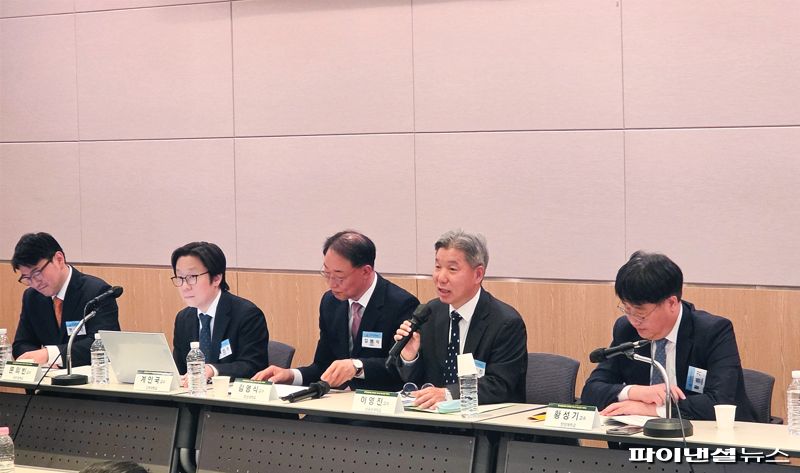
Presenting on the main topic, Chosun University Professor Myung-Sik Kim stated, "The government’s plan to limit equity stakes would artificially disperse major shareholders’ holdings and order the forced disposal of excess shares, thereby directly intervening in companies’ ownership and decision-making structures." He argued, "This directly restricts the core of the constitutional freedom of occupation, the corporate freedom derived from it, and property rights."
Kim further warned, "If these legal difficulties persist, even if legislation moves forward, constitutional complaints and other legal challenges will continue," adding, "If regulators push ahead with heavy-handed rules that have few parallels globally, there is a risk that the legal trust and stability built up so far could collapse overnight."
Academia also voiced concern that excessive government regulation would undermine the competitiveness of Korea’s virtual asset industry. Kim stressed, "If constitutional controversy drags on, the domestic virtual asset industry is highly likely to miss its critical window for growth before the system even takes root," and added, "The Digital Asset Basic Act needs to be redesigned in a way that achieves the public interest without undermining the industry’s capacity for innovation."
The subsequent general discussion was chaired by Sungkyunkwan University School of Law Distinguished Professor Lee Young-jin, with Hanyang University Professor Hwang Sung-gi, Korea University Professor Gye In-guk and Kookmin University Professor Moon Ui-bin joining to voice strong criticism. The panelists agreed that, even though alternatives such as strengthening internal control systems or tightening fit-and-proper tests for major shareholders are available, outright bans on equity ownership itself violate the principle of proportionality.
Within the industry, many welcome the opposition’s move to abolish taxation, yet there is skepticism over whether it can overcome resistance from the government and ruling party during the actual legislative process. At the same time, debate over regulations that could shake up exchange governance is adding to the mix, pushing policy uncertainty to the extreme. An industry official who requested anonymity lamented, "In this discord where the opposition talks about benefits and the government talks about regulation, it is companies that are being driven to the brink," and added, "There is an urgent need for genuine bipartisan cooperation that goes beyond political point-scoring and focuses on industry growth and user protection."
[email protected] Kim Mi-hee, Lim Sang-hyuk Reporter