"I Live Alone: Pyongyang Edition"... Kim Jong Un's 'Coal Flex' [Kim Kyung-min's Timely Hit]
- Input
- 2026-03-26 07:30:00
- Updated
- 2026-03-26 07:30:00
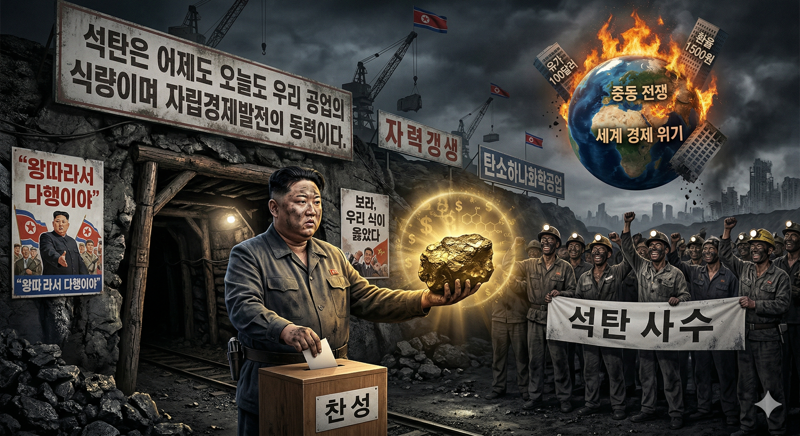
[The Financial News] The global economy is gasping for air. The Strait of Hormuz has been choked off. International oil prices are hovering around 100 dollars a barrel. An exchange rate of 1,500 won to the dollar is strangling South Korea's economy. In a hyper-connected world, mutual dependence has turned into a deadly poison.
Yet there is one place that seems to be smiling in the middle of this chaos: Pyongyang. Coal, long treated as an outdated relic, and the doctrine of self-reliance have re-emerged as saviors, riding the wave of high oil prices. In an era obsessed with eco-friendliness and low carbon, Pyongyang is doubling down on coal.
"It's a good thing we're shunned."
While the rest of the world frets over the flames in the Middle East, Kim Jong Un, President of the State Affairs Commission of North Korea, is looking elsewhere. His destination was not a cutting-edge industrial complex, but an aging coal mine. Where the leader goes signals the state's strategy. On the 15th, during elections for the 15th Supreme People's Assembly of North Korea, Kim Jong Un skipped the polling station in Pyongyang and instead visited the Cheonseong Youth Coal Mine in South Pyongan Province. There, he personally cast a yes vote for the mine manager, who was standing as a deputy candidate.
The symbolism is significant. In the 2014 elections for the 13th Assembly, he chose Kim Il Sung University of Politics, underscoring regime security. Seven years later, for the 14th Assembly, he appeared at Kim Chaek University of Technology, the top science and engineering school, proclaiming a focus on science and technology. This time, for the 15th Assembly, he went down to the coal face underground. The message is clear. Under the double burden of high oil prices and sanctions, the engine of survival for the Democratic People's Republic of Korea (DPRK) is ultimately resource self-sufficiency—"coal." It is a highly calculated piece of symbolism, declaring this both at home and abroad.
Rodong Sinmun is urging increased production day after day. Slogans about "defending coal" blanket the front page. While the world is being strangled by energy networks, Pyongyang is touting a paradoxical calm. It is a calm born of complete exclusion and isolation. Over many years, the DPRK has driven its dependence on oil to an extreme low. Instead, it has thrown itself into the C1 chemical industry, which gasifies coal to produce chemical products.
This distorted industrial structure is now being praised as an ideal wartime economic model for the age of high oil prices. The more external supply chains collapse, the louder Pyongyang proclaims, "Look, our way was right," in the name of juche, or self-reliance.
In the DPRK, coal is not just fuel for heating. It is a source of ruling funds and a powerful tool for cementing the system. Surging international oil prices have even boosted the black-market value of North Korean coal. The more the Strait of Hormuz is blocked, the higher the smuggling price of coal bound for China and Russia. The global war crisis is, in effect, earning Kim Jong Un more dollars.
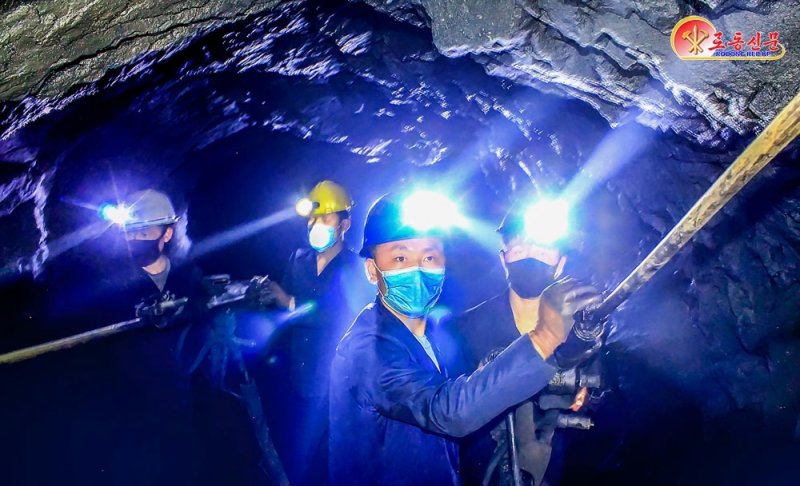
Zero impact from 100-dollar oil: the DPRK's psychological victory
"The working class in the coal industry are the core of our country, achieving the highest merits on the front lines of national construction. Coal was yesterday and is today the food of our industry and the driving force of our self-reliant economic development."
Kim Jong Un's on-site speech was even more blunt. He declared, "The more our development accelerates and the more our ideals are turned into reality, the more urgently the demand for coal is being raised," and stressed, "The backbone industries that must drive the prosperity and rejuvenation of our state all use coal as their fuel and raw material." This is a continuation of the goal set at the 9th Congress of the Workers' Party of Korea last month, where the DPRK pledged to increase coal output by 1.2 times over the next five years.
Even more chilling is the internal propaganda campaign. The DPRK is packaging the war in the Middle East as the downfall of imperialism. It is broadcasting, in great detail, the turmoil of capitalism suffering under soaring oil prices. To people groaning as even state rations dry up, the regime is injecting a sense of psychological fullness. Physical hunger is sublimated into "hardship for the revolution." The black coal dust smeared on their faces is turned into a medal of patriotism.
South Korea is reeling from a 1,500-won exchange rate and 150-dollar oil. The DPRK is gritting its teeth in mine tunnels, chewing on coal dust to survive. The Korean Peninsula is staging a dark comedy.
[email protected] Kim Kyung-min Reporter