"11 Trillion Won Piled Into Samsung Electronics Alone"—Retail Investors' AI Conviction as Foreigners Dump 10 Trillion Won
- Input
- 2026-03-25 07:58:20
- Updated
- 2026-03-25 07:58:20
[The Financial News] Despite a sharp stock market drop triggered by the war between the United States and the Islamic Republic of Iran, individual investors are aggressively buying shares. They are especially snapping up semiconductor bellwethers such as Samsung Electronics and SK hynix, effectively countering the large-scale sell-off by foreign investors.
Retail investors buying Samsung Electronics on every post-war dip
According to the Korea Exchange on the 24th, individual investors have purchased 26.2505 trillion won worth of shares so far this month. This is the largest net buying on record, surpassing the previous high of 22.3384 trillion won in January 2021.
Their buying intensity has increased as stock prices have plunged. On March 3, the first trading day after the war broke out, the KOSPI tumbled 7.24%, and individuals bought 5.7974 trillion won in a single day. When the KOSPI fell another 6.49% on the 23rd, they recorded an all-time daily high by net buying 7.0028 trillion won.
Notably, about 11.6085 trillion won—roughly 44% of all individual net purchases on the main board of the Korea Exchange this month—was concentrated in just one stock, Samsung Electronics. In effect, individual investors have been buying Samsung Electronics every time its share price dipped.
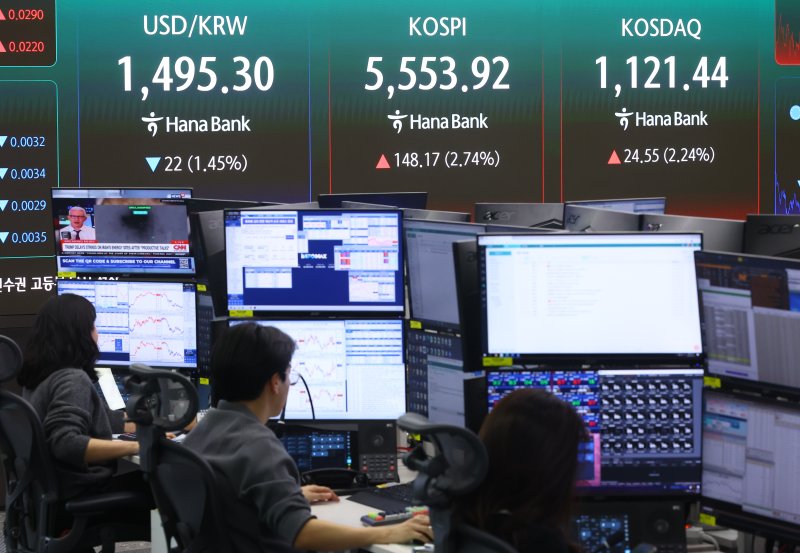
On the 24th, Samsung Electronics rebounded on the back of strong net buying by individuals. The KOSPI index closed the day at 5,553.92, up 2.74% from the previous session.
The reason individual investors are focusing on Samsung Electronics is clear. Demand for AI semiconductors is expanding, and this is driving a visible improvement in earnings. Even before the war, the sharp rise in the KOSPI was underpinned by profit growth at large-cap semiconductor names such as Samsung Electronics and SK hynix.
The pattern is not unfamiliar. During the "Donghak Ant Movement" in January 2021, individual investors also bought the most of Samsung Electronics, with net purchases of 10.1564 trillion won, and set a then-record monthly net buying total of 22.3384 trillion won. This month, they have easily surpassed that record by net buying 26.2511 trillion won.
Foreigners net sell 22 trillion won this month... holdings ratio falls to 37%
By contrast, foreign investors have net sold 10.539 trillion won worth of Samsung Electronics over the same period. In effect, foreigners are unloading about as much as individuals are taking in. Foreigners’ total net selling on the Stock Market Division of the Korea Exchange this month has reached 22.257 trillion won, already surpassing last month’s all-time monthly record of 21.073 trillion won.
Foreign investors’ share of market capitalization in the KOSPI market is also declining. According to Yonhap Infomax, as of the 23rd, the market value of KOSPI stocks held by foreigners stood at 1,663.609 trillion won, accounting for 37.32% of total market capitalization. Their shareholding ratio, which was 38.10% on February 26, has fallen into the 37% range this month.
Heavy reliance on crude oil imports and exchange-rate risks are cited as key reasons for the foreign exodus. On a weekly closing basis, the won–dollar exchange rate has risen 3.85% this month, and on the 23rd it briefly broke through 1,510 won intraday, hitting its highest level in about 17 years.
At the same time, concerns are mounting over the growing number of individual investors borrowing money to buy stocks. According to the Korea Financial Investment Association (KOFIA), as of the 20th, outstanding margin loans totaled 32.3605 trillion won, with 21.7436 trillion won in the KOSPI market and 10.6169 trillion won in the KOSDAQ (Korea Securities Dealers Automated Quotations) market.
In particular, margin financing is heavily concentrated in top-tier semiconductor stocks by market capitalization, including 2.9813 trillion won in Samsung Electronics and 2.1045 trillion won in SK hynix. With geopolitical risks stemming from the Middle East continuing due to the U.S.–Iran war, many are warning that caution is warranted.
Kim Seok-hwan, a researcher at Mirae Asset Securities, said, "The grace period set by former U.S. President Donald Trump for attacking power plants in the Islamic Republic of Iran expires this Friday, U.S. Eastern time," and added, "If there is no visible progress by then or if news breaks that negotiations have collapsed, oil prices could surge back to their highest levels in years, and volatility in financial markets could increase further, making it necessary to adjust exposure to risky assets."
[email protected] Kim Hee-sun Reporter