Japanese Labor and Management Pursue Coexistence, While Korean Unions Call Only for Strikes [Growing Union Risk]
- Input
- 2026-03-24 18:25:41
- Updated
- 2026-03-24 18:25:41
A recent remark by Keisuke Kito, head of the labor union at Toyota Motor Corporation, during collective bargaining has drawn attention. When Toyota President Koji Sato urged, "Let us not build walls between the company and the labor union, but become a single 'team' of labor and management," Kito responded, "We will remain a 'team' going forward. I want to convey our determination to continuously support the company by harnessing the 'strength of the shop floor.'" While the world’s No. 1 automaker Toyota Motor Corporation is again expected to reach a de facto no-strike agreement this year, Korea’s flagship global companies Hyundai Motor Company and Samsung Electronics are once more mired in labor disputes, highlighting a stark contrast between labor relations in Japan and Korea.
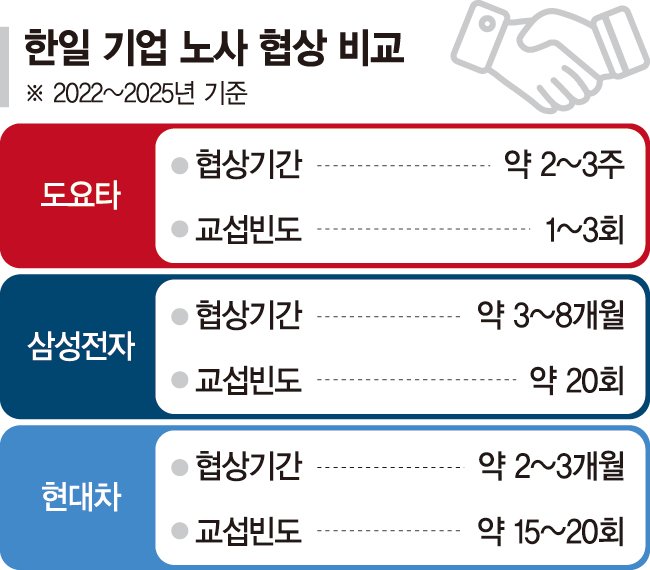
According to industry sources on the 24th, over the past four years collective bargaining at Toyota Motor Corporation has typically wrapped up in about two to three weeks. At Hyundai Motor Company and Samsung Electronics, however, bargaining has lasted at least two months and in some cases more than eight months. Toyota Motor Corporation has usually concluded talks in a single session, or at most three rounds, whereas Hyundai Motor Company and Samsung Electronics have endured as many as 20 or more drawn-out meetings. Hyundai Motor Company barely managed to reach an agreement last year, but at Samsung Electronics, after repeated setbacks, the labor union has now announced a general strike for May.
During the talks, Kito put forward a goal of "shortening vehicle delivery times as much as possible" and stressed that "everyone working at Toyota Motor Corporation must approach their work with this goal in mind." In response, Sato promised, "This year’s wages and bonuses will be paid as requested by the labor union," and proposed that labor and management jointly respond to the rapidly changing business environment driven by artificial intelligence (AI) and automation.
At Toyota Motor Corporation, a performance-linked cooperation system closely aligns the interests of workers and the company, creating long-term incentives for mutual growth. At Hyundai Motor Company, by contrast, strike authorization votes have become a routine part of the annual wage and collective agreement talks. Production disruptions during these disputes have caused losses ranging from tens of billions to hundreds of billions of won. Recently, the union at Hyundai Motor Company even warned that not a single robot would be allowed onto the shop floor without labor-management agreement, drawing criticism for its closed stance.
Samsung Electronics, at the center of the increasingly fierce semiconductor industry, is no exception. Since labor unions began to organize in earnest at the company, which had long maintained a no-union policy, labor-management conflict has become more entrenched. As the company tries to navigate volatility in semiconductors, union-related issues are emerging as an additional cost burden.
An official at a major conglomerate observed, "Korea’s confrontational labor-management culture is undermining global competitiveness, and structural reforms are needed."
hjkim01@fnnews.com Kim Hak-jae and Kim Dong-chan Reporter