Foreign Tourists Line Up for Tteokbokki and Gimbap: "Korean Food Is So Hip"
- Input
- 2026-03-24 18:16:26
- Updated
- 2026-03-24 18:16:26
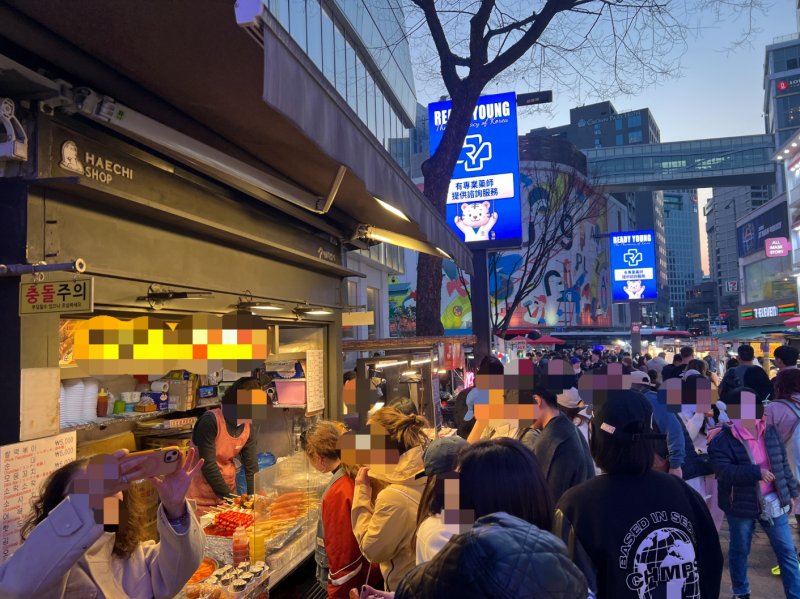
A foreign tourist encountered on the afternoon of the 23rd along Myeongdong Food Street in Jung District said, "I am very happy to finally see in real life the wide variety of street foods that you can only find in Korea," explaining why they had come.
That day, Myeongdong Food Street was filled with the savory smell of oil and the spicy aroma of tteokbokki. What stood out most was the diversity of customers’ nationalities. The street was packed with foreign tourists, from Muslim visitors wearing hijabs to blond Europeans. Many of them were holding so-tteok so-tteok skewers of sausage and rice cakes or dak-galbi chicken skewers, as if they had all agreed on what to eat.
■ "K-food is hip" — food street packed with foreigners
Dozens of street stalls line Myeongdong Food Street, and each one offers an array of snacks such as tteokbokki, hotteok, and gimbap. Recently viral items on social media, like the Dubai Chewy Cookie, also drew in both domestic and international tourists. Most of the foreign visitors interviewed that day beamed as they said they were thrilled to finally taste the K-Bunsik they had only seen on social media or being enjoyed by K-pop stars.
Amir, a tourist from Mongolia, remarked, "K-food has a young and hip image. I often see K-pop stars eating Korean food," adding, "It is a very meaningful experience to be able to try Korean snack foods myself." A tourist from Russia commented, "Korean food has its own uniquely hip appeal," and added, "After trying tteokbokki, which I had never seen before, I am planning to taste K-chicken as well," expressing high expectations.
Sindang-dong Tteokbokki Town, known as a mecca for tteokbokki, was relatively quiet that weekday. However, vendors there said the situation changes completely on weekends. Sindang-dong Tteokbokki Town is famous for the story that in 1953, a grandmother named Ma Bok-rim accidentally dropped noodles for black bean noodles into a gochujang-based sauce, which led to the creation of today’s gochujang tteokbokki.
Mr. Kim, who has been in charge of parking management in Sindang-dong Tteokbokki Town for 15 years, explained, "It’s quiet during weekday afternoons, but on weekends the entire alley is packed with young couples on dates," and added, "Recently, foreign tourists have also started showing up in large numbers on weekends, though we’re not quite sure how they all found out about this place."
■ Chronic problems of price gouging and hygiene
However, food prices on these streets remain at the center of controversy. On Myeongdong Food Street, a single plate of tteokbokki often costs between 5,000 and 7,000 won, and a single skewer easily exceeds 5,000 won. Most items, such as street steak or grilled lobster, are priced at 10,000 won or more.
The situation is similar at Gwangjang Market in Seoul, which has emerged alongside Myeongdong Food Street as another mecca of K-Bunsik. A recent controversy erupted after a popular YouTuber ordered sundae, a Korean blood sausage dish, priced at 8,000 won, only for the vendor to add meat without asking and then demand, "You need to pay 10,000 won since I added meat." Such excessive price gouging and aggressive sales tactics are being criticized as obstacles to the global expansion of K-Bunsik.
At the same time, attention is turning to whether recent tough government measures to eradicate price gouging will lead to real improvements. The government has announced that any shop caught overcharging customers will have its registration as a local currency merchant revoked. Markets where such shops operate will also face "joint responsibility" measures, such as being barred from taking part in Onnuri Gift Certificate refund events.
Hygiene remains another unresolved issue. A walk through Gwangjang Market showed that most street vendors were not wearing sanitary caps, and some were even preparing ingredients right next to open food-waste bins with no lids.
[email protected] Kim Seo-yeon and Park Kyung-ho Reporter