Fuel tax to be cut by more than double from next month, raising concerns over tax revenue loss and polarization in oil consumption
- Input
- 2026-03-24 18:11:53
- Updated
- 2026-03-24 18:11:53
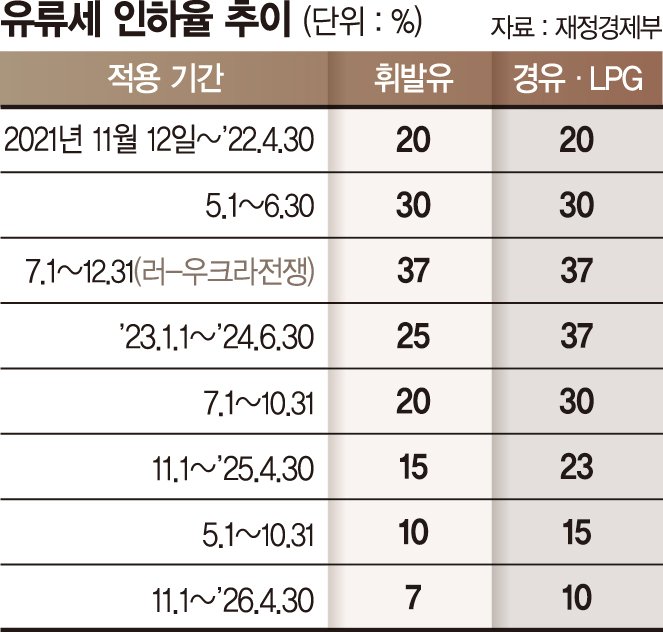
Due to the surge in global oil prices triggered by the Middle East war, the government is expected to sharply lower the fuel tax starting next month. The reduction rate is likely to be more than doubled from the current 7–10%. This would follow the fuel price cap system on petroleum products that was abruptly introduced on the 13th as part of measures to stabilize oil prices. However, some analysts argue that under the current combination of a strong dollar and high oil prices, the actual impact of a fuel tax cut will be limited. They also warn that tax revenues could fall and polarization in oil consumption could worsen.
According to the government and other sources on the 24th, the Ministry of Finance and Economy will discuss an additional fuel tax cut at a meeting of the Emergency Economic Council and the Task Force of Ministers on Special Management of People’s Livelihood Prices, to be chaired by Deputy Prime Minister and Minister of Economy and Finance Koo Yun-cheol on the 26th. In connection with the second designation of maximum prices for petroleum products on the 27th, the government is expected to announce the fuel tax cut as early as this week and seek approval at a meeting of the State Council of South Korea at the end of the month, so that it can take effect from next month. The current fuel tax reduction rates are 7% for gasoline and 10% for diesel and liquefied petroleum gas (LPG), and they are in place until the end of next month. An official at the Ministry of Finance and Economy said, "As Cheong Wa Dae and the government have already announced, we plan to move up the timing of the fuel tax adjustment," adding, "We are reviewing the resulting loss of tax revenue from an additional cut, and the size of the reduction will be determined in line with the second designation of maximum prices for petroleum products."
Previously, when international oil prices surged above 100 dollars per barrel following the outbreak of the Russo-Ukrainian War in 2022, the government raised the fuel tax cut to the legal maximum of 37%. Based on that precedent, the government is now moving to lower the fuel tax to a similar extent. What is different this time is that it has introduced a petroleum product price ceiling system that directly controls refinery supply prices. Under the first designated price ceiling, which held gasoline and diesel in the low 1,700 won per liter range, retail prices at gas stations over the past two weeks moved in the 1,800–1,900 won range. Since then, however, international oil prices have jumped to more than 110 dollars per barrel, so the second maximum price, scheduled for the 27th, is widely expected to be set in the low 1,800–1,900 won range. This would inevitably push gas station retail prices into the 2,000–2,100 won range. To at least keep prices at previous levels, the fuel tax cut would need to be raised to around 15–25%, roughly double the current rate. In that case, the discount effect on gasoline and diesel would increase from the current 50 won per liter range (57 won for gasoline, 58 won for diesel) to the low 100 won range. This is estimated to lower the consumer price inflation rate by about 0.2–0.3 percentage points.
The likelihood that the government will raise the fuel tax cut all the way to the maximum 37% in a single step is considered low. President Lee Jae Myung of South Korea has previously instructed a differentiated approach, saying, "If we lower the fuel tax uniformly, polarization will worsen." He ordered that the fuel tax be cut only modestly, with the remaining support provided directly to vulnerable groups.
In addition, the fuel tax—currently 694 won per liter for gasoline and 476 won for diesel—is levied as a fixed amount per liter. When international oil prices rise steeply, the share of the fuel tax in the final price shrinks, which also reduces the impact of any tax cut. Tax revenues, however, fall sharply. A 20% cut in the fuel tax would reduce tax revenue by more than 400 billion won per month.
skjung@fnnews.com Jeong Sang-geun Reporter