"Era of resource weaponization... Supply chains must be managed constantly through a pan-government control tower" [U.S.–Iran War]
- Input
- 2026-03-24 18:11:45
- Updated
- 2026-03-24 18:11:45
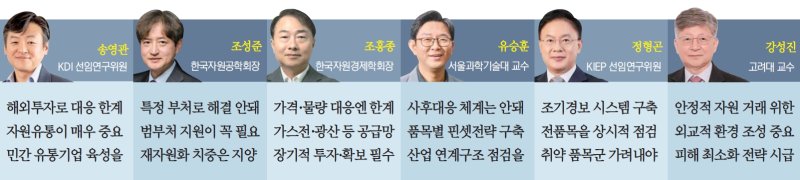
As supply chain risks have once again become a "hot potato" amid the recent escalation of war in the Middle East, experts unanimously argued that the "remedy after the fact" approach has clear limitations. They agreed on the need to build a complex control tower that spans diplomacy, trade, security, and the private sector.
With the "weaponization of resources" accelerating under intensifying protectionism around the world, experts also point to the need to resolve supply chain crises through a range of measures. These include public and private investment to secure critical minerals and intermediate goods, pragmatic diplomacy, tailored support by item, and the creation of private resource distribution platforms.
■ "We must change after-the-fact response systems and mindsets"
Energy and economic experts interviewed by Financial News on the 24th stressed that Korea must overhaul the reactive systems and mindsets that resurface every time a supply chain crisis hits.
JEONG Hyung-Gon, senior research fellow at the Korea Institute for International Economic Policy (KIEP), said, "The key is to build an early warning system that can constantly check all items," adding, "We need a system that mechanically screens every product based on trade data and other indicators. Rather than pointing to one specific resource each time, it is more important to identify structurally vulnerable groups of items." Seung Hoon Yoo, a professor at Seoul National University of Science and Technology (SEOULTECH), noted, "Due to recent instability in the Middle East, disruptions in the supply of oil and naphtha are spreading negative effects across the real economy, including plastic products. It is possible to respond after a problem erupts, but that does not reduce the problem itself in advance," and went on, "The direction for improvement can be summarized as building a preemptive response system, establishing item-specific supply chain strategies, and reviewing industrial linkage structures that include intermediate goods."
■ "Mobilize national capabilities"
Given that recent supply chain crises have evolved into complex forms that go beyond trade issues and are closely linked to international politics, diplomacy, and security (defense), some experts argue that the core task is to build a comprehensive, permanent support system at the pan-ministerial level. As the United States of America (U.S.) is pushing aggressive investment in critical minerals such as rare earths to break China’s resource dominance, and some countries are considering export and import controls, they point out that responses limited to the private or public sector, or to specific fields, are inevitably constrained.
They also expect that "tightrope diplomacy" will be unavoidable amid the power struggle between the U.S., Korea’s ally, and China, the largest supplier in the minerals market.
Kang Sung-jin, a professor at Korea University, stated, "Supply chain issues are not just an economic matter; they are heavily influenced by relations between countries," and argued, "The government must create a diplomatic environment in which companies can trade stably. Strategies that minimize corporate damage amid U.S.–China tensions are crucial." Cho Sung-joon, president of The Korean Society of Mineral and Energy Resources Engineers, emphasized, "Today’s supply chain problems cannot be solved by a single ministry such as the Ministry of Trade, Industry and Energy alone," adding, "Resources, the environment, public finance, investment and financing, diplomatic power, and defense are all intertwined, so pan-governmental support or a control tower is only natural."
■ "Foster private distribution networks and review multiple options"
Many experts also cited overseas investment as a medium- to long-term solution to mitigate future risks. However, because overseas investment and resource recycling take a long time, they also discuss measures such as fostering a Korean-style private resource distribution platform similar to the United Kingdom’s London Metal Exchange (LME). Cho Hong-jong, president of the Korean Resource Economics Association, said, "Once a supply chain problem occurs, responding through prices and securing volumes is structurally limited," and added, "Unless you invest capital in or secure assets such as gas fields, mines, and smelters, everything else has little real meaning. Long-term investment is essential for supply chains."
Some analysts argue that, beyond long-term overseas resource investment and resource recycling, short-term and realistic solutions must also be considered. President Cho Sung-joon pointed out, "Resource recycling becomes an efficient strategy only after the market for a specific item has grown significantly and enough recyclable materials are available," and cautioned, "We should avoid focusing too heavily on recycling alone."
SONG Yeongkwan, senior research fellow at the Korea Development Institute (KDI), explained, "Just as we saw 'food weaponization' in the past, we are now witnessing the 'weaponization of resources.' Even if we respond through overseas investment or the establishment of joint ventures, if the country in question restricts or bans exports, the effectiveness of those measures can be undermined," adding, "For now, relations with China are inevitably of paramount importance." He continued, "Distribution between resource production and consumption is extremely important. If we have a market or platform like the United Kingdom’s LME, we can spread the risk," and added, "We need to move beyond the current procurement and stockpiling system centered on the Public Procurement Service (PPS) and Korea Resources Corporation, and consider multiple options, including fostering many private distribution companies."
jhyuk@fnnews.com Junhyuk Kim, Chanmi Kim Reporter