Lower Barriers in the $125 Trillion U.S. Biosimilar Market: K-Bio Moves to Seize the Lead
- Input
- 2026-03-24 18:11:13
- Updated
- 2026-03-24 18:11:13
As the United States of America (U.S.), the world’s largest pharmaceutical market, lowers approval hurdles for biosimilars and rolls out policies to improve prescribing convenience, South Korean firms with strong technological capabilities are accelerating their overseas expansion.
■ Celltrion and Samsung Bioepis as the biggest beneficiaries
According to the pharmaceutical and biotech industry on the 24th, Celltrion and Samsung Bioepis are responding the most swiftly to these developments in the U.S.
The two companies remain among the global leaders in the number of biosimilar approvals, and they are steadily strengthening their dominance in the U.S. market.
In particular, a recently released draft guideline (Revision 4) from the U.S. Food and Drug Administration (FDA) effectively removes the requirement for separate switching studies to prove "interchangeability." This change is expected to create a more favorable environment for these companies to expand their market presence.
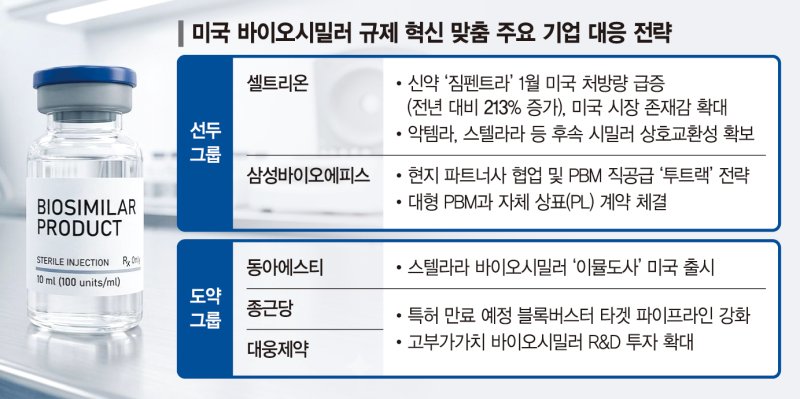
In the U.S. market, Celltrion is expanding its footprint as its new drug Zymfentra delivers strong results. As of January, prescription volume had surged 213 percent year-on-year, reaching an all-time high. In addition, for follow-on biosimilar products such as Actemra and Stelara, the company is securing interchangeability and gaining an edge in listing competitions with pharmacy benefit management companies (PBMs).
At the Celltrion Annual General Meeting of Shareholders held that day, Celltrion Group Chairman Seo Jung-jin said, "Zymfentra is on track to comfortably achieve its sales target of 350 billion won in the U.S. market this year," adding, "Until now, the unique distribution structure and healthcare environment in the U.S. have slowed the pace of early uptake." He went on to say, "We expect profit to increase by around 100 billion won each quarter," projecting that Celltrion’s annual operating profit will exceed 1.8 trillion won.
Samsung Bioepis is seeking to expand its market share through a two-track strategy: collaborating with local marketing partners in the U.S. while simultaneously tapping into supply channels via private health insurer PBMs. For its Stelara biosimilar, Samsung Bioepis has signed a Private Label (PL) agreement with a major PBM, securing a stable sales channel.
Traditional pharmaceutical companies have also become more active recently. Dong-A ST has launched its Stelara biosimilar Imuldosa in the U.S. market, accelerating its transition in business structure. As regulatory barriers ease in the U.S. and Europe, entry hurdles for new biosimilars are falling, raising expectations for a higher share of global sales. This trend is also expected to benefit companies such as Daewoong Pharmaceutical and Chong Kun Dang Pharmaceutical, which are strengthening their biosimilar businesses.
In major markets such as the U.S. and Europe, discussions on exempting or simplifying phase 3 clinical trials for biosimilars have been progressing rapidly. These changes offer latecomers direct advantages in shortening development timelines and cutting costs. In response, South Korean companies are speeding up pipeline development targeting global blockbuster drugs whose patents are set to expire within the next five years.
■ Biosimilar deregulation as a growth "golden time"
At the heart of the regulatory innovation being pursued by the FDA is "streamlining procedures based on scientific evidence." The FDA has decided to broadly accept pharmacokinetic (PK) data generated from drugs approved outside the U.S.
As a result, South Korean companies can file for approval without conducting large-scale, separate clinical trials within the U.S., potentially saving up to 20 million dollars (about 26 billion won) per program.
Market prospects are also strong. The U.S. biosimilar market is projected to grow to around 93.5 billion dollars (about 125 trillion won) by 2034. Amid ongoing instability in global supply chains, South Korean companies are leveraging their reliable manufacturing capacity and accumulated development experience to compete for early market leadership. An industry official noted, "The regulatory changes in the U.S. have created an environment where domestic companies can maximize their strength in efficient development capabilities," adding, "The period from this year through 2030, when many patents expire, will be a crucial window for South Korea to break through in the global market."
[email protected] Kang Jung-mo Reporter