"Is this San Francisco?"... Autonomous driving runs smoothly on late-night streets of Gangnam District
- Input
- 2026-03-24 18:06:50
- Updated
- 2026-03-24 18:06:50
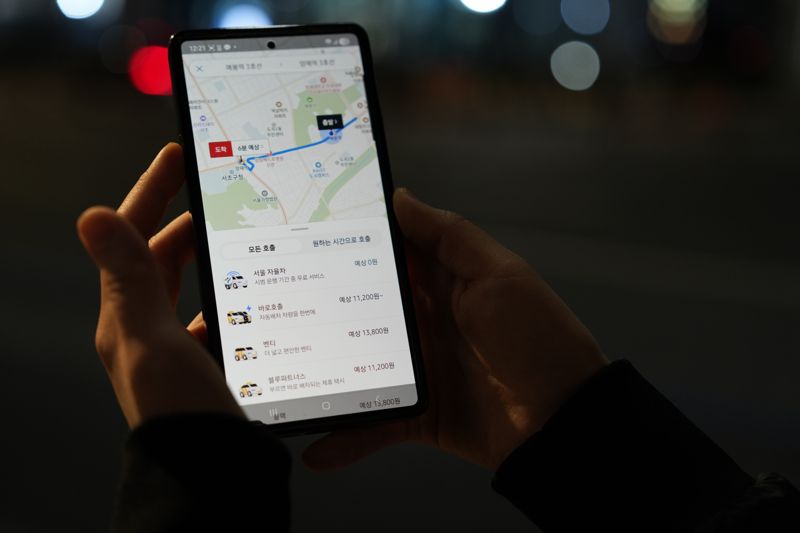
"The vehicle will now start moving on its own."
At 10 p.m. on the 23rd, in downtown Gangnam District, Seoul, an autonomous vehicle based on the Kia EV6 that had been requested via the Kakao T app pulled up. Mounted on the roof was Kakao Mobility’s in-house developed sensor kit, the AV Kit, which combines five lidars, five radars, and seven cameras, immediately catching the eye.
Once on board, the safety driver in the driver’s seat announced, "We’re departing," and at the same moment took both hands off the steering wheel. The stationary vehicle began to move, picking up speed on its own and merging smoothly into the flow of traffic.
Inside the car, a display showed the driving situation in real time. On the autonomous driving visualization device (AVV), pedestrians, surrounding vehicles, and the planned driving path recognized by the car were all visualized live.
The car changed lanes between surrounding vehicles and slowed in advance before crosswalks, coming to a complete stop. It also detected fast-approaching vehicles from behind and reduced speed accordingly. Tunnel sections were handled without difficulty. Minsun Kim, head of the autonomous driving business team at Kakao Mobility, who was riding in the front passenger seat, noted, "It used to be difficult to implement smooth autonomous driving in tunnels because GPS signals are cut off there." This autonomous vehicle drove through tunnels relying only on HD maps and fused sensor data. Kakao Mobility’s late-night autonomous driving service began on the 16th of this month. Only two vehicles are currently in operation, so wait times can occur when there are many requests.
Passenger reactions have been largely positive. Kakao Mobility cited one particularly memorable comment: "Is this San Francisco?" The rider said the experience in the heart of Gangnam District reminded them of a U.S. city where autonomous vehicles are already part of everyday life.
Safety also came close to earning full marks. The vehicle generally obeyed traffic signals, detected pedestrians, and kept a safe distance from the car ahead. However, ride comfort was not perfect, with sudden deceleration in some unexpected situations. Kim explained, "When the vehicle encounters movements we didn’t anticipate, it can sometimes brake sharply or feel less smooth to ride in."
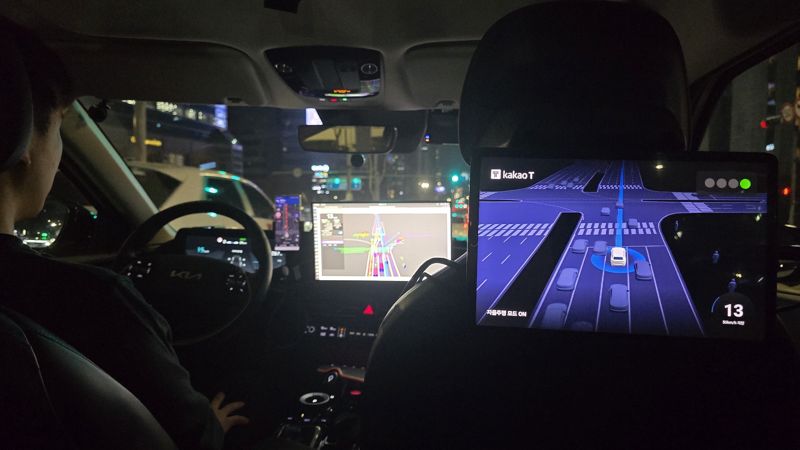
In certain complex areas, such as school zones and intersections, the person in the driver’s seat took over and drove manually. Under the current Act on the Promotion of and Support for Commercialization of Autonomous Vehicles, a safety driver is required to be on board during pilot operations. In actual service, the driver kept hands and feet close to the steering wheel and brake, ready to intervene at any moment.
Even so, the overall impression differed from what many had expected. According to Kakao Mobility, many on-site reactions were along the lines of, "I was worried because it’s autonomous driving, but I trust it more than I thought I would."
When the car came to a stop at the destination, a voice announcement said, "You have arrived. The ride is now ending." The trip through late-night Gangnam District lasted about 12 minutes and covered roughly 5 kilometers.
The autonomous vehicle incorporates Kakao Mobility’s proprietary technologies for AI-based perception, decision-making, and control. In Seoul, only two operators—Kakao Mobility and SWM—have obtained permits for zone-based autonomous passenger transport. The driving algorithm combines an AI Planner with a rule-based planner. Clear-cut rules, such as obeying traffic signals and maintaining safe following distances, are handled by the rule-based planner, while the AI Planner deals with more complex judgment calls. For traffic light recognition, the system uses not only cameras but also Vehicle-to-Everything (V2X) data provided by the Seoul Metropolitan Government, enabling it to respond even when signals are obscured or not directly visible. Driving data is processed through auto-labeling and then automatically fed back into model training.
For now, the service area is limited to the Gangnam-gu Autonomous Driving Pilot Zone, and it operates on weekdays from 10 p.m. to 5 a.m. Currently the rides are free, but under the Seoul Metropolitan Government Policy on Autonomous Transport Services, the program will switch to a paid service sometime in April.
[email protected] Minsun Kim Reporter