Seo Jung-jin: "Celltrion’s operating profit will exceed 1.8 trillion won this year"
- Input
- 2026-03-24 13:07:22
- Updated
- 2026-03-24 13:07:22
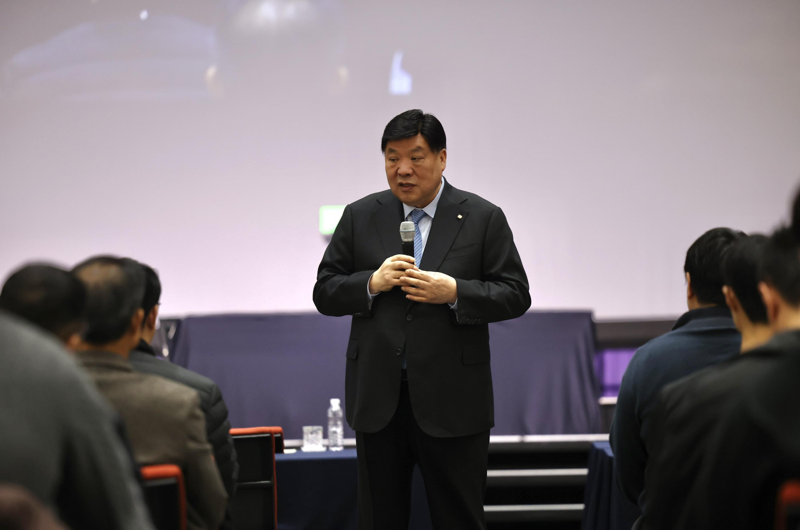
According to The Financial News, Seo Jung-jin, chairman of Celltrion Group, projected that the company’s quarterly profits will gradually expand this year, with annual operating profit expected to surpass 1.8 trillion won.
Serving as chair of the 35th annual general shareholders’ meeting at Songdo Convensia on the 24th, Seo stated, "We expect profits to increase by around 100 billion won each quarter," outlining this outlook.
The target Celltrion disclosed the same day also starts in the 300 billion won range in the first quarter and then expands step by step to the 600 billion won range in the fourth quarter, for a cumulative annual total of about 1.8 trillion won. However, Seo stressed that these figures were set on a conservative basis.
He explained that the company chose a stable plan rather than an aggressive forecast, taking into account intensifying price competition in the global biosimilars market, particularly from companies in India. He added that the company is internally operating with targets that are higher than the disclosed figures.
Regarding first-quarter results, Seo noted that, on a preliminary basis, performance is broadly in line with market expectations. He went on to say that gradual improvement should continue from the second quarter, and that earnings are expected to expand the most toward the end of the year, forming an upward trajectory.
In particular, he said the fourth quarter will be a period when key products become firmly established in the market, making meaningful results possible. To that end, the company is reviewing global sales data, prices, and market share by country twice a month.
Seo also addressed why the initial uptake of Zymfentra, which has been approved as a new drug in the United States, was slower than expected. He analyzed that rebate demands from Pharmacy Benefit Managers (PBM) in the United States, along with a reimbursement structure in which medical institutions earn less when treatment shifts from intravenous injection (IV) to subcutaneous injection (SC), have constrained the speed of market penetration.
However, he added that prescriptions have recently been increasing and expressed expectations that conditions will improve this year.
As a mid- to long-term strategy, Seo presented a two-track approach of growing both new drugs and biosimilars. The company currently has a pipeline of 23 new drug candidates, including 9 Antibody-Drug Conjugate (ADC) candidates and 5 multispecific antibody candidates.
In the anti-obesity drug field, Celltrion also has three fourth-generation candidate substances. One of them is scheduled to enter non-clinical animal studies for regulatory approval in May, with the goal of securing results within this year and moving into a phase 1 clinical trial next year.
The company will also continue to expand its biosimilar business. It presented a roadmap to increase its current portfolio of 11 biosimilar products to 18 by 2030 and to 41 by 2038.
vrdw88@fnnews.com Kang Jung-mo Reporter