Middle East war halts operations at 15 of 24 Gulf ports; most requests focus on logistics cost support
- Input
- 2026-03-24 09:35:17
- Updated
- 2026-03-24 09:35:17
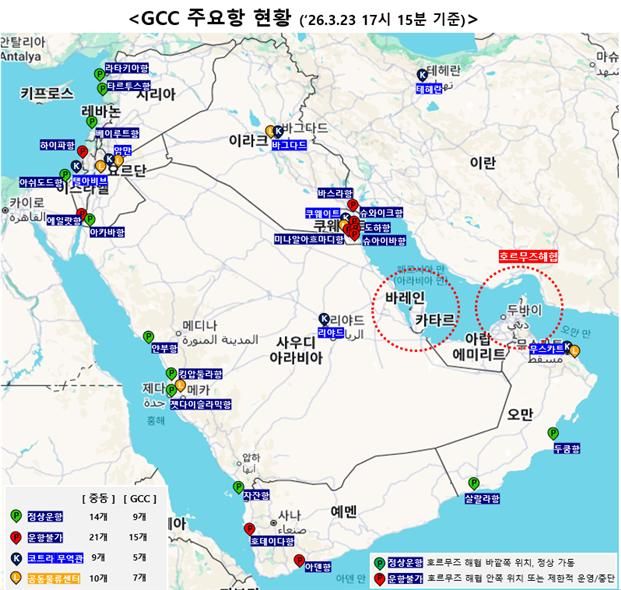
[The Financial News] As the Middle East war unfolds amid clashes between the United States of America (U.S.) and the Islamic Republic of Iran (Iran), more than 60% of major ports in six Gulf Cooperation Council (GCC) countries, including Saudi Arabia and the State of Qatar, are reportedly unable to operate.
Operations have been suspended or restricted at 15 of 24 major ports. KOTRA stated on the 24th that it is updating and providing, on a daily basis, real-time information collected on port and air cargo conditions in the Middle East, as well as alternative routes, while using emergency vouchers to support costs such as returns, warehousing, and war-risk surcharges.
As questions and difficulties related to export–import logistics disruptions have piled up, KOTRA’s 13 trade centers in the Middle East are responding on the ground. Between the 3rd and the 20th of this month alone, a total of 256 inquiries from exporting and importing companies were received.
An analysis of 242 cases received up to the 19th showed that requests for support due to soaring logistics costs—such as higher freight, warehousing, and insurance fees—were the most common, accounting for 68 cases (28%).
In one case, Company A was scheduled to ship plastic products to Iran, but due to the recent situation in the Middle East, the shipping line demanded an additional fee of 3,000 dollars per 40-foot container. In the end, however, the company was notified that transport was impossible because the port had been closed, leading to return and storage costs. Company A then shipped its goods to the Port of Jebel Ali in the United Arab Emirates (UAE) for export, but was informed by the carrier that, because it could not pass through the Strait of Hormuz, the vessel would instead call at the alternative port of Khor Fakkan and the cargo would have to be moved inland. Faced with sharply higher logistics costs, the company asked KOTRA to help cover the increase.
In response, KOTRA has been informing companies that additional logistics costs arising from the Middle East situation can be covered by the Emergency Middle East Situation Voucher and is exploring concrete support measures.
Other inquiries included 30 cases (12%) seeking information or advice on logistics disruptions, 36 cases (15%) asking whether exports were still possible, 18 cases (7%) involving difficulties in contacting buyers or cancellations of contracts and exports, and 12 cases (5%) reporting setbacks in investment, market entry, or construction project orders.
There were also four cases (2%) asking about safety and evacuation measures for business trips or long-term stays.
As of the 23rd, a review of operations at 24 major GCC ports showed that only nine ports located outside the Strait of Hormuz, including those in the Sultanate of Oman, were operating normally. Ports in other locations such as the UAE, Saudi Arabia, Bahrain, the State of Qatar, and Kuwait are situated inside the Strait of Hormuz or are under restricted or suspended operations, making it impossible for vessels to call there.
KOTRA explained that Khor Fakkan in the UAE, located about 120 kilometers from the Strait of Hormuz, and Sohar in the Sultanate of Oman, about 200 kilometers away, serve as inland detour routes. KOTRA added, "The airspace over Iran, Iraq, and Kuwait remains closed, and although some flights have resumed in other areas, conditions are unstable and air cargo logistics are becoming increasingly congested."
In this context, KOTRA is offering Emergency Middle East Situation Vouchers totaling 8 billion won, with up to 150 million won available per company.
In addition, KOTRA is providing a 20% discount on service fees for all 14 types of Export24 global agency services, including support for identifying potential buyers. Together with its export logistics cooperation network—EMS, DHL, Samsung SDS, Taewoong Logistics, and others—it is also offering tailored discount services and logistics information.
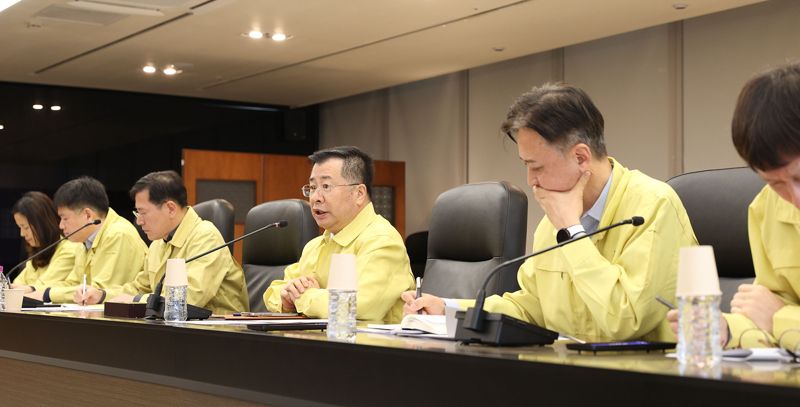
Presiding over a meeting of the Emergency Response Task Force on the Middle East Situation that day, President and CEO of KOTRA Kang Kyung-sung said, "The ongoing situation in the Middle East is affecting our companies’ exports, overseas investments, and project orders." He added, "We will make every effort to use our 13 trade centers in the Middle East to monitor and share on-the-ground developments in real time, and to work with the government and related organizations to support companies in line with their inquiries and specific difficulties."
hjkim01@fnnews.com Kim Hak-jae Reporter