Fears of Middle East war escalation push won toward 1,520 per dollar [U.S.–Iran conflict]
- Input
- 2026-03-23 18:48:58
- Updated
- 2026-03-23 18:48:58
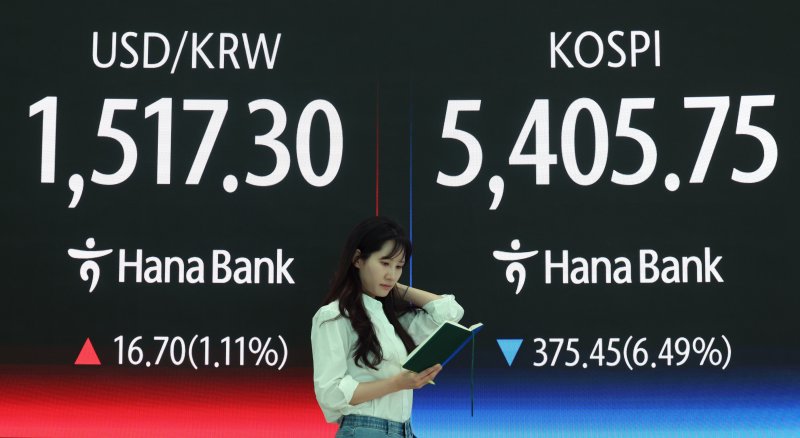
On the 23rd, the KOSPI closed at 5,405.75, down 6.49% (375.45 points) from the previous trading day. Heavy net selling of more than 4 trillion won each by foreign investors and institutions briefly drove the index below the 5,400 level during the session. A sell-side circuit breaker was also triggered in the futures market, deepening the losses. Individual investors stepped in to buy more than 8 trillion won, absorbing the supply. The KOSDAQ Index also finished down 5.56% at 1,096.89, breaking below the 1,100 mark, as a broad-based sell-off spread across risk assets.
With the won weakening, the US Dollar–South Korean Won exchange rate surged toward 1,520 won, reaching its highest level in 17 years. In the Seoul Foreign Exchange Market that day, the rate closed weekly trading at 1,517.3 won per dollar, up 16.7 won from the previous session. This is the highest level since March 9, 2009 (1,549 won), during the Global Financial Crisis (GFC). Intraday, it climbed as high as 1,517.4 won. The move is seen as the result of rising demand for dollars amid heightened military tensions in the Middle East, alongside stronger risk aversion toward non-reserve currencies.
Joain, a researcher at Samsung Securities, stated, "As tensions between the United States of America (U.S.) and the Islamic Republic of Iran intensify, the possibility of a prolonged crisis in the Middle East is coming to the fore," adding, "Prices of West Texas Intermediate crude oil (WTI) and Brent Crude Oil have climbed to around 98 dollars and 107 dollars, respectively, and inflation concerns are spreading rapidly."
Even so, she advised investors not to succumb to excessive fear. Joain noted, "At this stage, the U.S. and the Islamic Republic of Iran are still testing each other’s red lines, so we cannot rule out the possibility of negotiations in the short term," and added, "The 5,500 level on the KOSPI corresponds to an early 9-times multiple on a 12‐month forward Price-to-Earnings Ratio (P/E ratio) basis, so the market’s valuation appeal remains intact."
[email protected] Choi Doo-seon, Hong Ye-ji Reporter