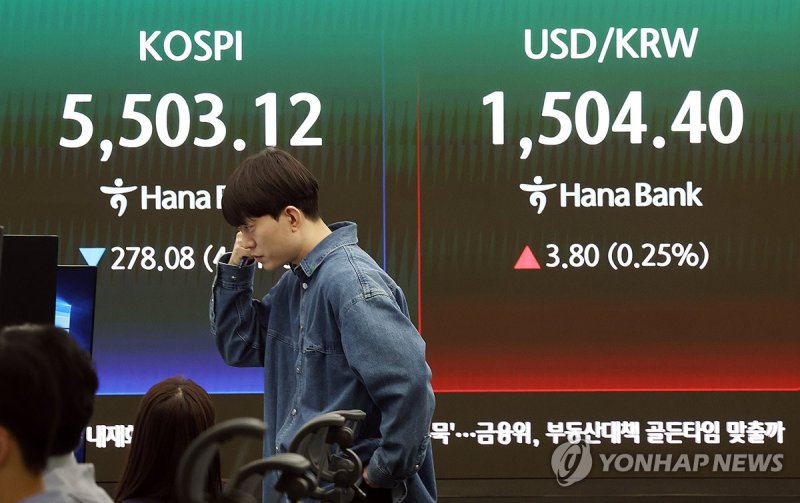
"KOSPI plunges another 5%"... Are twentysomething debt-fueled retail investors entering a painful holding phase?
- Input
- 2026-03-23 10:59:36
- Updated
- 2026-03-23 10:59:36
According to The Financial News, the sharp drop in the KOSPI earlier this month, triggered by instability in the Middle East following clashes between the United States of America (USA) and the Islamic Republic of Iran, has significantly increased losses for individual investors using margin loans. In particular, among twentysomething retail investors who borrow to invest, the loss rate was found to be more than three times higher than that of ordinary investors who did not use margin financing.
Average return for margin users down 19% as of the 9th
As of the 22nd, an analysis by the financial sector and financial authorities of about 4.6 million individual comprehensive accounts at two major domestic securities firms showed that, from the start of this month through the 9th, individual investors using margin financing posted an average account return of -19.0%. This is about 2.3 times worse than the -8.2% return recorded by investors who did not use margin loans.
By age group, older investors showed larger losses in absolute terms. Investors in their 60s who borrowed to invest recorded returns of -19.8%, while those in their 20s and 30s posted relatively smaller losses of -17.8% and -18.2%, respectively.
However, the age groups where the gap with non-margin investors was most pronounced were people in their 20s and 30s. Among those in their 30s, accounts without margin financing had the best performance across all age groups at -6.6%, but once margin was used, the loss expanded to 2.8 times that level. For investors in their 20s, the loss for those borrowing to invest was 2.7 times greater than the -6.7% return on non-margin accounts. In contrast, the gap for investors in their 50s was limited to 1.9 times.
For small-scale investors, the difference in losses between those borrowing to invest and ordinary investors was even wider. Accounts using margin with investment capital of less than 10 million won showed returns of -20.7%, which is 2.8 times worse than the -7.5% return for non-margin accounts. Among twentysomething small investors in particular, the loss rate ballooned to 3.2 times when margin financing was used, marking the largest gap.
Twentysomething investors deepen losses with all-in bets on single stocks
This appears to be because many investors in their 20s use margin loans to make concentrated bets on a few stocks, engaging in so-called all-in investing. A financial sector official analyzed, "Unlike older investors, young small-scale investors tend to take more aggressive short-term positions, which seems to be why their losses are much larger than those of investors who do not use margin financing."
Meanwhile, the financial authorities judge that, with the size of margin loans at about 0.6% of total Market capitalization (market cap) as of the 6th, the risk of this spilling over into broader market instability is limited. Even so, they have instructed securities companies to step up investor guidance on the risks of leveraged investing and ordered a review of risk management systems related to margin financing and contract for difference (CFD) transactions.
Some securities companies have also begun taking their own measures, such as suspending promotional events related to margin loans. A financial authorities official emphasized, "Investing with leverage can greatly magnify losses when stock prices fall," adding, "Margin financing should only be used cautiously and within a level that investors can afford to bear."
Fears of war escalation push KOSPI down as much as 5%
On the 23rd, as tensions in the Middle East peaked following the "48-hour ultimatum" issued by the Islamic Republic of Iran, the KOSPI plunged 4% shortly after the open, triggering a Temporary Suspension of Program Trading Sell Quotes (sell-sidecar) for the first time in 10 trading days.
At 9:37 a.m. that day, the KOSPI was at 5,477.83, down 303.37 points (‐5.25%) from the previous session. Samsung Electronics tumbled 5.12% to 189,300 won, falling below the 190,000-won level, while SK hynix dropped 6.36%, retreating to the 940,000-won range.
[email protected] Kim Hee-sun Reporter