"High returns from war beneficiary stocks?" Phishing scams exploiting Middle East crisis trigger warning
- Input
- 2026-03-23 12:00:00
- Updated
- 2026-03-23 12:00:00
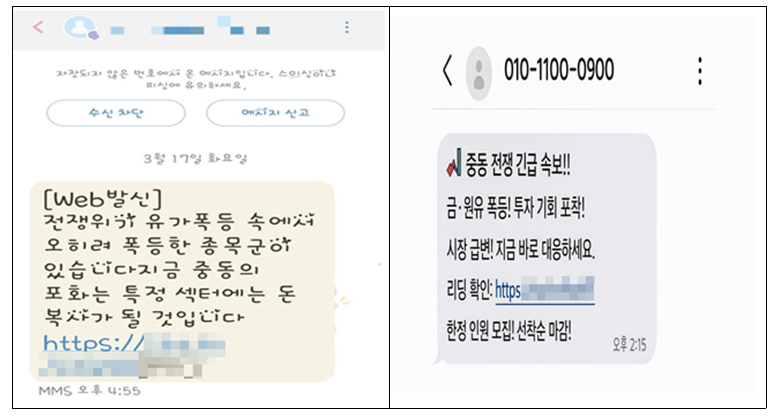
The Financial News reported that police have urged the public to be extremely cautious, noting a series of phishing attempts that exploit heightened tensions in the Middle East and the resulting anxiety among citizens.
The National Police Agency Integrated Response Team for Telecommunication and Financial Fraud announced on the 23rd that it had issued an "emergency phishing alert" to all residents. The team also disclosed three major phishing scenarios that have actually been confirmed, based on recent reports filed with its response center, all of which exploit the Middle East situation.
One of the most common schemes involves luring victims into investment chat rooms by promoting oil and defense-related stocks. Scammers send out mass text messages claiming that investing in so-called "war beneficiary stocks" will guarantee high returns. These messages recommend hot war-related stocks and promise to refund the principal and compensate for losses if a certain level of profit is not achieved. When recipients reply or click the attached link, they are drawn into an investment chat room, then induced to sign up for a fake trading platform, where the scammers disappear after stealing their investment funds.
Smishing, or SMS phishing, that impersonates flight cancellation or rebooking notices by exploiting the Middle East situation is also rampant. Taking advantage of airspace restrictions and rerouted flight paths in the region, scammers send messages such as, "Your flight has been canceled due to the situation in the Middle East. Please access this link for rebooking and refunds," along with an internet address (URL). When victims click the link, they are taken to a fake airline or travel agency website, where they are prompted to enter personal information such as credit card details, which is then stolen.
Other cases include romance scams in which fraudsters pose as doctors or soldiers stationed in the Middle East and then demand money transfers. There are also bait messages offering a free book that supposedly explains the current Middle East situation and global affairs and helps readers prepare, while in reality demanding personal information.
The National Police Agency Integrated Response Team for Telecommunication and Financial Fraud also warned that, beyond the cases identified so far, scammers are likely to impersonate an international relief organization and direct people to fake donation sites under the pretext of "emergency support for Middle East refugees." They may also continue phishing attempts disguised as government programs such as "emergency loans for small business owners" or "fuel cost refund support." According to the team, these crimes are typical phishing schemes that reappear in every national or international disaster, with only the scenario slightly modified.
So far, however, no cases have been confirmed in which these attempted crimes have actually resulted in financial damage. The team stated that it is monitoring attempted offenses in real time, swiftly blocking phone numbers and URLs used in the schemes, and making every effort to prevent harm.
The team further advised the public to recognize that open chat rooms that promise "principal guarantees" while asking victims to transfer money to personal bank accounts are clearly scams. People should always verify flight cancellations or changes directly through the official app or main customer service number of the relevant airline or travel agency. They also stressed that individuals must never respond when someone exploits war, international tensions, or humanitarian crises to stir anxiety or sympathy and then asks for personal information or money.
Shin Hyo-seob, Head of the Integrated Response Unit, said, "You must never click on links contained in text messages from unclear or unknown sources, and cutting off contact with the phishers as quickly as possible is the best defense for protecting your assets." He added, "If you suspect a phishing crime or have already suffered damage, please report it immediately to the National Police Agency Integrated Response Team or the 112 Police Emergency Number to receive counseling and guidance on follow-up measures."
[email protected] Jang Yu-ha Reporter