"Companies Cannot Shoulder This Alone"... Call Grows for Government-Led Supply Chain Management [Era of Resource Security 2.0]
- Input
- 2026-03-22 18:41:35
- Updated
- 2026-03-22 18:41:35
"Naphtha must also be stockpiled"
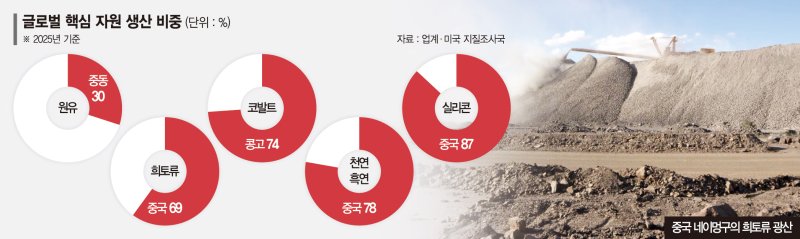
According to industry sources on the 22nd, concerns over disruptions in raw material supply are rapidly mounting, particularly in the petrochemical and refining sectors. As the possibility of the Islamic Republic of Iran blocking the Strait of Hormuz is discussed, uncertainty over imports of Middle Eastern crude oil and naphtha has grown, intensifying both price increases for these products and competition to secure volumes.
Refiners are actively seeking new suppliers outside the Middle East to diversify crude oil import sources, looking to the United States of America (U.S.), Australia, as well as Guyana and Gabon. An industry official noted, "There is already a policy in place to subsidize the freight cost difference when importing non–Middle Eastern crude, so the same level of support is needed for volumes transported via the alternative routes that the Kingdom of Saudi Arabia (KSA) has recently been using."
Some also point out that naphtha still falls into a blind spot in the national stockpiling system. Jong-eun Jung, an executive director at LG Chem, explained, "Crude oil and Liquefied Natural Gas (LNG) are recognized as resources for the national power grid, so stockpiling systems have been established for them, but that is not the case for naphtha," adding, "Government-level investment and support are needed to build stockpiling systems for basic feedstocks such as Ethylene."
Against this backdrop, industry players believe that government-led management is required across the entire supply chain, including diversification of crude oil import sources, expansion of strategic stockpiles, and the establishment of emergency response systems. Given the characteristics of the energy market, which requires large-scale investment and long-term contracts, they argue that it is too great a burden for private companies to bear the risks on their own.
"Urgent need for full-cycle support systems for critical minerals"
The same trend is evident in the field of critical minerals. Rare earth elements are essential strategic resources for electric vehicles, semiconductors, wind power, and the defense industry, yet with no domestic production base, Korea relies on overseas sources for almost all stages from raw material procurement to processing. In particular, intermediate materials such as fluorides and chlorides, which are needed for separation and refining, are heavily concentrated in certain countries, leading experts to judge that supply chain risks are structurally embedded. Concerns are also growing that any disruption in supply could ripple across the entire advanced industrial sector.
Jin-gyu Lee, a senior expert at the Korea Rare Earth Industry Association, stressed the need for separate laws and systems for critical minerals such as rare earths. He stated, "We need a special act to support the rare earth industry, structured similarly to the Hydrogen Economy Promotion and Hydrogen Safety Management Act," and added, "Building an ecosystem at the national level must go hand in hand with support for companies." He went on to say, "Given the high dependence on overseas sources even for key materials, it is difficult for companies to build supply chains on their own," emphasizing, "The government must create the industrial base and investment environment."
Observers also argue that supply chain policy should move beyond simply securing raw materials and be expanded into a "full-cycle strategy" that covers processing and recycling.
An industry representative commented, "To stabilize supply chains, we need a comprehensive support system that connects raw material procurement with processing and resource recycling," and continued, "We must strengthen diversification of supply sources through diplomatic, trade, and financial support, as well as bolster R&D and demonstration support for processing technologies." The official further emphasized, "Through industry–academia–research collaboration and joint public–private procurement strategies, energy and critical minerals should be managed as national strategic assets."
[email protected] Gu Ja-yoon Reporter