Confused Retail Investors: Brokerages Keep Raising Target Prices Despite Middle East-Driven Volatility [US–Iran War]
- Input
- 2026-03-22 18:41:25
- Updated
- 2026-03-22 18:41:25
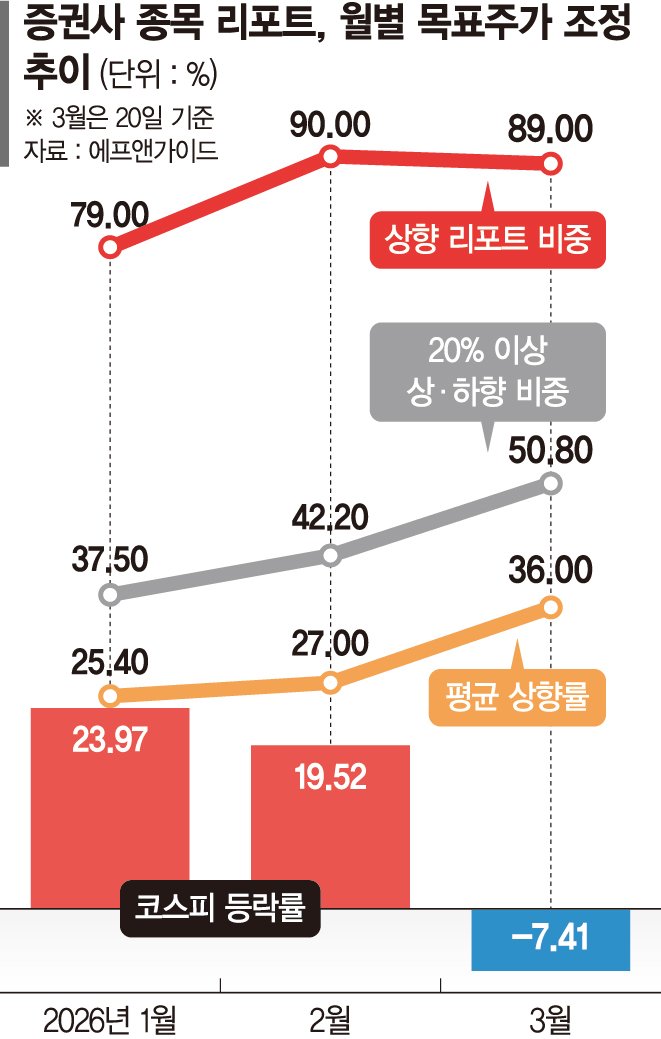
According to FnGuide on the 22nd, the share of reports in which target prices were raised or lowered by more than 20% climbed from 37.5% in January to 42.2% in February, and further to 50.8% as of the 20th of this month. In other words, more than half of the stocks covered in reports are seeing large target price changes, indicating a high-volatility pattern in target price revisions.
Compared with the bull market in January and February, the magnitude of target price revisions has actually grown. The Korea Composite Stock Price Index (KOSPI) rose 23.97% in January and 19.52% in February, but fell 7.41% in March, marking a reversal in the index trend. Even so, the average rate of upward target price revisions by stock was 25.4% in January, 27.0% in February, and jumped to 36.0% in March. Despite greater volatility this month than during the January–February rally, the scale of upward revisions has become even larger.
Although market corrections and other factors have increased volatility, the share of reports raising target prices has remained high. In March, there were 270 upward revisions and 33 downward revisions, meaning about 89% of all changes were upward. Compared with January, when about 79% of revisions were upward, and February, at around 90%, the pattern of predominantly raising targets has continued regardless of the market’s direction.
This trend is concentrated in certain themes. In nuclear power and power equipment stocks, including Daewoo Engineering & Construction, whose target price was raised by 143%, the average rate of upward revision exceeded 40%. Semiconductor equipment names such as PSK, which saw a 179% increase, also recorded average upward revisions in the 40% range, amplifying their gains. Financial holding companies and brokerages likewise enjoyed upward revisions reflecting expectations for the government’s value-up policy, with stocks including SK Square posting average increases in the high-30% range. Notably, there was not a single downward target price revision among nuclear power and power equipment-related stocks.
By contrast, target prices were clearly revised downward in some consumer names and in the bio and medical device sectors. For major stocks such as PharmaResearch, down 30%, and Medytox, down 15%, target prices were cut by double digits, lowering market expectations. As downward revisions focused on companies with low earnings visibility or rising cost burdens, the gap between sectors has become more pronounced.
There have also been cases where target prices swung sharply in a short period amid the volatile trading environment. LS Securities raised its target price for HD Hyundai from 309,000 won to 440,000 won on the 3rd. However, as geopolitical risks in the Middle East intensified and uncertainty surrounding its robotics business grew, the firm lowered the target again to 415,000 won on the 20th, roughly 17 days later. As the assumptions behind reports are rapidly revised in response to changing market conditions, target prices have been whipsawed in a short time.
Analysts caution that the recent wave of upward target price revisions should not be interpreted too optimistically. While some industries, such as artificial intelligence (AI) and nuclear power, may be less exposed to Middle East risks in the short term, a prolonged rise in oil prices could slow the broader economy and ultimately weigh on all sectors. Experts advise that in a highly volatile market, target prices can change quickly, so investors need to exercise caution when using them for investment decisions.
A brokerage industry official said, "In a phase like the current one, where market volatility is high, target prices are inevitably adjusted quickly in line with market conditions." The official added, "Since upward revisions are concentrated in specific themes, investors should not treat target prices as an absolute benchmark, but instead assess them together with the overall market environment."
[email protected] Bae Han-geul Reporter