Seoul Youth Buckling Under Rent Burden
- Input
- 2026-03-22 18:24:31
- Updated
- 2026-03-22 18:24:31
Although the share of people in their 20s and 30s moving into Seoul increased last year, their actual quality of life appears to remain low. Essential costs for housing, finance and daily living are high, yet many young people feel they have little choice but to come because of school or career needs.
Following jobs and schools to Seoul... inflow of young people continues
According to the Seoul Metropolitan Government on the 22nd, since 2019 the net migration of young people aged 19 to 39 has turned positive. Except for 2021, this age group has continued to flock to Seoul through 2024.
For young people in Seoul, the main reason for moving into the city or relocating within it is not the housing environment but jobs and education. The "Seoul Youth Survey" found that the top reason for deciding to move was "a place close to school or work, or with good transportation" (30%), far ahead of "facilities and infrastructure" (19.9%).
Once they arrive, however, many young people become primary victims of an unstable real estate market. Among Seoul residents aged 19 to 39, 42% reported living in owner-occupied housing, but most are believed to rely on support from family members who already own homes in the city. Even so, rental arrangements such as jeonse (31.7%) and monthly rent with a deposit (20.8%) account for a large share, meaning more than half are effectively living in someone else’s home.
Earning 2.5 million won a month, paying 570,000 won in rent
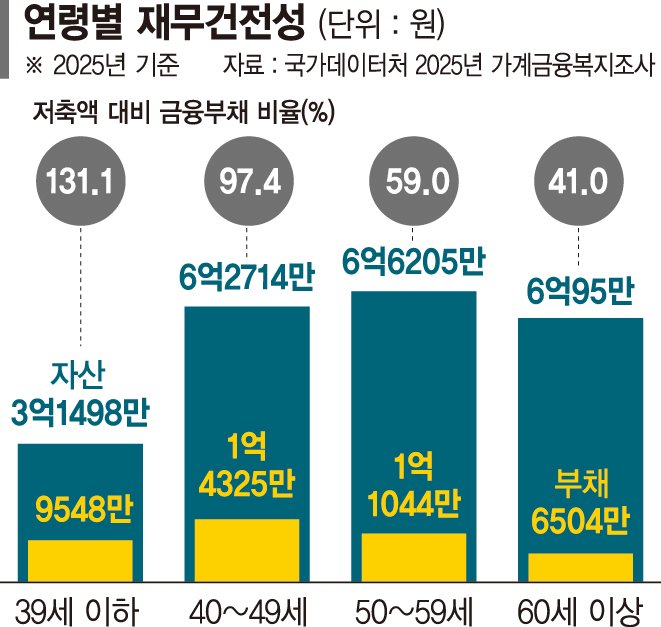
The financial situation of young households is also strained. According to the 2025 Survey of Household Finances and Living Conditions, the average debt held by households headed by someone aged 39 or younger was 95.48 million won, close to 100 million won. Of this, financial liabilities accounted for 82.72 million won, making up the bulk of their debt.
For households headed by someone under 40, the debt-to-asset ratio stood at 30.3%, the highest among all age groups and above those in their 40s (22.8%) and 50s (16.7%). In particular, their financial debt amounted to 131.1% of their savings, meaning that even if they poured in all their savings, they still could not pay off what they owe. For young people paying monthly rent, average monthly housing costs were about 570,000 won, or 22.8% of the average monthly income of young people in the greater Seoul area (about 2.5 million won). In effect, most young residents are in a "negative net worth" position while struggling to cope with Seoul’s high living and housing costs.
June 3 mayoral election puts youth housing in the spotlight
Oh Se-hoon, Seoul Metropolitan City Mayor, said, "The key to solving youth housing problems is to pursue both sufficient housing supply and policies that ease housing cost burdens," adding, "We plan to supply 74,000 housing units for young people by 2030."
Chong Won-oh, former head of Seongdong District Office and a candidate in the upcoming Seoul mayoral election, also pledged, "We will increase private and public housing sales at 70–80% of market prices," and promised, "We will supply 50,000 youth housing units, including 7,000 university dormitory rooms and 20,000 co-living units in one-room neighborhoods."
[email protected] Lee Chang-hoon Reporter