Egg Prices Near 7,000 Won per Tray... Even Pork Belly Is Becoming a Luxury
- Input
- 2026-03-22 18:24:14
- Updated
- 2026-03-22 18:24:14
According to the livestock industry on the 22nd, this winter season has seen ASF, AI, and FMD break out at the same time across multiple regions, disrupting the supply of meat.
ASF has been reported in 22 cases, setting a new all-time high. AI has been confirmed in 57 cases this year, far exceeding the 32 cases in the 2022–2023 season and 49 cases in 2024–2025. FMD has also been detected for a second consecutive year, with three cases confirmed at cattle farms in Ganghwa, Incheon, and Goyang, Gyeonggi Province.
This is the first time since 2019 that all three major livestock diseases have spread simultaneously. With the outbreaks continuing for a second straight year, the livestock supply chain has taken a direct hit.
During this winter season, more than 9.86 million laying hens have been culled, the highest level in five years. That is more than double the previous year’s figure of 4.83 million. The number of pigs culled due to ASF has also surpassed 150,000, exceeding last year’s total of around 34,000.
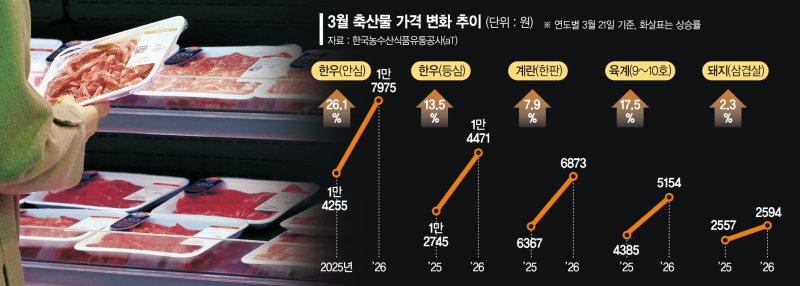
The large-scale culling has sharply reduced meat supply, sending livestock prices higher. According to the Korea Agro-Fisheries & Food Trade Corporation (aT), as of the 21st, retail prices for whole chickens in the 9–10 size range averaged 5,154 won, up 769 won (17.5%) from 4,385 won a year earlier. The price of a tray of eggs rose from 6,367 won to 6,873 won over the same period, an increase of 506 won (7.9%).
Prices of Korean beef and domestic pork are also climbing steeply. Korean beef tenderloin (per 100 grams) has risen from 14,255 won to 17,975 won, up 3,720 won (26.1%). Sirloin (per 100 grams) increased from 12,745 won to 14,471 won, a gain of 1,726 won (13.5%). Pork belly (per 100 grams) edged up from 2,557 won to 2,594 won, an increase of 37 won (2.3%).
Global data platform Trading Economics reports that the price of nitrogen, a key ingredient in fertilizer, has climbed from 503 dollars per ton on January 1 to 610 dollars now, an increase of 107 dollars (21.2%).
Countries bordering the Persian Gulf account for 30–40% of global nitrogen production, so supply instability caused by the United States–Iran war has translated into a sharp spike in prices.
Corn, the main raw material for animal feed, has also risen from 164 dollars to 183 dollars per ton over the same period, up 19 dollars (11.6%). As these related costs continue to climb in succession, high prices for agricultural and livestock products are expected to persist for the time being.
An industry official said, "Even amid global supply chain issues, we are working to diversify our supply chains," adding, "Given that war is an unexpected factor, we are closely monitoring the situation."
security@fnnews.com Park Kyung-ho Reporter