[Editorial] Excluding Multi-Homeholding Officials From Housing Policy: Aim for Both Integrity and Expertise
- Input
- 2026-03-22 18:15:10
- Updated
- 2026-03-22 18:15:10
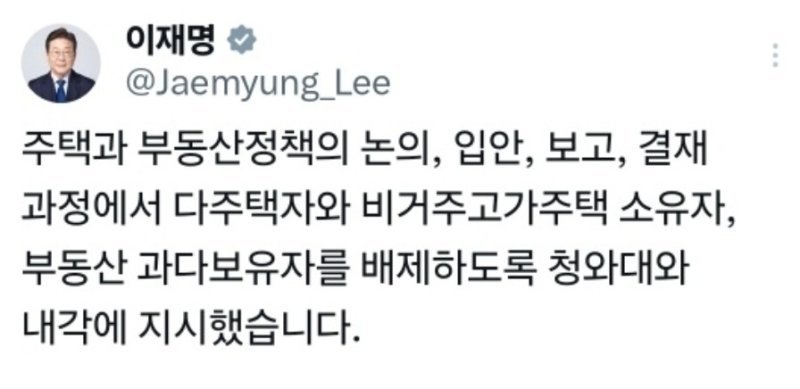
This directive appears intended to preempt conflicts of interest in the discussion, drafting and approval of politically sensitive real estate policies. When senior officials who own multiple homes take part in policy design, suspicions naturally grow that the purpose of the system may be distorted or used to pursue private gain. Once public trust in policy is shaken, even the most sophisticated system is unlikely to deliver meaningful results.
In fact, previous administrations repeatedly faced public backlash over senior officials owning multiple homes or expensive properties in which they did not reside. While the official policy line emphasized stabilizing housing prices and curbing speculation, some officials sold homes in provincial areas while holding on to properties in prime districts of Seoul, fueling controversy over what became known as the "one smart home" strategy. A civic group’s analysis of housing ownership among officials at Cheong Wa Dae, the Blue House, once found that 28% were multi-homeowners. As criticism mounted that policies decided by such officials could hardly be designed for low-income, home-less citizens and young people, trust in those policies suffered significant damage.
Given this history, efforts to block accusations of double standards and thereby secure the moral legitimacy of policy are necessary. If those who make policy are directly affected by its outcomes, it is difficult to win broad public support. Real estate policy in particular is directly tied to people’s daily lives. For that reason, the integrity and consistency of public officials are crucial factors that determine policy effectiveness. The government should transparently disclose officials’ housing holdings and their links to policy, and put in place institutional mechanisms to manage conflicts of interest.
At the same time, real estate policy involves complex, interlocking elements such as taxation, finance, supply and urban planning, so expertise cannot be overlooked. If policymakers are excluded solely on the basis of whether they own a home, policy design capacity may weaken and regulations may drift away from reality. The principle that personal interests must not influence policy formulation should be upheld, but clear criteria and safeguards are also needed so that experienced experts with relevant knowledge can participate. Only when transparent asset disclosure is combined with robust conflict-of-interest rules can the government secure both moral legitimacy and professional competence.
Recently, there have been signs of stabilization in the real estate market. Prices of high-end apartments have fallen somewhat in the three Gangnam districts of Seoul (Gangnam, Seocho and Songpa), and this stabilizing trend appears to be spreading to the Han River Belt, including Yongsan District, Seongdong District and Dongjak District. The heavier burden of property holding taxes due to higher officially assessed values is encouraging a wait-and-see attitude, adding downward pressure on prices. The cooling of previously overheated sentiment can be seen as a positive signal.
What matters now is what happens after May 9, when the temporary easing of the capital gains tax surcharge on home sales expires. If multi-homeowners start pulling listings and raising asking prices, the impact of current policies could be undermined. Tax reforms, including those on property holding, may need to be considered depending on conditions, but given their broad impact on the overall economy, they must be approached with caution. Above all, the government should closely monitor real estate market conditions while consistently demonstrating a clear commitment to stabilizing housing prices. When excessive expectations for price gains are curbed and steady, coherent signals of stability are sent to the market, the effects of real estate policy can be sustained.