"Impact of EU Carbon Border Tax to Fully Materialize by 2031... Export Volume Could Plunge 18%"
- Input
- 2026-03-23 06:00:00
- Updated
- 2026-03-23 06:00:00
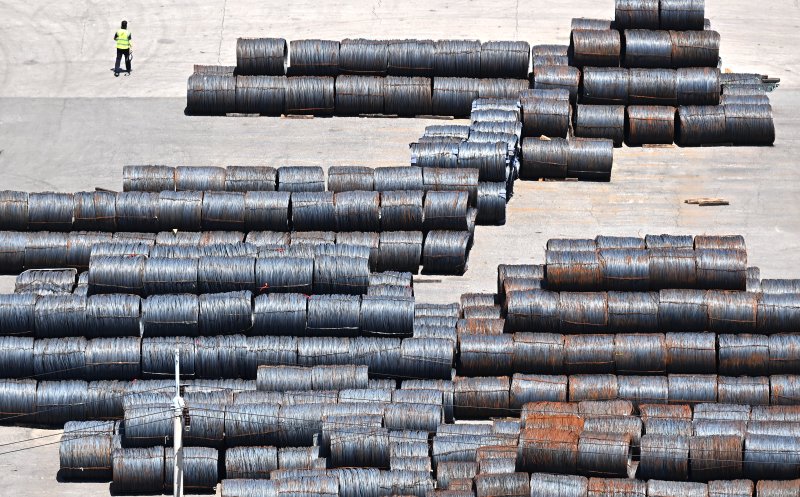
[Financial News] A new analysis warns that the impact of the European Union (EU) Carbon Border Adjustment Mechanism (CBAM) on exports to the EU will fully materialize from 2031. It stresses that companies must urgently move ahead with building low-carbon supply chains.
The study projects that from 2031, when free allocation of emissions allowances is sharply reduced and the list of CBAM-covered products is expanded, export volumes to the EU could fall by as much as about 18%. This is because CBAM imposes costs in proportion to the amount of carbon emitted in the production of exported goods.
According to a report titled "Impact of the EU CBAM on Exports to the EU," released on the 23rd by the Korea International Trade Association (KITA)'s Institute for International Trade and Commerce, carbon-related costs for exports to the EU are expected to surge. This is due to the planned expansion of CBAM-covered items in 2028 and the gradual phase-out of free allocation of emissions allowances within the EU through 2034.
In December last year, the European Commission (EC) announced a draft revision of CBAM that would expand the list of covered products. The scope would move beyond existing items such as steel and aluminum to include downstream (finished) products like machinery, electronic equipment, transport machinery, and precision, medical, and measuring instruments.
The revision is expected to take effect in January 2028 after approval by the European Parliament (EP). The institute noted that 94% of the newly added downstream items are industrial products with high steel and aluminum content, and assessed that CBAM’s reach could therefore expand significantly.
The institute specifically identified 2031 as the turning point when the financial burden from CBAM will start to rise in earnest.
Within the EU, the share of free allocation of emissions allowances is scheduled to be reduced step by step from 97.5% in 2026 to 0% in 2034. From 2031, the free allocation rate will fall to 39%, below half, which will significantly increase the relative cost burden of paid allowances.
Based on these regulatory changes, the institute estimated that, if companies do not respond with measures such as a transition to low-carbon operations, a 1% increase in export prices due to CBAM charges would lead to a 0.98% decline in export volume for the affected products.
Export volumes to the EU for CBAM-covered items are expected to decline by only about 0.9–5.3% through 2030. However, as free allocation is sharply reduced between 2031 and 2034, the drop in export volumes is projected to widen to between 7.7% and 17.9%.
Kwanjae Lee, a senior researcher at KITA, said, "With the scope of CBAM expanding from 2028 and carbon cost burdens intensifying from 2031, our companies do not have much time to respond." He emphasized, "To maintain export competitiveness, firms must build a proactive supply chain management system, including completing the transition to low-carbon facilities and process innovation by 2030."
[email protected] Kwanjae Lee Reporter