Individuals and Foreign Investors Bet on a KOSPI Rebound: "Will Semiconductors Push the Index Back to 6,000?"
- Input
- 2026-03-22 12:54:53
- Updated
- 2026-03-22 12:54:53
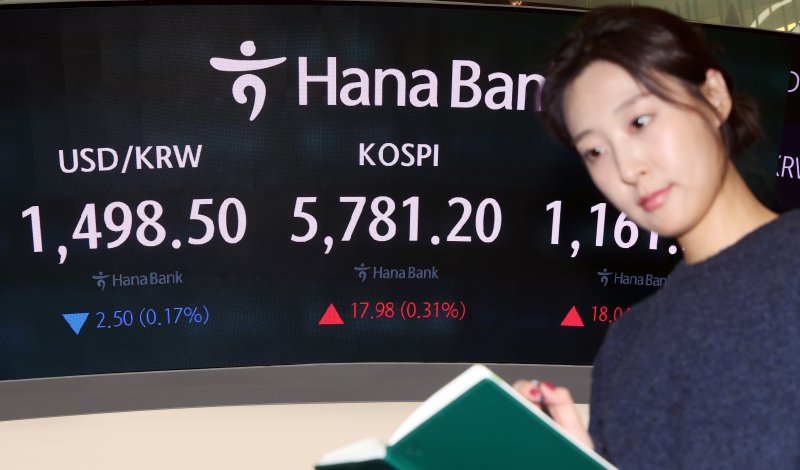
Individual and foreign investors are betting on a rise in the South Korean stock market. In particular, funds are flowing into semiconductor-related exchange-traded funds (ETFs). Analysts at Financial News note that concerns over the Middle Eastern crisis are easing and optimism is returning to the Artificial Intelligence (AI) semiconductor industry, suggesting that the foreign selling cycle may be entering its final phase.
According to ETF CHECK by Koscom Corporation on the 22nd, the ETF most heavily bought by individuals over the past month (February 20 to March 19) was the KODEX 200 ETF, with net purchases totaling 1.1557 trillion won. This was followed by net buying of 925.6 billion won in KODEX Leverage ETF, 800.4 billion won in KoAct KOSDAQ Active ETF, 402.9 billion won in Timefolio TIME KOSDAQ Active ETF, and 316.7 billion won in Mirae Asset TIGER 200 ETF. These products are ETFs that track domestic stock market indices.
Since the beginning of this month, individuals have been net buyers of 16.9182 trillion won in the domestic stock market, using the heightened volatility caused by the Middle Eastern crisis as an opportunity to buy on dips. In contrast, foreigners have turned more aggressive sellers, offloading a net 16.1533 trillion won in the same period. However, securities analysts point out that in the past, foreign selling has tended to persist for a certain period and then come to an end, raising the possibility that the current flow of funds is in the latter stage of that cycle.
In fact, over the past month, foreign investors have bought ETFs that profit from a rise in the domestic stock market, including 124.7 billion won of KODEX Leverage ETF, 68.7 billion won of Mirae Asset TIGER KOSDAQ150 Leverage ETF, 64.1 billion won of KODEX MSCI Korea Total Return ETF, and 60.5 billion won of TIGER Leverage ETF.
Hyun-guk Ahn, a researcher at Hanwha Investment & Securities, said, "We estimate that U.S.-based funds have been net sellers for six consecutive months through March," adding, "Historically, excluding 2008 and 2020, consecutive net selling has tended to end after about six months."
Many expect the turnaround in the domestic stock market to be led by the semiconductor industry. Recently, global AI bellwethers Micron Technology and Oracle Corporation have both reported earnings that beat market consensus, reinforcing the view that the AI-driven semiconductor cycle is not yet over.
Over the past month, individual investors have been net buyers of 697 billion won in Mirae Asset TIGER Fn Semiconductor TOP 10 ETF, 343.7 billion won in Mirae Asset TIGER Semiconductor TOP10 Leverage ETF, and 194.2 billion won in HANARO Fn K-Semiconductor ETF. Foreign investors have also bought 143.6 billion won of TIGER US Philadelphia Semiconductor NASDAQ ETF and 7.8 billion won of Mirae Asset TIGER Fn Semiconductor TOP 10 ETF, indicating that positive sentiment toward the semiconductor sector remains.
Jong-min Kim, a researcher at Samsung Securities, commented, "The upward revision rally in KOSPI earnings estimates, led by Samsung Electronics and SK hynix, is still underway. Micron Technology's recent earnings surprise is heightening expectations for Samsung Electronics' preliminary first-quarter results, which are due early next month." He added, "Although the prolonged Middle Eastern crisis is stoking fears of a resurgence in inflation, it is still too early to predict an immediate economic shock."
At the same time, some warn that the domestic market has become heavily dependent on semiconductor stocks, deepening a concentration risk, and that investors should prepare for the possibility of rising uncertainty in the AI industry.
Choi Gwang-hyeok, a researcher at LS Securities, noted, "Despite the recent series of uncertainty factors, strong export growth in South Korean semiconductor stocks has supported both the economy and share prices." He cautioned, "However, South Korea's exports and economy are now closely linked to the U.S. AI cycle. If AI-related uncertainty in the U.S. increases or an AI bubble bursts, the impact on South Korea could be severe."
[email protected] Im Sang-hyeok, Bae Han-geul Reporter