Japan–U.S. Summit Ends Smoothly, but Risk of an ‘Additional Bill’ Remains [Japan Inside]
- Input
- 2026-03-22 10:00:09
- Updated
- 2026-03-22 10:00:09
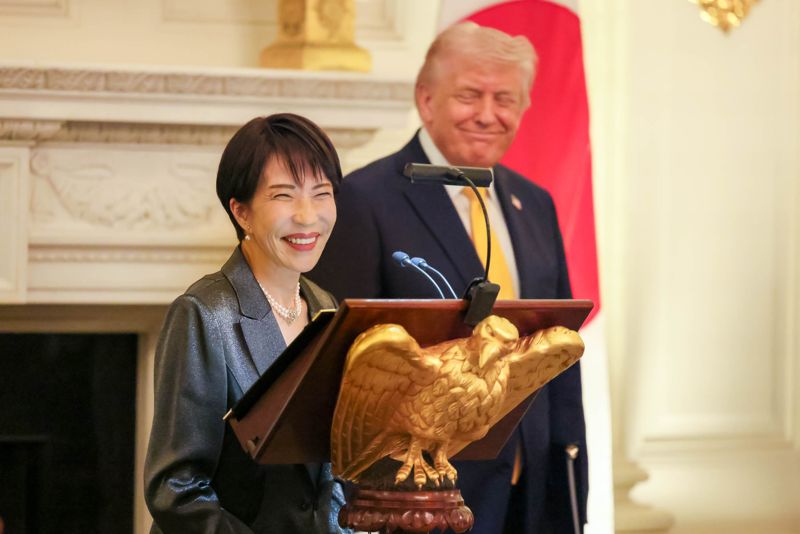
TOKYO – Prime Minister Sanae Takaichi returned to Japan on the 21st after completing her schedule for the Japan–U.S. summit with President Donald Trump, and both the Government of Japan and political circles largely view the talks as having "ended successfully." Even amid uncertainty over the situation in the Middle East, many see it as positive that the two countries wrapped up the summit without a clash. However, some point out that the original agenda—China strategy, the Taiwan issue, U.S. engagement in the Indo-Pacific, and tariffs—was overshadowed by developments in Iran, leaving both achievements and unresolved challenges.
■ Agenda shaken by the ‘Iran factor’
The summit held in Washington, D.C., on the 19th (local time) unfolded differently from what Japan had initially envisioned. Tokyo had prepared to focus discussions on responding to China, the Taiwan issue, and tariff negotiations. But just before the meeting, a U.S. strike on Iran sharply worsened the situation in the Middle East, shifting the core agenda toward Iran and the Strait of Hormuz.
Within the Government of Japan, there had been strong caution that "no one knows what President Trump might demand." Officials were particularly concerned that he might publicly raise sensitive requests such as dispatching the Japan Self-Defense Forces (JSDF).
In the end, that scenario did not materialize. President Trump did not make strong public demands on Japan. Instead, he struck a relatively friendly tone, saying that "Japan is different from the North Atlantic Treaty Organization (NATO)."
According to Japan Broadcasting Corporation (NHK) and other Japanese media, government officials described the talks as having a "friendly atmosphere." Deputy Chief Cabinet Secretary Ozaki Masanao told reporters after the summit, "It did not feel like only the second meeting; I sensed a high level of trust," adding that it was "a successful summit."
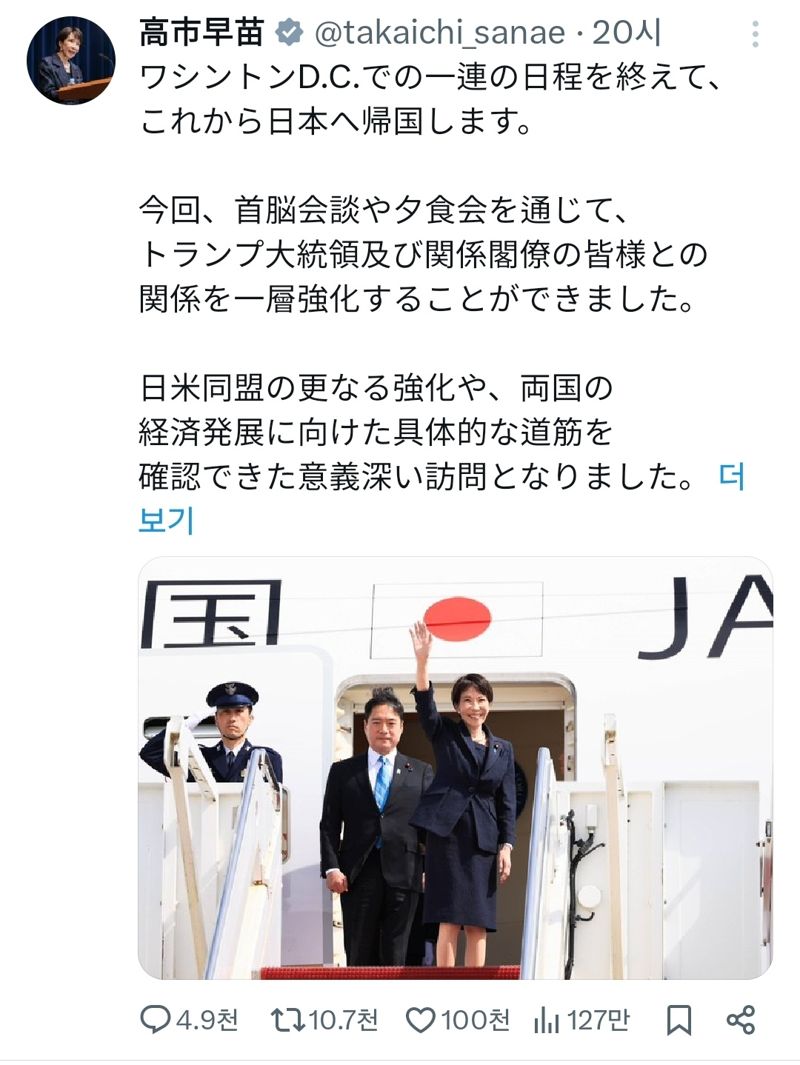
Prime Minister Takaichi also wrote on her way back to Japan on the 21st, posting on her X (formerly Twitter) account, "It was a meaningful visit in which we further strengthened the U.S.-Japan alliance and confirmed concrete directions for advancing both countries’ economies," and, "We further solidified our relationships with President Trump and the relevant cabinet members."
■ Using the ‘economic card’ to minimize friction
Japanese media and experts say Japan’s strategy of putting large-scale economic cooperation at the forefront, instead of offering direct responses in the security domain, proved effective.
Japan presented what it called an "economic package," including a second round of investment in the United States worth about $73 billion (roughly 10.9 trillion yen), projects involving small modular reactors (SMR), gas-fired power generation, cooperation on rare-earth elements (REE) supply chains, and joint stockpiling of U.S. crude oil. In the security field, Tokyo also proposed expanding production of SM-3 Block IIA interceptor missiles and jointly developing and producing missiles.
In particular, cooperation on REE supply chains and expanded missile production are seen as ways to ease the United States’ economic-security and military burdens, respectively.
Because China is using REE as a diplomatic lever to exert economic pressure, diversifying supply chains has become an urgent task.
Expanded missile production is also crucial. As the U.S. military has been using interceptor missiles to defend against Iran’s missile attacks, stockpiles have been rapidly depleted, making it necessary to ramp up new production or secure support from other countries.
In fact, there are suggestions that the United States and Gulf states may have used more than 1,000 MIM-104 Patriot surface-to-air missile system interceptors—twice the annual production—alone. To make up for the shortfall, Washington is reportedly considering redeploying forces and assets currently stationed overseas.
Kenichiro Sasae, president of The Japan Institute of International Affairs (JIIA), told the Yomiuri Shimbun, "This summit was characterized by its focus on the economy and economic security," and assessed that Japan "made the talks a success by delivering results in areas that interest President Trump."
Kumano Hideo, chief economist at the Dai-ichi Life Research Institute, similarly commented in an interview with Nihon Keizai Shimbun (The Nikkei), "The Government of Japan’s strategy of focusing on economic cooperation proved effective," adding, "Concerns that the United States would make sweeping demands for cooperation because of the situation in Iran did not come to the fore."
■ A ‘postponed-problems summit’... uncertainty persists
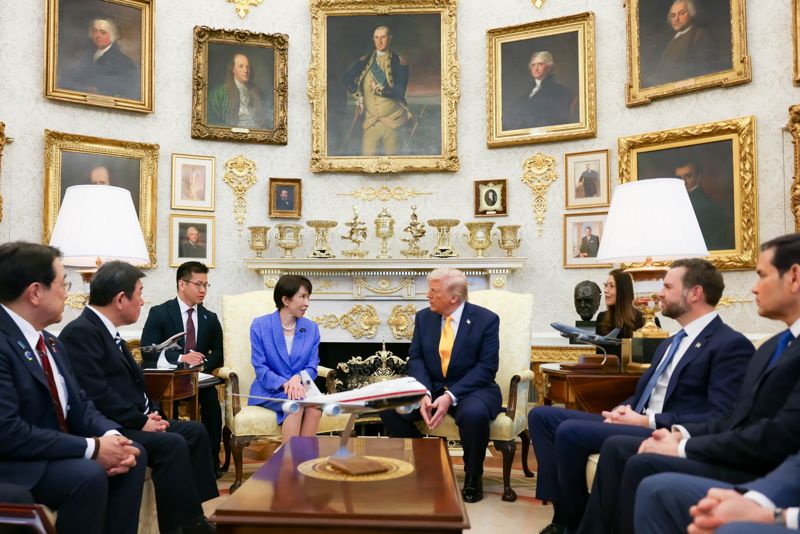
Alongside the positive assessments, there is also a fair amount of caution. While the summit "avoided confrontation," it was at the same time a meeting that "pushed problems into the future."
The biggest variable is whether President Trump will make additional demands. Experts warn that if the war with Iran drags on, Japan could face much stronger pressure.
Jeffrey W. Hornung, a senior political scientist at RAND Corporation focusing on Japan in the national security research division, predicted, "If the war with Iran continues, Japan will face stronger demands."
Nicholas Szechenyi, a senior fellow at the Center for Strategic and International Studies (CSIS), also noted, "A key issue going forward is how much Prime Minister Takaichi can contribute within Japan’s legal constraints," and warned, "If domestic procedures are delayed, President Trump’s dissatisfaction could grow."
Uncertainty also hangs over the economic cooperation. The specific details of the second round of investment projects in the United States have yet to be finalized.
According to joint documents released by the two governments, the second round of projects could reach up to $73 billion (about 10.9 trillion yen), more than double the $36 billion announced for the first round last month.
The SMR projects, to be built in Tennessee and the State of Alabama by U.S. energy company GE Vernova and Japan’s Hitachi, are expected to total $40 billion. Planned natural gas power plants in the Commonwealth of Pennsylvania and Texas are also large, at $17 billion and $16 billion respectively, but the participating companies have not been disclosed.
A government official said, "The details have not been fully finalized," and added, "There was an element of organizing the plan in broad strokes with President Trump in mind."
Additional candidate projects—such as Alaska oil infrastructure, large nuclear reactors, an advanced display factory, copper smelting facilities, and batteries for data centers—were also mentioned. However, they were left out of the current package because profitability assessments have not been completed.
■ Private-sector participation is ‘crucial’... rising concerns over profitability
According to The Nikkei, private companies and financial institutions feel burdened by the way large-scale projects are being rolled out in quick succession under government leadership.
An executive at a major Japanese bank remarked, "Even if funds are injected in stages, it could still be a considerable burden."
Concerns over profitability are also significant. For SMR projects, construction costs are difficult to reduce unless a mass-production system is established. The display factory plan was likewise excluded from the second round due to issues securing labor and sales channels.
Within the Government of Japan, some are warning that similar problems could recur, citing past cases in which Japan Overseas Infrastructure Investment Corporation for Transport & Urban Development (JOIN), a public–private fund, incurred losses on overseas infrastructure projects. In reality, a Foxconn LCD factory investment plan launched in 2018 in Wisconsin was drastically scaled back and fell far short of expectations.
Economist Kumano Hideo pointed out, "Diversifying procurement by using U.S. crude oil has its merits, but factors such as the cost of Alaskan crude oil require detailed examination," adding, "There is a risk that this will amount to an overly optimistic outlook based on projects that have yet to be fleshed out." He went on, "A weak yen is pushing up the cost of investment in the United States, and there is a risk that companies will be buffeted by policy shifts," and cautioned, "It is worrisome when economic-security logic takes precedence over profitability and economic rationality."
The Nikkei noted, "Japan’s direct investment in the United States came to $63.9 billion last year, down 16% from the previous year, while exports to the U.S. also fell 4%," and warned, "If private-sector participation does not keep pace, the substantive foundation of the U.S.-Japan alliance could be weakened."
[email protected] Seo Hye-jin Reporter