Major Shift in Medical and Pharmaceutical Admissions: "Repeat Test-Takers Favored in Provinces, High School Seniors Favored in Capital Region"
- Input
- 2026-03-22 09:17:55
- Updated
- 2026-03-22 09:17:55
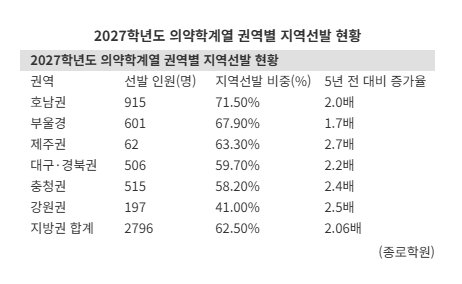
According to Financial News, the number of regional quota seats for medical and pharmaceutical fields in non-capital regions for the 2027 academic year is expected to reach 2,796, double the figure from five years ago and the largest ever. As a result, the average number of students per general high school in the Honam region who fall within the likely admission range will expand to 4.0. This is expected to accelerate a polarized admissions structure in which repeat test-takers dominate in provincial areas, while current 12th graders (high school seniors) hold the advantage in the Seoul metropolitan area. On the 22nd, Jongro Academy reported that the total number of seats at 99 universities nationwide offering medicine, dentistry, Korean medicine, and pharmacy for the 2027 academic year will be 6,632. Of these, 66 universities outside the capital region will admit 2,796 students under regional quotas, accounting for 62.5% of their total intake. This is 2.06 times higher than the 1,357 seats in the 2022 academic year, a jump driven by the expansion of regional talent tracks and regional physician programs.■ Diverging fortunes by regionLim Seong Ho, head of Jongro Academy, stated, "As regional quotas for medical and pharmaceutical fields in non-capital regions have expanded significantly, conditions are now ideal for repeat test-takers with strong school grades to try again." He added, "In particular, repeat test-takers are likely to outperform current high school seniors in meeting CSAT minimum score requirements for early admission, so the share of successful repeat test-takers in provincial areas will likely rise further."
In contrast, the admissions landscape in the Seoul metropolitan area is expected to look very different. Top-performing students in the capital region are effectively blocked from applying to medical and pharmaceutical programs in provincial areas because of regional restrictions. They are therefore forced to concentrate their applications on universities located in Seoul and the surrounding Gyeongin area. In this structure, current 12th graders with stronger school records may have an advantage over repeat test-takers.
Lim predicted, "For the 2027 admissions cycle, polarization will become more pronounced, with higher acceptance rates for repeat test-takers in provincial areas and for current high school seniors in the capital region." He went on, "At some medical schools in non-capital regions, once carried-over seats from early admission are included, there may even be cases where repeat test-takers account for an overwhelming majority of successful applicants."
How universities allocate regional physician program seats between early and regular admission, along with their final detailed admissions plans, is expected to become the biggest variable in future admissions. Test-takers will need to closely analyze changes in quota sizes and application patterns in the region where they live and build their strategies accordingly.■ Honam region tops list with 71.5% regional quotaBy region, the Honam region will have 915 regional quota seats, the highest number, accounting for 71.5% of its total intake. Next is the Buul-Gyeong metropolitan area with 601 seats (67.9%), followed by the Jeju region with 62 seats (63.3%), the Daegu–Gyeongbuk region with 506 seats (59.7%), the Chungcheong region with 515 seats (58.2%), and the Gangwon region with 197 seats (41.0%). Compared with five years ago, the number of seats has surged across all regions: the Honam region by 2.0 times, the Daegu–Gyeongbuk region by 2.2 times, and the Gangwon region by 2.5 times. However, in terms of proportion, the gap between the Honam region and the Gangwon region reaches 30.5 percentage points, indicating that disparities among regions remain large.
This expansion in regional quotas is significantly lowering the barrier to entry for students at general high schools in non-capital regions seeking admission to medical and pharmaceutical fields. The average number of students per general high school in these areas who are likely to gain admission is projected to rise from 1.4 in the 2022 academic year to 2.8 in 2027, exactly doubling. The Honam region stands out in particular, with the figure expected to reach 4.0 students per school, the highest potential admission rate in the country. The Jeju region is projected at 2.8 students per school, while the Daegu–Gyeongbuk and Chungcheong regions are each expected to reach 2.7, marking a substantial widening of the admission range compared with five years ago.
monarch@fnnews.com Kim Man-gi Reporter