Endless 'Popup Window Hell'... It Was an Illegal Practice That Misled Consumers [The Basics of Consumption]
- Input
- 2026-03-22 09:00:00
- Updated
- 2026-03-22 09:00:00
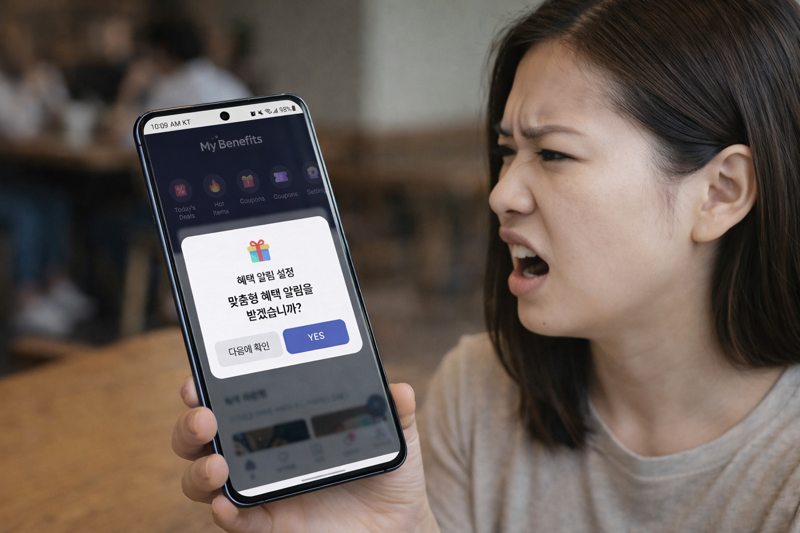
[Financial News]Case 1. After installing a mobile shopping application, one user was confronted with a pop-up asking whether to receive "personalized benefit notifications" every time they opened the app and logged in. The screen only offered two buttons: "YES" and "Remind me later." Even after choosing "Remind me later," the same pop-up reappeared whenever the app was launched. Over time, the user felt increasingly fatigued by the repeated notification requests.Case 2. Another user was browsing an online shopping mall when a pop-up reading "Today Only Discount" appeared. They clicked the "X" at the top to close it, but the same pop-up reappeared as soon as they moved to a different page. The identical window kept popping up every time they turned a page, forcing the user to close it multiple times throughout the entire shopping process.According to the Department of Market Research's Market Surveillance Team at the Korea Consumer Agency on the 22nd, these cases fall under a type of dark pattern known as "Repeated Interference." Repeated Interference refers to practices that repeatedly ask consumers to change a choice they have already made or refused. As a result, it tends to appear more often in areas such as consent to receive advertising or the provision of personal information, rather than in one-off product purchase steps. A typical example is a pop-up window that keeps appearing during the use of an online webpage or application.
This type of pattern is problematic not because it directly deceives consumers, but because it burdens their decision-making by constantly demanding the same choice. Consumers end up spending time and energy repeatedly making the same selection or refusal, and to avoid this inconvenience, they may eventually make a choice they did not actually want.
However, not every repeated display is subject to regulation. Simple notifications that merely provide information or confirm whether the consumer has made a choice are generally not considered problematic. But when specific options are presented and the same change of choice is persistently requested, it can be interpreted as Repeated Interference.
The Act on the Consumer Protection in Electronic Commerce, Etc. prohibits such conduct. Under this law, businesses must not obstruct consumers' free decision-making by repeatedly requesting, through pop-up windows or similar means, that they change content they have already chosen or decided. An exception is allowed if consumers are given the option not to receive the same request again for a certain period, which is set at seven days.
If a business violates these provisions, it may be fined up to 5 million won. From July 21, this upper limit is scheduled to be raised to 10 million won.
An official at the Korea Consumer Agency stated, "When using online webpages or applications, consumers are often exposed to pop-up windows for various purposes, such as consent to receive advertisements or to provide information, so they should be careful not to casually agree or click 'YES.'"
localplace@fnnews.com Kim Hyun-ji Reporter