Trump Considers Scaling Back Iran Operation, Says South Korea, China and Japan Should Be Involved in Strait of Hormuz
- Input
- 2026-03-21 08:41:18
- Updated
- 2026-03-21 08:41:18
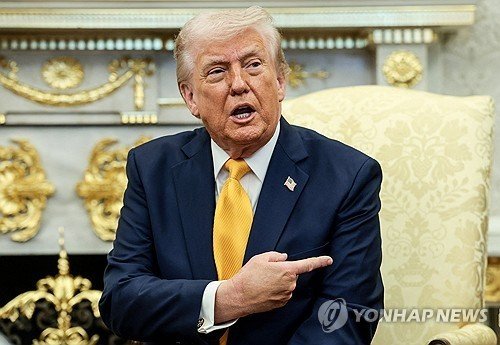
In a post on the social media platform Truth Social that day, President Donald Trump wrote, "As we consider ways to gradually wind down our large-scale military efforts in the Middle East against the terror regime of Iran, we are very close to achieving our military objectives."
He listed five operational objectives: neutralizing Iran’s missile capabilities and launchers; destroying its defense industrial base; disabling the Islamic Republic of Iran Navy and the Islamic Republic of Iran Air Force, including its air-defense systems; completely blocking Iran’s nuclear capabilities while maintaining the ability of the United States to respond swiftly and forcefully should such a situation arise; and providing the highest level of protection for U.S. allies in the Middle East.
President Donald Trump did not spell out what he meant by a "gradual wind-down of military efforts," but his remarks are being interpreted as putting a future drawdown of operations on the table, based on his assessment that the military objectives are close to being achieved.
At the same time, signs of additional deployments of the United States Armed Forces (U.S. military), including Marines, to the Middle East have been detected. Observers say it remains to be seen whether President Donald Trump is genuinely seeking an exit from the conflict with the Islamic Republic of Iran, or whether he mentioned the idea without a concrete plan in an effort to calm volatility in oil and stock markets.
Earlier, at a meeting with reporters at the White House, President Donald Trump said, "You don’t have a ceasefire when you are literally demolishing the other side," making clear that he does not want a ceasefire with the Islamic Republic of Iran.
Against this backdrop, President Donald Trump again underscored the need for contributions from allies such as South Korea and Japan to the normalization of navigation in the Strait of Hormuz. Speaking to reporters at the White House about the Strait of Hormuz, which is effectively under blockade by the Islamic Republic of Iran, he said, "We’re doing very well there," and added, "We don’t use that strait. We don’t need it." He went on, "Europe and South Korea, Japan, China and many other countries need it, so they should get involved."
Previously, President Donald Trump had asked seven countries, including South Korea, Japan, China, the United Kingdom of Great Britain and Northern Ireland (UK) and France, to join a mission to escort oil tankers passing through the Strait of Hormuz, which is under blockade by the Islamic Republic of Iran. The United States argues that, because it is less dependent on crude oil shipped through the Strait of Hormuz, it is reasonable for countries with higher dependence to take part in tanker escort and related operations.
In his Truth Social post, President Donald Trump also stated, "The Strait of Hormuz should be guarded and policed, as necessary, by the other countries that use it." He added, "If requested, we will help these countries with their efforts related to the Strait of Hormuz, but once the Iranian threat is eliminated, that will not be necessary," and continued, "The important thing is that this will be an easy military operation for those countries."
[email protected] Lee Hyun-jung Reporter