A real 'Dooly' once lived in Korea...New Cretaceous dinosaur species named “Doolysaurus”
- Input
- 2026-03-21 06:00:00
- Updated
- 2026-03-21 06:00:00
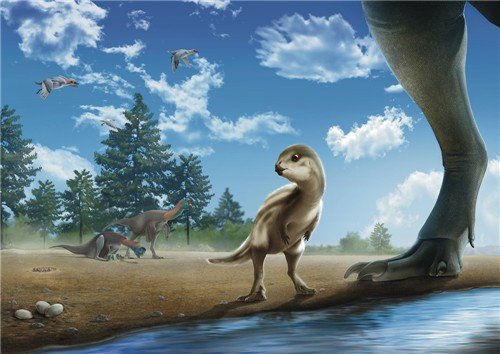
[Financial News] The scientific name of a new dinosaur species discovered in Sinan County, South Jeolla Province, has been designated “Doolysaurus,” after the cartoon character “Dooly the Little Dinosaur.”
On the 19th, a research team led by Jongyun Jung of the Korea Dinosaur Research Center, Chonnam National University, and The University of Texas at Austin announced in the international journal Fossil Record that they had named the turkey-sized dinosaur found on Aphaedo Island in Sinan County, South Jeolla Province, “Doolysaurus huhmini” (Doolysaurus huhmini).
The team explained that the genus name “Doolysaurus” was inspired by Dooly, one of the most beloved cartoon characters in Korea. They added that the species name “huhmini” honors Huh Min, Administrator of the Korea Heritage Service, who founded the Korea Dinosaur Research Center, Chonnam National University, contributed to dinosaur research in Korea for more than 30 years, and worked with UNESCO to preserve Korean dinosaur fossil sites.
“Dooly is an extremely famous and iconic dinosaur character in Korea, and every generation here knows Dooly,” said Dr. Jeong, first author and corresponding author of the paper. He added, “The fossil specimen is also a juvenile—literally a ‘baby’—so it is a perfect name to commemorate Dooly with a new dinosaur species.”
The fossil was discovered in 2023 by Dr. Cho Hye-min of the Korea Dinosaur Research Center, Chonnam National University (now at the Gwangju National Science Museum), in the Ilseongsan Formation, a middle Cretaceous rock formation on Aphaedo Island in Sinan County, South Jeolla Province. “When we first found the fossil, we could only confirm a few preserved leg bones and several vertebrae,” Dr. Jeong recalled. “We did not expect there would be parts of the skull and so many additional bones.”
Skull bones hidden inside hard rock were revealed through micro-CT scans at the High-Resolution X-ray Computed Tomography Facility at The University of Texas at Austin (UTCT). This is the first time in Korea that a dinosaur fossil including part of the skull has been found, and it is the first discovery of a new dinosaur species in the country in 15 years.
Based on the fossil’s size, anatomical features, and histological analysis, the dinosaur is thought to be a juvenile rather than a fully grown individual, probably around 0 to 2 years old. It was about the size of a turkey, but as an adult it likely grew to roughly twice that size, and its body was probably covered with downy, fibrous structures. Numerous small pebbles (gastroliths) found in the stomach region, which would have aided digestion, suggest it was omnivorous, feeding on plants, insects, and small animals.
Phylogenetic analysis further showed that Doolysaurus belongs to Thescelosauridae, a group of bipedal dinosaurs (thescelosaurids) that lived in East Asia and North America during the middle Cretaceous, about 113 million to 94 million years ago.
[email protected] Kim Hee-sun Reporter