Where Did That Bag You Paid an Extra 100 Won For Actually Go? [Lee You-beom’s Eco & Energy]
- Input
- 2026-03-21 06:00:00
- Updated
- 2026-03-21 06:00:00
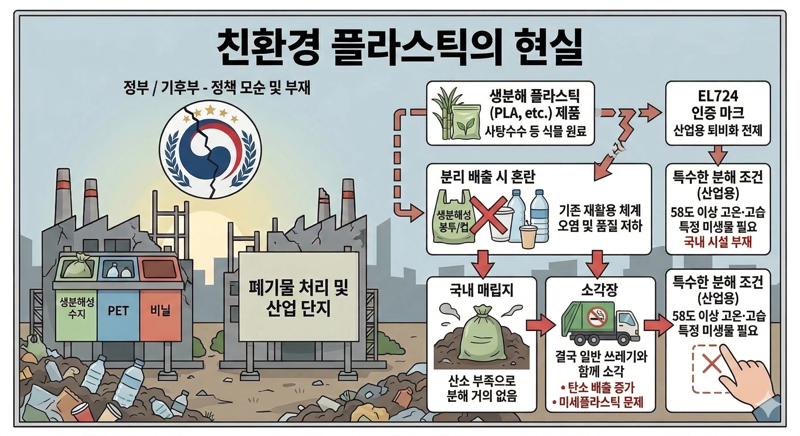
[The Financial News]#. At a convenience store in downtown Seoul, a customer identified as A stood at the checkout and chose a "biodegradable" shopping bag to carry the items.The bag cost an extra 100 won, but A picked it up thinking, "It’s eco-friendly." In reality, for this bag to actually break down, it needs an industrial composting facility that can provide temperatures above 60 degrees Celsius and specific microorganisms. Such facilities are virtually nonexistent in Korea. The bag A purchased will ultimately be sent to an incinerator along with regular household waste.As the markets for so-called eco-friendly bio-based plastics and biodegradable plastics expand every year, hidden technological and regulatory loopholes are coming under scrutiny. Despite their green image, many of these materials do not truly biodegrade, and they also clash with existing recycling systems. Experts stress that infrastructure and consistent policy must come before material innovation.
Bio-based plastics: far from naturally decomposing
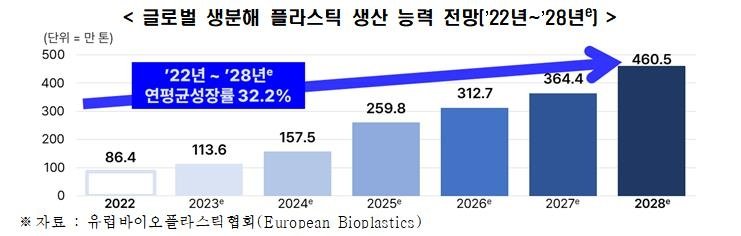
According to European Bioplastics (EUBP), global production capacity for bio-based plastics is expected to almost double, from 2.31 million tons in 2025 to 4.69 million tons in 2030. Actual production in 2025 is projected at 1.67 million tons, with an average operating rate of 72%. This suggests the market has moved beyond mere expectations and is now entering a phase of real production expansion.
The biodegradable plastics market is also on the rise. Market research firm MarketsandMarkets forecasts that the global biodegradable plastics market will grow from 12.9 billion dollars in 2024 to 33.5 billion dollars in 2029, an average annual growth rate of 21.3%. Even so, that volume is only about 0.5% of the roughly 431 million tons of plastic produced worldwide each year. The market is growing, but it is still far from large enough to shake the overall plastics system.
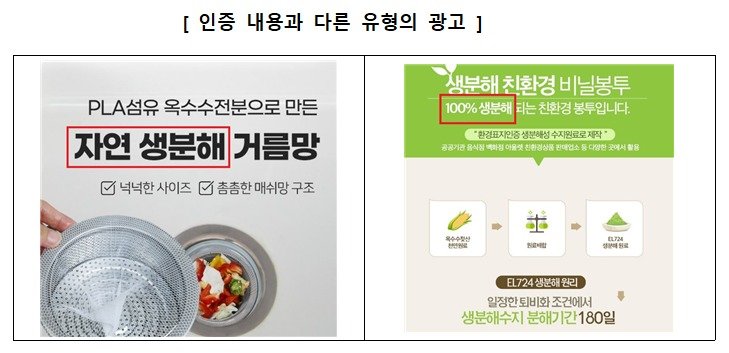
The confusion around eco-friendly plastics starts with how concepts are mixed together. "Bio-based" means the material is made from plant-derived feedstock, while "biodegradable" means it can be broken down by microorganisms. These are completely different properties, yet marketing often bundles them together under a single "eco-friendly" label. For example, plant-based polyethylene made from sugarcane (bio-PE) has the same chemical structure as petroleum-based PE and does not break down in nature. By contrast, a biodegradable plastic synthesized from petroleum, such as PBAT, can be decomposed by microorganisms if the right conditions are met. In other words, "where it comes from" and "whether it decomposes" are separate questions.
The most common misconception is that "bioplastics = plastics that easily rot in nature." In reality, bioplastics are defined more by the origin of their raw materials. Even if they are made from bio-based feedstocks such as plants, many of these materials are not biodegradable. Experts point out that a product labeled "eco-friendly" is no different from conventional plastic if there is no proper treatment system in place.
Biodegradable plastics that neither decompose nor allow recycling
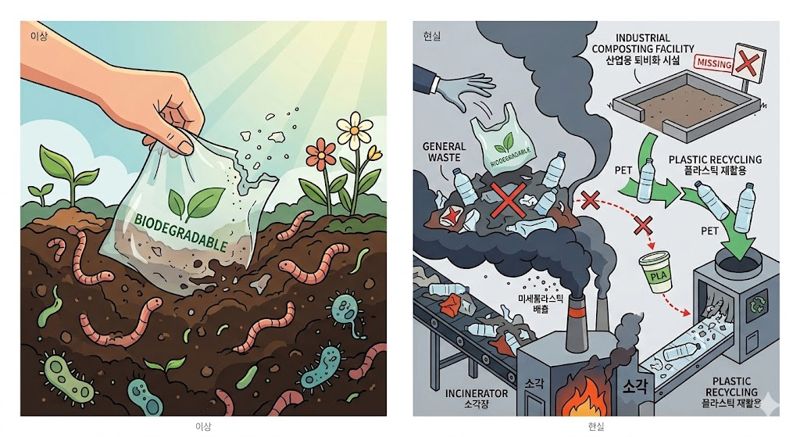
Biodegradable plastics are not a cure-all either. The word "biodegradable" makes it sound as if the material will quickly disappear even if thrown on the ground or into the sea, but the reality is far more complex. For the representative material Polylactic acid (PLA) to break down, it needs a hot and humid environment of at least 58 degrees Celsius and specific microorganisms at the same time. Those conditions can only be met in industrial composting facilities, which are virtually nonexistent in Korea. Landfills lack oxygen, so almost no decomposition occurs there, and if the material is dumped in the ocean, it can persist for hundreds of years.
An even more serious problem is the conflict with existing recycling systems. PLA looks almost identical to polyethylene terephthalate (PET), so it is often mistakenly thrown into PET recycling bins. Studies show that contamination with as little as 1–2% PLA can significantly degrade the quality of an entire batch of recycled PET. It is an irony in which a well-intentioned material ends up undermining both treatment routes at once.
There is also the issue of carbon footprints. Life-cycle assessments (LCA) that include fertilizer production, farm machinery use, and processing have found that some bioplastics emit more greenhouse gases than conventional petroleum-based plastics.
The United Nations Environment Programme (UNEP) has long warned that simplistic expectations such as "it will biodegrade in the ocean" can be misleading. A label that says "biodegradable" on plastic does not mean it can solve the problem of marine plastic pollution. In the end, experts argue, what matters is not the name of the material but the actual systems for disposal, collection, and treatment.
Promotion → suspension → grace period... investment heads overseas
Korea’s policy on biodegradable plastics has been a series of mixed signals. The Ministry of Environment, now the Ministry of Climate, Energy and Environment, introduced the Korea Eco-Label Certification EL724 system in the early 2010s and offered benefits to certified products. In 2022, however, it completely halted new certifications, citing the fact that these products "do not actually biodegrade under domestic environmental conditions." After strong backlash from industry, the government reversed course in 2024 and temporarily allowed new certifications again, deciding to run pilot projects through 2028 and then reconsider whether to keep the system.
The cost of this policy confusion has been high. LG Chem suspended operations at its biodegradable plastics plant in Daesan in Seosan, South Chungcheong Province, where it had invested 2 trillion won. SKC affiliate SK Leaveo abandoned plans to enter the domestic market and instead decided to build a plant in Vietnam. Policy uncertainty has effectively pushed investment overseas.
There is also a structural contradiction built into the Korea Eco-Label Certification EL724 system. The certification criteria are based on industrial composting conditions. As a result, containers made of the same material are treated differently: certified products are classified as non-recyclable, while non-certified ones can be recycled. In effect, the eco-label ends up steering products toward landfilling or incineration.
To actually biodegrade these materials, they must be collected separately and sent to composting facilities, but there is no such collection system in place. Industry insiders have proposed linking biodegradable plastics to the existing food-waste collection network and assigning them a separate sorting code, but this idea has yet to be institutionalized.
"Systems over materials, and reduction over systems"
Experts emphasize that for eco-friendly plastics to be genuinely eco-friendly, three conditions must be met at the same time: infrastructure development, consistent policy, and a reduction in overall usage.
First, building infrastructure such as industrial composting facilities and dedicated collection and sorting systems is urgent. Restoring policy consistency is also crucial. The European Union (EU) has legislated that marketing claims about biodegradability can be used only when the corresponding treatment environment actually exists. In Korea, many are calling for a long-term roadmap to be presented when Korea Eco-Label Certification EL724 is reviewed again in 2028.
The most fundamental solution, however, is to reduce consumption. Cutting how much plastic we use is a far more powerful environmental measure than improving how well it decomposes. A survey by the Korea Consumer Agency found that 86.2% of consumers believe biodegradable plastics help the environment. But in a reality where there are neither dedicated treatment facilities nor collection systems, that belief may simply provide a false sense of comfort that hides the underlying problem.
An industry official said, "Eco-friendly plastics are not a magic solution. Until the right regulations and infrastructure are in place, using less is the most reliable way to be eco-friendly."
Climate, environment, and energy are like two sides of the same coin. Depending on how energy is produced, it can accelerate global warming, while changes in climate and the environment in turn affect energy demand and supply.[Lee You-beom’s Eco & Energy]is a weekly Saturday column that explores climate, environmental, and energy issues that are inseparable from one another. Subscribe to the reporter’s page to receive it conveniently.
[email protected] Lee You-beom Reporter