Property holding tax on two Gangnam homes hits 44.87 million won... "Half my salary in taxes?" jitters [Real Estate A to Z]
- Input
- 2026-03-21 15:00:00
- Updated
- 2026-03-21 15:00:00
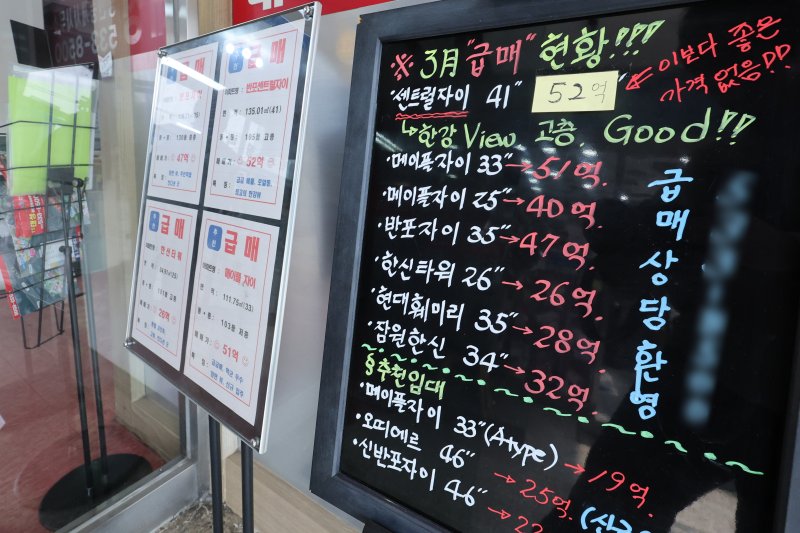
[Financial News] The basis for calculating officially assessed values is the actual transaction price. A comparison of this year’s apartment official values with last year’s actual transaction price index from the Korea Real Estate Board (KREB) shows a broadly similar pattern. However, in some areas, the increase in official values has far exceeded the rise in the actual transaction price index.
How big is the gap between actual prices and official values?
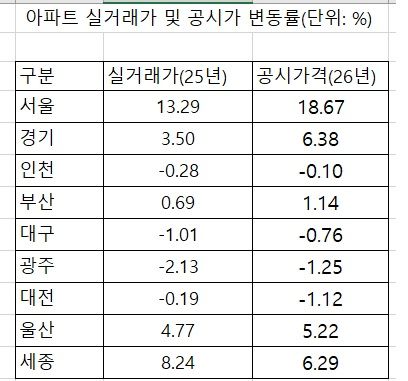
Looking first by region, areas where last year’s apartment actual transaction price index fell also recorded negative growth in official values. According to KREB statistics, among major cities, the regions where actual transaction prices declined in 2025 were Incheon Metropolitan City (-0.28%), Daegu (-1.01%), Gwangju Metropolitan City (-2.13%), and Daejeon Metropolitan City (-0.19%). In these areas, this year’s apartment officially assessed values also showed negative year-on-year changes.
In Gyeonggi Province, actual transaction prices rose 3.50% last year, while official values climbed 6.38%. The gap was even larger in Seoul. Actual transaction prices there increased 13.29%, but officially assessed values jumped 18.67%.
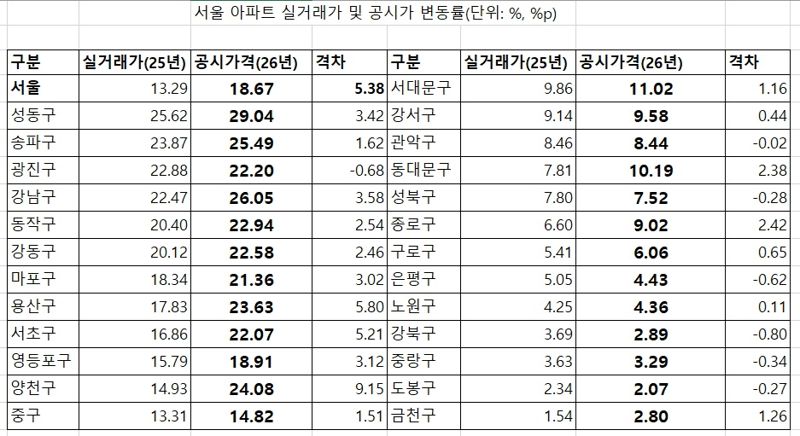
A comparison of the increase in actual transaction prices and official values across Seoul’s 25 districts shows that in some areas, official values have far outstripped market price gains.
By district, Seongdong District ranked first in both actual and official price growth. In 2025, Seongdong District posted the highest increase in actual transaction prices at 25.62%. It also topped the list for this year’s official value growth, with a 29.04% rise.
Including Seongdong District, Songpa District, Gwangjin District, Gangnam District, Dongjak District, and Gangdong District all saw actual apartment prices climb more than 20% last year. In these districts, this year’s officially assessed values also jumped by a similar 22–26%.
By contrast, some districts have seen official values rise far more than actual prices, drawing attention. Yangcheon District is a prime example. Last year, actual transaction prices there rose 14.93%, but official values surged 24.08%, creating a 9.15 percentage point gap. Seocho District and Yongsan District also stood out, with actual prices up 16–17% while official values climbed 22–23%.
An industry source said, "Differences are inevitable because the calculation methods are not identical, but we are likely to see a sharp increase in objections to officially assessed values, particularly in certain districts and specific complexes."
Double burden for multiple-home owners... What if you can’t sell before June 1?
With officially assessed values for Seoul apartments jumping, owners of multiple homes have little choice but to shoulder a heavier tax burden. For these owners, the official values of all their homes are added together, and tax is levied on the amount exceeding 900 million won. A fair market value ratio of 60% is applied.
The reference date for property holding tax is June 1. If ownership transfer through sale or gifting is not completed before June 1, the owner is taxed under the multiple-home standard.
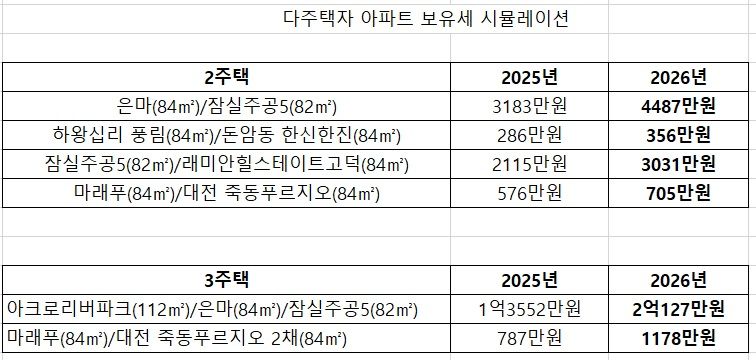
Let’s look at the property holding tax burden for multiple-home owners analyzed by Woo Byung-tak, a senior specialist at Shinhan Premier Pathfinder at Shinhan Bank. The calculations are based on the officially assessed values actually disclosed.
For a two-home owner holding an 84m2 exclusive-use Eunma Apartments unit in Daechi-dong and an 82m2 exclusive-use Jamsil Jugong 5 Danji unit in Songpa, the property holding tax (including surtaxes) will rise from 31.83 million won in 2025 to 44.87 million won in 2026. For an owner of two homes in Hawangsimni-dong and Donam-dong in Gangbuk, the area north of the Han River in Seoul, the tax is also expected to increase from 2.86 million won to 3.56 million won over the same period. A three-home owner with prime properties in Gangnam is projected to face a property holding tax burden of around 200 million won.
The government is considering measures that would further increase the property holding tax burden. Previously, Deputy Prime Minister Koo Yoon-cheol remarked, "If we were to levy a 1% property tax like in the United States, a 5 billion won home would incur 50 million won in property holding tax a year. If half of your annual salary goes to taxes, it would be very hard to endure."
Some observers also warn that higher property holding taxes could be passed on to tenants through higher rents. An industry insider noted, "It is reasonable to pay more property tax when home prices rise, but landlords may shift that tax burden onto tenants through higher monthly rents or other lease payments," adding, "We saw a similar pattern under a previous administration."
Meanwhile, according to KREB, the average jeonse deposit for apartments in Seoul rose from 596 million won in January this year to 598 million won in February. During the so-called jeonse crisis in 2021, the average jeonse deposit exceeded 600 million won. The all-time high average jeonse deposit stands in the 630 million won range. The average monthly rent for apartments climbed from 1.5 million won in January to 1.51 million won in February, continuing to set new record highs.
[email protected] Lee Jong-bae Reporter