Trump presses Japan on Hormuz deployment; Tokyo draws a legal line
- Input
- 2026-03-20 08:29:15
- Updated
- 2026-03-20 08:29:15
[The Financial News] U.S. President Donald Trump has publicly called on Japan to play a larger role in defending the Strait of Hormuz, but Tokyo has placed greater emphasis on diplomatic support while keeping its distance from military involvement. The episode highlighted a gap between the rhetoric of alliance solidarity and the level of concrete action Japan is prepared to take.
At the U.S.-Japan summit held at the White House on the 19th (local time), President Trump said regarding the Strait of Hormuz issue, "I expect Japan to step up."
He noted, "There are 45,000 U.S. troops stationed in Japan, and the United States is providing massive support," adding, "Given that relationship, it is only natural for Japan to take the lead." He went on to stress that "Japan imports more than 90% of its oil through that strait, so it has every reason to get involved."
However, President Trump stopped short of mentioning specific measures such as sending warships, keeping his pressure at a more general level. Asked about the extent of Japan’s response, he said, "Japan is giving us tremendous support and wants to play an active role," adding, "It’s not like the North Atlantic Treaty Organization (NATO)." His remarks were seen as both a relatively friendly assessment of Japan among U.S. allies and a nudge for Tokyo to do more.
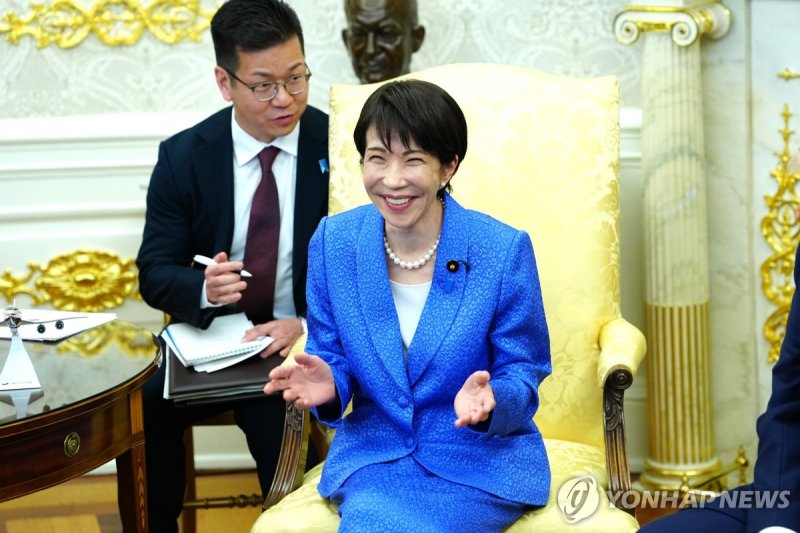
In response, Prime Minister Takaichi Sanae strongly criticized Iran’s move to block the Strait of Hormuz and aligned herself with the United States, but avoided spelling out any concrete support measures. In her opening statement, she said, "Iran’s development of nuclear weapons can never be tolerated," and declared, "We strongly condemn the act of effectively blockading the Strait of Hormuz."
She also praised President Trump, saying, "I believe you alone can bring peace to the world." The comment appeared aimed at easing the political burden on Trump, who is facing domestic and international criticism over the conflict in the Middle East.
After the summit, Prime Minister Takaichi said, "We agreed that ensuring the safety of the Strait of Hormuz is important," but added, "There are measures that are possible and measures that are not possible within the scope of Japanese law, and I explained these in detail." Her remarks made clear that Japan is maintaining a stance of limited action, constrained by legal restrictions, rather than moving toward immediate military involvement.
Japan’s constitution strictly limits the use of force, and Tokyo has long taken a cautious approach to sending the Japan Self-Defense Forces or warships to areas where combat is under way. Some have floated the possibility of indirect participation, such as supporting mine-clearing operations or dispatching units for research and study, but no such options were discussed in detail at this summit.
This summit was significant in that it was the first meeting between the United States and an allied leader focused on how to respond to the Strait of Hormuz. As Washington presses its allies to expand their roles, Japan appears to have chosen a strategy of combining diplomatic support with a deliberate distance from direct military engagement.
[email protected] Kim Kyung-min Reporter