"We Are Willing to Act"... Seven-Nation Hormuz Statement Leaves Out Warships
- Input
- 2026-03-20 07:28:02
- Updated
- 2026-03-20 07:28:02
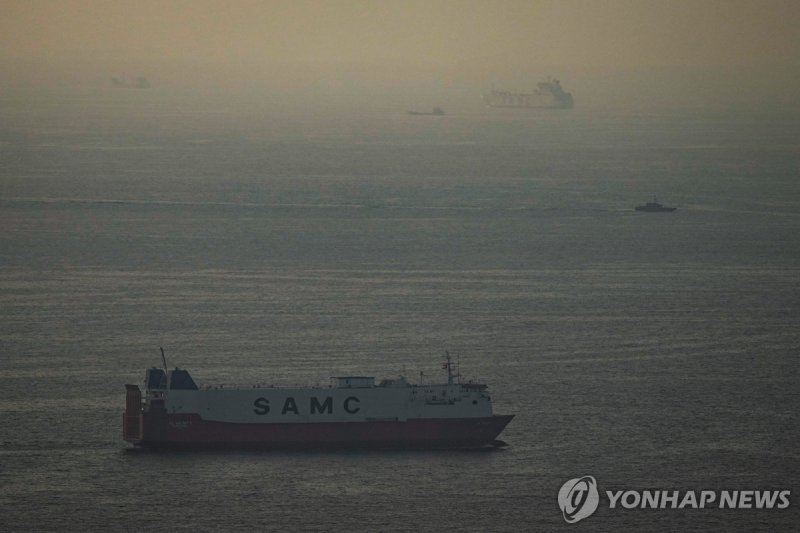
[The Financial News] Seven countries, including major European states, Japan, and Canada, issued a joint statement condemning Iran’s blockade of the Strait of Hormuz and mentioned the possibility of taking action. However, the move remained a political message only, as it did not include any concrete military support. Observers say it is a compromise intended to mollify United States President Donald Trump, who has expressed dissatisfaction with the allies’ cautious response.
On the 19th (local time), the United Kingdom of Great Britain and Northern Ireland (UK), France, Germany, Italy, the Netherlands, Japan, and Canada declared in a joint statement that they "condemn in the strongest terms the de facto closure of the Strait of Hormuz by Iranian forces." They called for an end to the laying of naval mines and to drone and missile attacks, stressing that disruptions to the energy supply chain pose a threat to international peace and security.
The statement added that the countries are "ready to contribute to appropriate efforts to ensure safe navigation routes." Yet it did not spell out any concrete measures such as dispatching warships or providing other military assets. In effect, it remained at the level of a declaration of principles.
The joint statement is widely seen as a political response meant to compensate for allies’ reluctance to join the U.S.-led maritime coalition to protect the Strait of Hormuz. Donald Trump had previously voiced strong displeasure at European allies’ refusal to send troops and at the lukewarm stance of the Republic of Korea, Japan, and others, saying that he "does not need anyone’s help."
In practice, the statement initially involved six countries, with Canada joining later, and the UK is reported to have led the push to broaden participation. Germany and France, which had been skeptical, came on board at the last minute, and Japan also added its name in the final stages. The Republic of Korea, by contrast, did not take part.
It remains unclear whether the statement will translate into concrete action. After it was released, Donald Trump met Japanese Prime Minister Sanae Takaichi at the White House and is reported to have asked Japan to play a greater role. Pressure on allied nations is likely to continue.
The Strait of Hormuz is a critical chokepoint through which more than 20% of the world’s seaborne crude oil passes. With Iran effectively blocking the strait, military tensions between the United States and the State of Israel on one side and Iran on the other have escalated, deepening instability in the energy supply chain. Recently, Iran and the State of Israel have attacked each other’s energy facilities, driving up oil and gas prices and heightening fears of a global energy crisis.
[email protected] Kim Kyung-min Reporter