[Editorial] Chain Shock Across Steel and Other Industries, Even Unions Warn of Crisis
- Input
- 2026-03-19 19:02:57
- Updated
- 2026-03-19 19:02:57
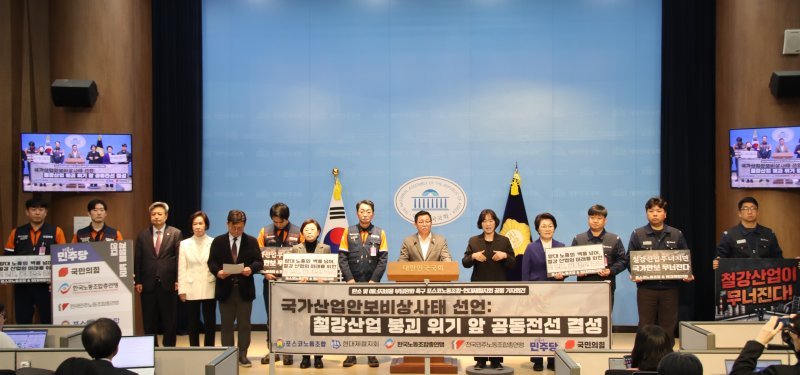
In fact, what the two unions demanded from the government that day was a cut in industrial electricity rates, expanded support for carbon neutrality, and greater public investment in eco‐friendly technologies. These are not the usual issues directly tied to wages or collective bargaining that unions typically put forward. Their stance appears to reflect a sense of alarm that, unless the industrial base is prevented from collapsing, any other negotiations will become meaningless.
Korea’s steel industry has already been in crisis due to overproduction by Chinese companies and a slump in the domestic construction market. Last year, the situation worsened when the United States decided to impose a high tariff of 50% on Korean steel, putting exports under serious strain. More recently, the Office of the United States Trade Representative (USTR) has even moved to impose additional tariffs based on Section 301 of the Trade Act of 1974. On top of this, the conflict involving the United States and Israel on one side and the Islamic Republic of Iran on the other has driven up maritime freight rates sharply.
Alongside steel, the petrochemical sector, another key industry, is also going through an unprecedented crisis. Concerns that the Islamic Republic of Iran may prolong its blockade of the Strait of Hormuz have disrupted supplies of naphtha, a core feedstock for petrochemicals. This instability in naphtha supply has led to a surge in prices for basic plastic materials, sending shockwaves across the broader industrial landscape. Polypropylene and polyethylene used in packaging for instant noodles and snacks are all produced from naphtha. As a result, the naphtha shortage is no longer a problem for a few companies but is spreading into a systemic challenge for entire industries.
The crisis in these key industries is inflicting serious damage on regional economies. Last year, Yeosu, South Jeolla Province, and Seosan, South Chungcheong Province, where petrochemicals are central, were designated as preemptive industrial crisis response zones, followed by declarations of crisis in Pohang, North Gyeongsang Province, and Gwangyang, South Jeolla Province, both major steel production bases. Recently, Dangjin, South Chungcheong Province, and Nam District, Ulsan, have also applied for designation as preemptive industrial crisis response zones, showing that the industrial crisis is spreading across regions without distinction.
Calls for strong government action are growing not only from unions but across industry as a whole. To weather the immediate crisis, it is urgent to temporarily ease the burden on companies by cutting energy costs and to secure time for industries to endure through measures such as trade‐risk responses and financial support. At the same time, the government must craft a comprehensive industrial strategy that includes transitioning to eco‐friendly production processes and stabilizing supply chains, so that the country can cope with technological change and geopolitical uncertainty. Emergency measures for industries in crisis and structural responses to enable a new leap forward must not be delayed any longer.