[Editorial] Social Safety Nets for Labor Flexibility Require Joint Efforts by the Public and Private Sectors
- Input
- 2026-03-19 19:02:55
- Updated
- 2026-03-19 19:02:55
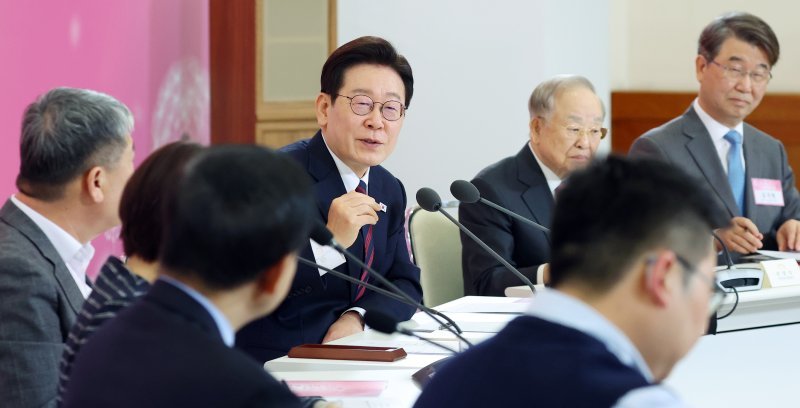
Labor-market flexibility was again on the agenda at the forum. For companies, more flexible labor practices are unavoidable if they are to secure productivity and manage their organizations sustainably. From their perspective, they cannot rely only on rigid permanent positions and are effectively compelled to hire non-regular workers with more flexible terms. For workers, however, easier dismissals that come with labor flexibility are a matter of life and death.
Pointing to this reality, Lee Jae-myung noted that society must listen carefully both to workers who say "dismissal means death" and to companies that complain of "rigid employment." He also stressed that it is wrong to demand unilateral sacrifice from workers. In effect, he acknowledged that, as in the past, achieving greater labor flexibility remains an extremely difficult task.
Lee Jae-myung went on to say, "It would be desirable for labor to concede on employment flexibility, while, in return, strengthening the social safety net to compensate for this, and having companies that benefit from greater employment flexibility shoulder the cost." He thus put forward one possible solution. He added, "Rather than forcing one side to bear all the losses, we should find a balance point through social compromise."
A social safety net is a safeguard that allows people in difficult circumstances, including those who have lost their jobs, to continue living as members of society. As a form of welfare, it is fundamentally a responsibility of the state. Lee Jae-myung is effectively saying that companies should bear the cost. He is proposing "expanding employment flexibility" and "strengthening the social safety net" as twin directions for reform, and this will require thorough debate before it can be translated into policy.
As Lee Jae-myung said, labor-management conflict must be resolved by removing mutual distrust and engaging in dialogue. The first step is to sit down together and exchange views on contentious issues. Without meeting face to face, no agreement or compromise can emerge. In this respect, it is regrettable that the Korean Confederation of Trade Unions (KCTU) did not take part in the launch of the ESLC. If the KCTU continues to stay away, even reforms in the style envisioned by Lee Jae-myung will not proceed smoothly. Any agreement produced by half-hearted dialogue is likely to falter midway, even if it is implemented.
Labor issues encompass a wide range of questions, starting with employment itself. They are inherently complex. Because the interests of labor and management diverge so sharply, it is often very difficult to reach agreement. Through a process of public deliberation in which citizens, workers, and businesses jointly design solutions, all stakeholders must work toward outcomes that are broadly acceptable.
Labor reform is about protecting workers’ rights while at the same time boosting corporate productivity and securing a sustainable path for the national economy. The moment decisions tilt too far to one side, competitiveness will inevitably erode.
Another task for the ESLC is to anticipate and prepare for how future industrial and social changes will affect the labor market. Demographic shifts and the introduction of artificial intelligence (AI) are prime examples. Low birth rates and population aging are already creating intergenerational conflicts over jobs. Efforts to introduce AI into workplaces are fueling job insecurity. In a country like ours, which faces a severe low birth rate and highly advanced industries, these are issues of critical importance.