Oil at $110, won at 1,501... Middle East conflict rattles global economy
- Input
- 2026-03-19 18:39:01
- Updated
- 2026-03-19 18:39:01
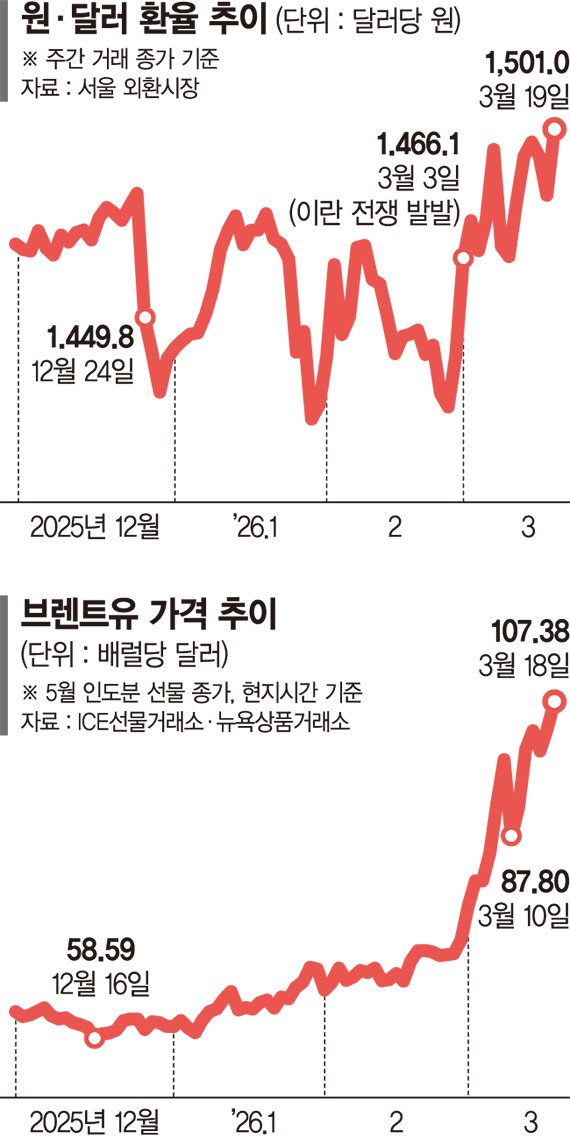
In Europe that day, May-delivery Brent Crude Oil futures settled at $107.38 per barrel, up 3.8% from the previous session, but prices then spiked in Asian trading. As of the morning session on the 19th, the price had surged to $112.86 per barrel. This was the first time in nine days, since the 9th, that Brent Crude Oil traded intraday in the $110-per-barrel range. April-delivery West Texas Intermediate crude oil (WTI) futures also reached $100.02 per barrel in Asian trading on the 19th. Citibank forecast that Brent Crude Oil could climb to $120 per barrel within days and average as high as $130 in both the second and third quarters of this year. At the same time, it warned of potential supply disruptions of 11–16 million barrels per day through April.
Oil prices spiked as the much-feared scenario of energy infrastructure in the Middle East coming under attack became reality. It was the first time since the war began on the 28th of last month that Israel has struck the Islamic Republic of Iran’s energy facilities. On the 18th, Israel bombed the South Pars gas field, the country’s largest natural gas field. In retaliation, the Islamic Republic of Iran attacked natural gas facilities in northern Ras Laffan Industrial City in Qatar, a key U.S. ally. These facilities account for 20% of global Liquefied Natural Gas (LNG) supply.
Startled by the escalation, U.S. President Donald Trump warned that if the Islamic Republic of Iran strikes Qatar’s LNG facilities again, he would order an unprecedented large-scale bombing to wipe out the Pars energy facilities. At the same time, he sent a message aimed at preventing further escalation, saying, "If the Islamic Republic of Iran does not carry out additional attacks on Qatar, there will be no further Israeli strikes on the South Pars gas field."
He also tried to calm the Islamic Republic of Iran and the markets, adding, "I had absolutely no knowledge of this attack on the South Pars gas field." With the Strait of Hormuz—through which 20% of the world’s seaborne oil passes—already blocked by the Islamic Republic of Iran, the additional attacks on energy facilities fueled growing fears of a wider conflict.
The won–dollar exchange rate opened and closed in the 1,500-won range. On the 19th at the Seoul Foreign Exchange Market, the rate finished at 1,501.0 won per dollar, up 17.9 won from the previous trading day. It opened at 1,505.0 won, 21.9 won higher than the day before, then fluctuated before easing slightly into the close. Both the opening and closing levels were the highest in 17 years, since March 10, 2009, during the global financial crisis, when the intraday rate hit 1,561.0 won.
Major Asian stock indexes also moved sharply lower. The Korea Composite Stock Price Index (KOSPI) closed at 5,763.22, down 161.81 points (2.73%) from the previous session. Japan’s Nikkei Stock Average (Nikkei 225) ended at 53,372.53, a drop of 1,866.87 points (3.4%) from the prior day. Spot gold, a representative safe-haven asset, fell about 2.9% as expectations for Fed rate cuts and concerns over inflation rose, and during the session it slid to its lowest level since February 6. On the New York Mercantile Exchange (NYMEX), April-delivery gold futures settled at $4,896.20 per ounce (31.1 g), down 2.2% from the previous session.
pjw@fnnews.com Park Jong-won Reporter