Australia Rapidly Emerging as Alternative Supplier of Ultra-Light Crude and LNG [U.S.–Iran War]
- Input
- 2026-03-19 18:37:33
- Updated
- 2026-03-19 18:37:33
■ Strengthening South Korea–Australia energy cooperation
According to industry sources on the 19th, Kim Jung-kwan, South Korea’s Minister of Trade, Industry and Energy, held a bilateral meeting with Madeleine King, Australia’s Minister for Resources and Northern Australia, on the sidelines of the Indo-Pacific Energy Security Ministerial and Business Forum (IPEM) in Tokyo on March 14–15. They discussed ways to expand energy cooperation. Foreign Minister Cho Hyun also spoke by phone with Penny Wong, Australia’s Minister of Foreign Affairs, to share concerns over crude supply instability stemming from the Middle East and to explore options for securing alternative supply chains. The two countries agreed to step up cooperation to stabilize energy and resource supply chains.
With the risk that Iran could block the Strait of Hormuz raising Middle East-related concerns, market attention is rapidly shifting toward Australia. Its relatively low geopolitical risk and the solid foundation of existing cooperation make it a highly realistic alternative supply source.
Australia is a leading producer of ultra-light crude in the Asia-Pacific region and has a strong advantage in supplying high value-added feedstock suitable for producing basic petrochemical feedstocks such as naphtha. Ultra-light crude has a high proportion of light components and low sulfur content, which makes it highly efficient to refine and a preferred feedstock for South Korea’s refining and petrochemical industries.
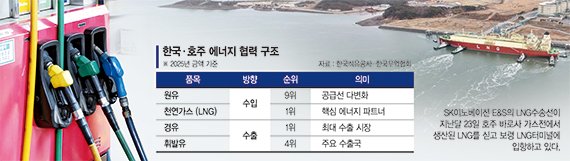
Recently, supply disruptions from the Middle East have spread from crude oil to naphtha, further highlighting the strategic importance of Australian ultra-light crude. According to the Korea National Oil Corporation (KNOC), Australia was South Korea’s ninth-largest crude supplier last year. In January this year, imports of ultra-light crude from Australia reached about 2.18 million barrels, up 7% from a year earlier.
■ Building an “energy value chain” with Australia
The two countries already have a strong foundation of cooperation in liquefied natural gas (LNG). Australia accounted for 32.8% of South Korea’s LNG imports last year, maintaining its position as the largest supplier, followed by Qatar (15.3%), Malaysia (15.0%), the United States of America (U.S.) (9.2%), and Russia (5.1%). In the downstream segment, including refining and sales, the complementary structure is also clear. Diesel produced by South Korean refiners is exported in large volumes to Australia, making it their biggest export market, and gasoline is also shipped there as one of the main export destinations. In effect, an “energy value chain partnership” has been established in which Australia supplies feedstock and South Korea supplies refined products.
Industry officials expect South Korea’s energy cooperation axis to tilt further toward Australia in light of the latest Middle East risks. An industry source noted, "As we need to diversify crude import sources to reduce dependence on the Middle East, Australia is the most practical alternative, given that cooperation is already in place from upstream to downstream." The source added, "Australia’s own supply capacity is constrained by reduced refining facilities, while South Korea has strong refining competitiveness, so the two sides are highly complementary."
South Korean companies are also moving quickly. SK Innovation E&S has begun importing LNG produced at the Barossa gas field in Australia, securing a long-term supply chain. This is the first time a South Korean private company has handled the entire process—from overseas gas field exploration and development to production and import—to bring in LNG.
POSCO International is operating the Senex Energy gas field in Queensland, Australia. Senex Energy is an onshore gas field that POSCO International acquired in 2022 for about 400 billion won, and it has recently expanded its production to around 1.2 million tons.
solidkjy@fnnews.com Reporter Koo Ja-yoon Reporter