First Shareholders’ Meeting Season After Third Amendment Bill to the Commercial Act Passes: Investors Race to Find Beneficiaries
- Input
- 2026-03-19 18:26:20
- Updated
- 2026-03-19 18:26:20
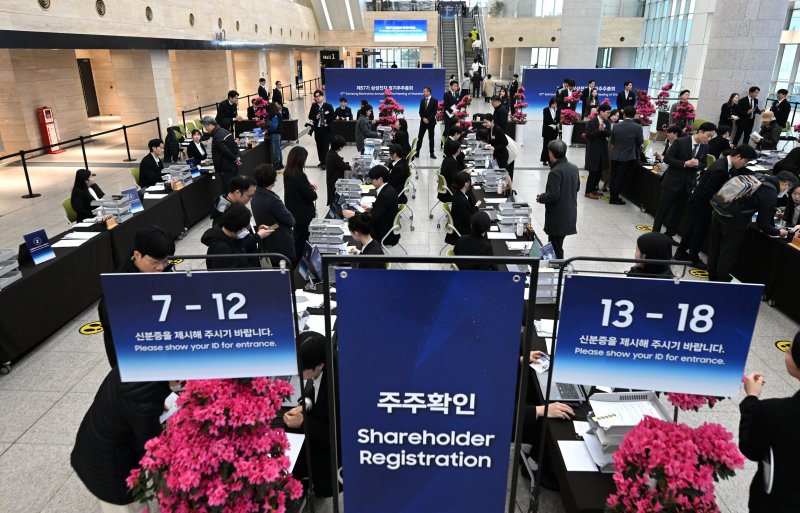
According to Korea Securities Depository (KSD) on the 19th, 1,573 out of 2,727 listed companies with December year-ends will hold their annual general meetings next week (March 23–29). Samsung Electronics, which held its meeting on the 18th, announced a plan to cancel treasury shares and decided on an additional dividend of 1.3 trillion won on top of last year’s regular annual dividend of 9.8 trillion won. On the same day, Samsung Electronics’ share price closed at 208,500 won, up 7.53% from the previous session.
Investors are most focused on the cancellation of treasury shares. Interest has grown in companies with a high proportion of treasury stock after the Third Amendment Bill to the Commercial Act, which makes such cancellations mandatory, was passed. In fact, from January this year through the 19th, 165 listed companies have announced plans to cancel treasury shares, more than double last year’s total of 70.
Kang Hyun-gi, an analyst at DB Securities, stated, "Due to recent events such as the Iran crisis, the forward price-to-earnings ratio (PER) of the KOSPI has fallen below its long-term average, which may have diluted the momentum from the Commercial Act amendments." He added, "It is worth paying attention to holding companies such as Lotte Corporation, SK Group, Doosan Group and LS Group, as well as financial stocks like Mirae Asset Securities, DB Insurance, Samsung Fire & Marine Insurance and Hyundai Marine & Fire Insurance."
Lee Sung-hoon, analyst at Kiwoom Securities, commented, "Sectors such as securities, insurance, utilities, holding companies and steel, which have low price-to-book ratios (PBR) and high treasury-share holdings, are expected to continue benefiting from the first through third Commercial Act amendments and subsequent policy measures."
However, experts caution that simply holding a large amount of treasury stock does not automatically make a company a beneficiary. This is because companies may add exception clauses such as "for business purposes" under the Commercial Act to their articles of association in order to avoid cancelling those shares.
The securities industry also stresses the need to pay attention to companies like Celltrion and KT&G, which are focusing more on securing future growth engines than on immediate shareholder returns.
Celltrion has announced that it will cancel 65% of its treasury shares, excluding those earmarked for employee compensation, while using the remaining 35% as a "growth engine." KT&G, immediately after the Third Amendment Bill to the Commercial Act passed, declared that it would cancel all of its treasury shares. At the same time, it submitted an agenda item to add a clause to its articles of association stating that the company may hold or dispose of treasury shares "when necessary for business purposes, such as adopting new technologies or improving the financial structure."
With the so-called "stock-price suppression prevention law" and the mandatory value-up disclosures for low-PBR listed companies being pursued in parallel, some analysts predict that the low-PBR theme could spread to small and mid-cap stocks.
Lee predicted, "If the relevant bills pass, the range of policy beneficiaries—currently concentrated in some large-cap financial and holding companies—could expand to individual stocks." He added, "When we break down the share of companies with a PBR below 0.8 times, small caps account for 50.2%, mid caps 22.5% and large caps 9.5%. This suggests that the low-PBR theme will increasingly spread to small and mid-cap stocks."
Kyung-yeon Lee, an analyst at Daishin Securities, said, "With the amendment to the Restriction of Special Taxation Act, the provision of 'free-float market capitalization' data and participation in 'value-up disclosures' are both expanding." Lee added, "We expect this to help improve market accessibility for Korean equities in discussions on inclusion in the MSCI Developed Markets Index by Morgan Stanley Capital International (MSCI)."
[email protected] Han Young-joon Reporter