‘Energy War’ Intensifies... U.S. Holds Rates Amid Inflation and Growth Fears [Iran War]
- Input
- 2026-03-19 18:21:20
- Updated
- 2026-03-19 18:21:20
■ "The economy cannot withstand $100 oil"
In an interview with the Financial Times (FT) on the 18th (local time), Antoni said, "The U.S. economy is not in a position to withstand oil at $100 a barrel." He added, "The economy is weaker than we think, and inflation is more severe," noting that "if last year’s lower energy prices helped keep inflation in check, the situation has now reversed and energy will instead exert broad upward pressure on prices."
Jerome Hayden Powell, chair of the Federal Reserve System (the Fed), also remarked at the press briefing that "over the past five years, we have experienced tariff shocks and a pandemic, and now we are facing an energy shock of considerable magnitude and duration." He continued, "We do not know how exactly that shock will play out," and added, "We are concerned that this situation could adversely affect inflation expectations."
Barclays recently estimated that a 10% rise in oil prices would push up the U.S. inflation rate by about 0.2 percentage points within one to two months. If oil stays above $100 a barrel for two to three months, it warned, inflation could surge to an annualized 3.5% by this summer and end the year slightly above 3%. The Producer Price Index (PPI) for February, released the same day, already jumped 0.7% from the previous month, far exceeding the market consensus of 0.3%.
■ Slowing growth and weakening employment
Warning signs are already visible across the economy. U.S. growth in the fourth quarter of last year slowed sharply to an annualized 0.7%, down from 4.4% in the previous quarter. Labor market conditions are also cooling rapidly. In February, U.S. nonfarm payrolls fell by 92,000 from the previous month, the largest decline since December 2020, when jobs dropped by 185,000 in the immediate aftermath of the COVID-19 pandemic.
Joseph Eugene Stiglitz, a Columbia University professor and recipient of the Sveriges Riksbank Prize in Economic Sciences in Memory of Alfred Nobel, warned that the U.S. economy is facing a risk of stagflation—high inflation combined with recession. "Prices are rising due first to tariffs and now to the impact of war, while growth momentum is weakening," he said. Goldman Sachs projects that if oil prices rise by $10 a barrel and remain elevated through year-end, annual Gross Domestic Product (GDP) growth will fall by about 0.1 percentage points.
Concerns about stagflation are spreading particularly fast. The Iran War is squeezing both energy and financial markets, bringing inflation fears and growth risks to the forefront at the same time. Some analysts warn that if energy costs stay high for an extended period, stagflation—where recession and rising prices occur together—could materialize. Caspar Hense, a portfolio manager at RBC BlueBay Asset Management, told Reuters, "The risk of a repeat of the 1970s is increasing," adding, "If the war drags on and oil prices rise much further, the safe-haven status of government bonds could be shaken, and all asset classes could be affected."
■ Fed leaves benchmark rate at 3.50–3.75%
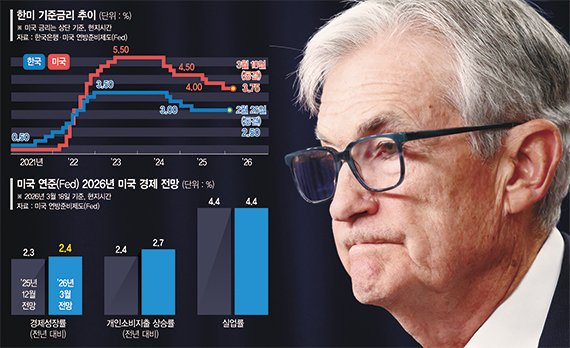
Meanwhile, on the same day the Fed kept its benchmark interest rate unchanged at 3.50–3.75%. At its Federal Open Market Committee (FOMC) regular meeting, which concluded that day, the committee voted 11–1 to hold the rate at this level. It was the second consecutive decision to leave rates unchanged this year, following January.
In its statement, the Fed stressed uncertainty, saying that "the implications of developments in the Middle East for the U.S. economy are uncertain." It also noted that "inflation remains somewhat elevated." However, the Fed kept its year-end median projection for the policy rate at 3.4%, the same level as in its December forecast. This is being interpreted as signaling the possibility of one rate cut before the end of the year.
[email protected] Reporter