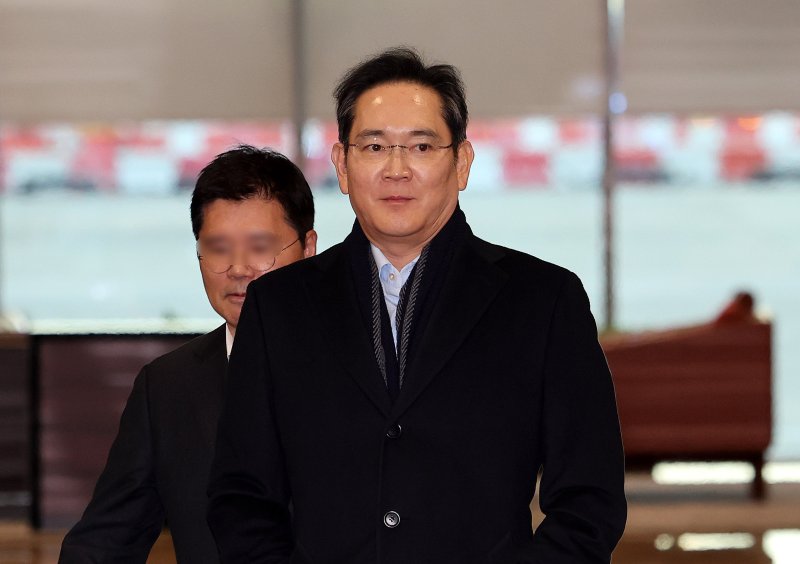
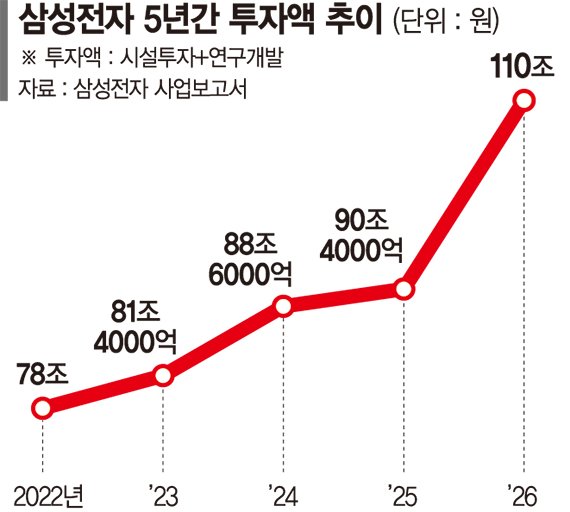
Lee Jae-yong, chairman of Samsung Electronics. News1 Samsung Electronics will invest more than 110 trillion won this year in facilities and research and development (R&D) as it moves to secure leadership in the era of AI semiconductors. Its annual investment will exceed 100 trillion won for the first time, marking the largest amount in the company’s history. The move is seen as an aggressive step to reshape the AI semiconductor market landscape. Samsung Electronics also plans to accelerate mergers and acquisitions (M&A) to secure future growth engines.
On the 19th, Samsung Electronics confirmed and announced an investment plan of 110 trillion won in facilities and R&D, the largest scale ever, through a disclosure titled “Plan to Enhance Corporate Value.” This represents an increase of about 21.6% from last year’s 90.4 trillion won and is the biggest investment since the company was founded.
AI semiconductor ‘super-gap’ strategy acceleratesJun Young-hyun, vice chairman and head of the Device Solutions Division at Samsung Electronics, stated, “As the world’s only semiconductor company that has all three—memory semiconductors, foundry, and advanced packaging—we will secure leadership in the AI semiconductor era.” By expanding investment, Samsung Electronics intends to cement its position in high-value memory markets, including High Bandwidth Memory (HBM), and build a commanding lead in AI semiconductors.
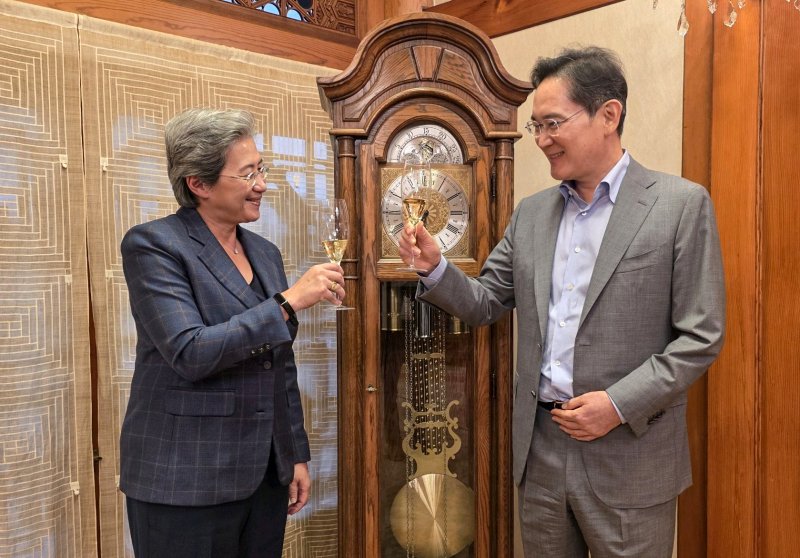
Lee Jae-yong, chairman of Samsung Electronics, and Lisa Su, CEO of Advanced Micro Devices (AMD), raise their glasses for a commemorative photo on the 18th at Seungjiwon, Samsung Group’s VIP guest house, in Itaewon, Seoul. Photo courtesy of Samsung Electronics. The company appears to be ramping up investment in line with the semiconductor supercycle. Last month, Samsung Electronics became the first in the world to supply High Bandwidth Memory 4 (HBM4) to Nvidia, and it has also been selected by AMD, Nvidia’s main rival, as a priority supplier of HBM4. Beyond memory semiconductors, its foundry business is also expanding its client base for advanced process orders to companies such as Tesla, Nvidia, and Google. At the shareholders’ meeting the previous day, Han Jinman, head of the foundry business, highlighted the recent rise in Samsung’s status in the global semiconductor market and hinted at an upswing cycle, saying, “Please wait just one to two more years.”
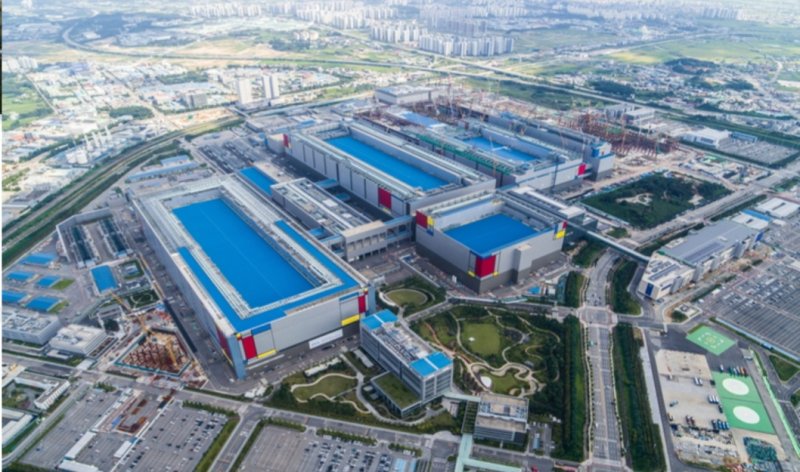
Most of the 110 trillion won investment is expected to be made in Korea. At the group level, Samsung announced last November that it would invest 450 trillion won domestically over five years. The latest plan is expected to give momentum to the construction of Line 5 at the Pyeongtaek campus, the Yongin Semiconductor Cluster, and the Samsung Taylor Semiconductor Fab in the United States. Line 5, which will be newly built in the second complex of the Pyeongtaek campus, is scheduled to begin full-scale operations in 2028. Samsung plans to turn Pyeongtaek into a core global semiconductor production base. The Samsung Taylor Semiconductor Fab will start producing advanced AI semiconductors for Tesla and others in the second half of next year.
A Samsung Electronics official said, “As the global AI era takes off in earnest, we expect mid- to long-term demand for memory semiconductors to grow, and we plan to secure production lines in advance so we can respond quickly to changes in the market.”
Samsung Electronics’ semiconductor plant in Pyeongtaek. Photo courtesy of Samsung Electronics. Trillion-won M&A to gain speedTrillion-won mergers and acquisitions are also expected to pick up pace. Samsung Electronics announced that it will pursue sizable M&A deals in future growth areas such as advanced robotics, medtech, automotive electronics, and Heating, Ventilation, and Air Conditioning (HVAC). Last year, it acquired German HVAC company FläktGroup for 1.5 billion euros (about 2.5 trillion won), the Advanced Driver-Assistance System (ADAS) business unit of German auto parts maker ZF Friedrichshafen (ZF) for about 2.5 trillion won, and the audio business of Masimo Corporation in the United States for 350 million dollars (about 500 billion won). The company is expected to continue to make its presence felt in the global M&A market this year. In particular, there are growing expectations for additional M&A in the humanoid robotics field. Samsung Electronics plans to deploy manufacturing robots at major factories around the world and aims to transform its semiconductor plants into “autonomous factories” based on AI, robotics, and Digital Twin technology by 2030.
ehcho@fnnews.com Jo Eun-hyo, Lim Su-bin Reporter