"Chilled by the Middle East war"... Chung Dong-young says "Lee administration has prevented the war from spilling over"
- Input
- 2026-03-19 11:21:49
- Updated
- 2026-03-19 11:21:49
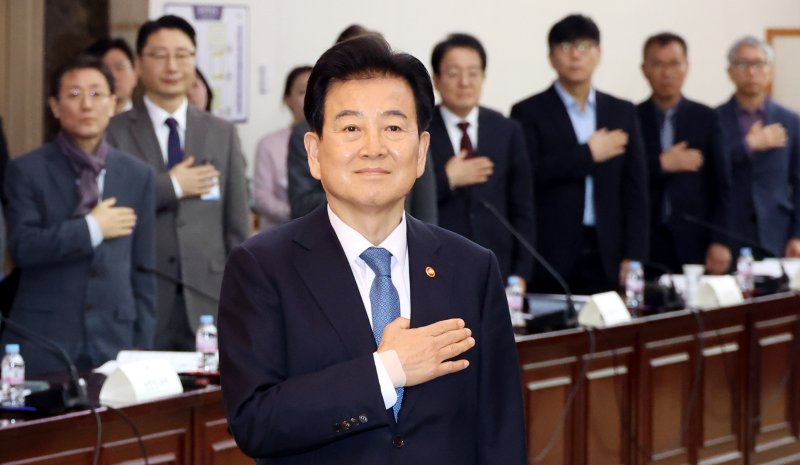
The government stated that it will continue its peace policy by ending the negative line of hostile confrontation between the two Koreas and realizing independent defense through the transfer of wartime operational control.
Chung added, "Inter-Korean relations are currently in ruins. It is impossible not to speak of the failure of South Korean politics," saying he feels a deep sense of shame.
The Committee for the Development of Inter-Korean Relations meeting chaired by Chung that day consisted of 15 government members from ministries and agencies including the Ministry of Foreign Affairs, the Ministry of National Defense of the Republic of Korea, the National Intelligence Service (NIS), the Ministry of Finance and Economy, the Ministry of Science and ICT, and the Ministry of Land, Infrastructure and Transport, along with 15 civilian members.
The Committee for the Development of Inter-Korean Relations reviewed a draft of the Fifth Basic Plan (2026–2030), which sets out the direction for the development of inter-Korean relations over the next five years.
The draft of the Fifth Basic Plan is a mid- to long-term comprehensive plan to implement the Korean Peninsula Peaceful Coexistence Policy of the Lee administration. It confirms a basic direction of redefining inter-Korean relations as a peaceful coexistence that aims toward unification. It presents the vision of "peaceful coexistence and joint growth on the Korean Peninsula" and three goals: "institutionalizing peaceful coexistence between the two Koreas," "building a foundation for joint growth on the Korean Peninsula," and "realizing a Korean Peninsula free of war and nuclear weapons." It also sets out three guiding principles: "respecting the DPRK's system," "not pursuing unification by absorption," and "not pursuing hostile acts."
The plan identifies six key tasks: redefining inter-Korean relations based on reconciliation and cooperation and institutionalizing peaceful coexistence; seeking a resolution to the North Korean nuclear issue and progress toward a peace regime on the Korean Peninsula; promoting mutually beneficial inter-Korean exchanges and cooperation that win public support; alleviating the suffering caused by division and resolving humanitarian issues; preparing for a future of a peace economy and joint growth on the Korean Peninsula; and expanding public participation and international cooperation to build consensus on peace and unification.
The Ministry of Unification (MOU) plans to finalize the draft of the Fifth Basic Plan, reflecting the discussions at the Committee for the Development of Inter-Korean Relations, through a vice-ministerial meeting and a Cabinet meeting, then report it to the National Assembly of the Republic of Korea and release it to the public.
[email protected] Kim Kyung-soo Reporter