Ruling Party and Government Seek to Turn Middle East Crisis into Opportunity to Reshape Stock Market
- Input
- 2026-03-19 10:54:40
- Updated
- 2026-03-19 10:54:40
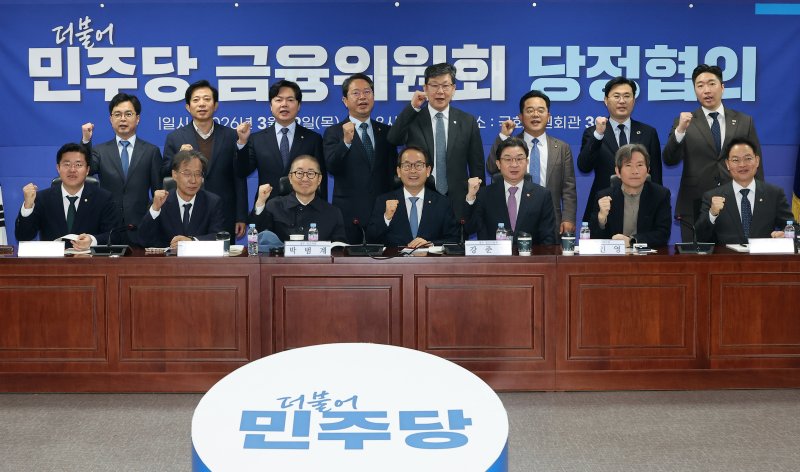
[Financial News] Lawmakers on the National Policy Committee from the Democratic Party of Korea and the Financial Services Commission agreed on the 19th to treat the blow to the domestic stock market from the Middle East crisis as an opportunity to strengthen its fundamentals. They plan to protect shareholders by responding forcefully to unfair practices, including by boosting rewards for reporting stock-price manipulation, and to push innovation in the stock market through measures such as expanding special listings for technology firms.
At the meeting held at the National Assembly, the ruling party and government discussed ways to improve the structure of the capital market. The agenda included restoring confidence in the stock market, enhancing shareholder protection, promoting capital-market innovation, and improving access to the capital market.
As a first step, they decided to significantly increase rewards for reporting stock-price manipulation. To better protect shareholders, they will also prohibit multiple listings by companies, and expand this ban to include split listings and mergers and acquisitions aimed at expanding controlling shareholders’ influence.
If stock-price manipulation is uncovered, rewards for whistleblowers will be strengthened and the size of joint investigation teams will be greatly increased. In addition, the government plans to introduce employment restrictions at listed companies for those responsible for accounting fraud and other illegal acts.
The ruling party and government also agreed to draw up measures to prevent stock-price suppression, including publishing a list of low price-to-book ratio (PBR) companies. They believe that disclosing such a list will put pressure on companies by influencing investors’ decisions and prompting them to consider withdrawing capital. As part of efforts to strengthen the Stewardship Code, they will introduce performance reviews of its implementation to encourage more active shareholder engagement by institutional investors.
To foster innovation in the stock market, they will expand tailored special listings for technology companies to enhance the competitiveness of the KOSDAQ (Korean Securities Dealers Automated Quotations) market. Companies in Artificial Intelligence (AI), robots, content, and Information Technology (IT) are expected to be key beneficiaries. The Financial Services Commission also reported to the party that it is preparing an investment allocation strategy for the National Growth Fund, a policy initiative of the Lee Jae-myung administration. The separation of KOSDAQ into segments and the incubating function for KONEX-listed firms are also expected to be strengthened.
They will work to improve access to the stock market as well. With the number of individual investors in Korea having reached 15 million, the authorities plan to strengthen financial education programs.
Democratic Party lawmakers on the National Policy Committee also offered recommendations regarding the process of drawing up the government’s supplementary budget proposal. In particular, they urged the Financial Services Commission to ensure that funds are allocated to support small and medium-sized enterprises and small business owners by making use of institutions under the committee’s purview, such as the Industrial Bank of Korea (IBK).
They also discussed partially refunding interest payments for diligent borrowers who are using relatively high-interest policy finance products, such as the Sunshine Loan and the Special Guarantee Program for Lowest-Credit Borrowers offered by the Korea Inclusive Finance Agency.
The ruling party and government also aligned their positions on key bills to be handled during the March extraordinary session of the National Assembly. These include amendments to the Special Act on the Prevention of Loss Caused by Telecommunications-Based Financial Fraud and Refund for Loss, which would introduce a no-fault compensation system to prevent and eradicate Voice phishing (vishing); revisions to the Electronic Financial Transactions Act; amendments to the Credit Information Use and Protection Act to support livelihoods and expand inclusive finance; and several amendments to the Financial Investment Services and Capital Markets Act.
Democratic Party lawmakers on the National Policy Committee stated that they will convene subcommittee meetings starting on the 31st of this month to begin full-scale deliberations on these bills.
[email protected] Kim Hyeong-gu Reporter