3,000 visitors flock to Samsung Electronics booth at GTC: spotlight on HBM4 and Groq wafers
- Input
- 2026-03-19 11:06:47
- Updated
- 2026-03-19 11:06:47
[Financial News] "AMAZING High Bandwidth Memory (HBM)4!" (a handwritten inscription by Nvidia CEO Jensen Huang).
During NVIDIA GTC 2026, where Samsung Electronics ran its exhibition booth for four days starting on March 16 (local time), the company showcased cutting-edge memory technologies such as High Bandwidth Memory 4 (HBM4) and Groq, drawing intense interest from global visitors and underscoring its presence in the artificial intelligence (AI) memory market.
According to industry sources on the 19th, Samsung Electronics set up a booth of about 37 square meters at NVIDIA GTC 2026 to welcome global big tech customers and general attendees. Over the first two days, March 16–17, the cumulative number of visitors reached around 1,500, already surpassing last year’s 1,400. By the end of the event, the total visitor count was expected to exceed 3,000.
The strong interest in this year’s Samsung Electronics booth is seen as a result of its differentiated product competitiveness and technology, which stood out on site. In particular, recent changes in the market environment, including memory shortages, appear to have further heightened attention on Samsung’s memory capabilities.
The Samsung Electronics booth was organized around three themes—AI Factory, Local AI, and Physical AI—providing a multidimensional showcase of the company’s memory solutions that maximize AI performance on Nvidia platforms.
In the AI Factory zone, Samsung exhibited LPDDR5X (Low Power Double Data Rate 5X), SOCAMM2, GDDR7, the Samsung PM1763 enterprise SSD, and the Samsung PM1753 enterprise SSD, presenting a memory portfolio for next-generation AI data centers where both training and inference are increasingly critical.
In the Local AI zone, the company showcased Low-Power Double Data Rate 6 (LPDDR6), optimized for on-device AI, along with compact form-factor storage solutions such as the Samsung PM9E1 solid-state drive and Samsung PM9E3, which can be used in personal AI supercomputers like NVIDIA DGX Spark and NVIDIA DGX Station.
In the Physical AI zone, Samsung displayed automotive memory products such as Automotive LPDDR5X and detachable AutoSSD that support the NVIDIA DRIVE AGX platform, emphasizing technology that can extend beyond mobility into robotics.
The three zones were arranged in a sequential viewing path so that visitors could directly experience Samsung Electronics’ integrated memory capabilities that maximize the performance of Nvidia platforms.
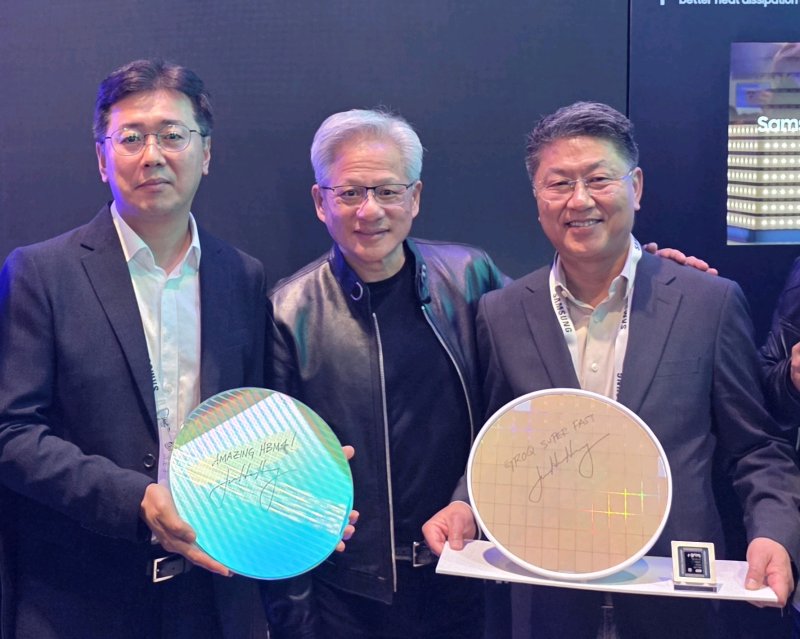
Samsung Electronics has expanded its collaboration with Nvidia by participating in GTC for three consecutive years. Following 2024 and last year, Jensen Huang again visited the Samsung booth this year.
The areas that drew the most attention from visitors at this exhibition were the "NVIDIA Gallery" and the "Game Zone."
The NVIDIA Gallery featured physical displays of key memory solutions that make up the next-generation AI platform, the NVIDIA Vera Rubin platform, including HBM4, SOCAMM2, and the Samsung PM1763 enterprise SSD. Interest was particularly strong in HBM4, the industry’s first to be mass-produced and shipped.
In addition, the "HBM4 Hero Wall," which brought together HBM4E (High Bandwidth Memory 4E), unveiled by Samsung as the world’s first, and HBM4, the world’s first to enter mass production and shipment, became a centerpiece of the booth and a major draw for visitors.
After Jensen Huang remarked in his opening keynote that "Samsung is manufacturing the Groq chip," interest in the wafer display implementing this chip surged, and related questions continued on site.
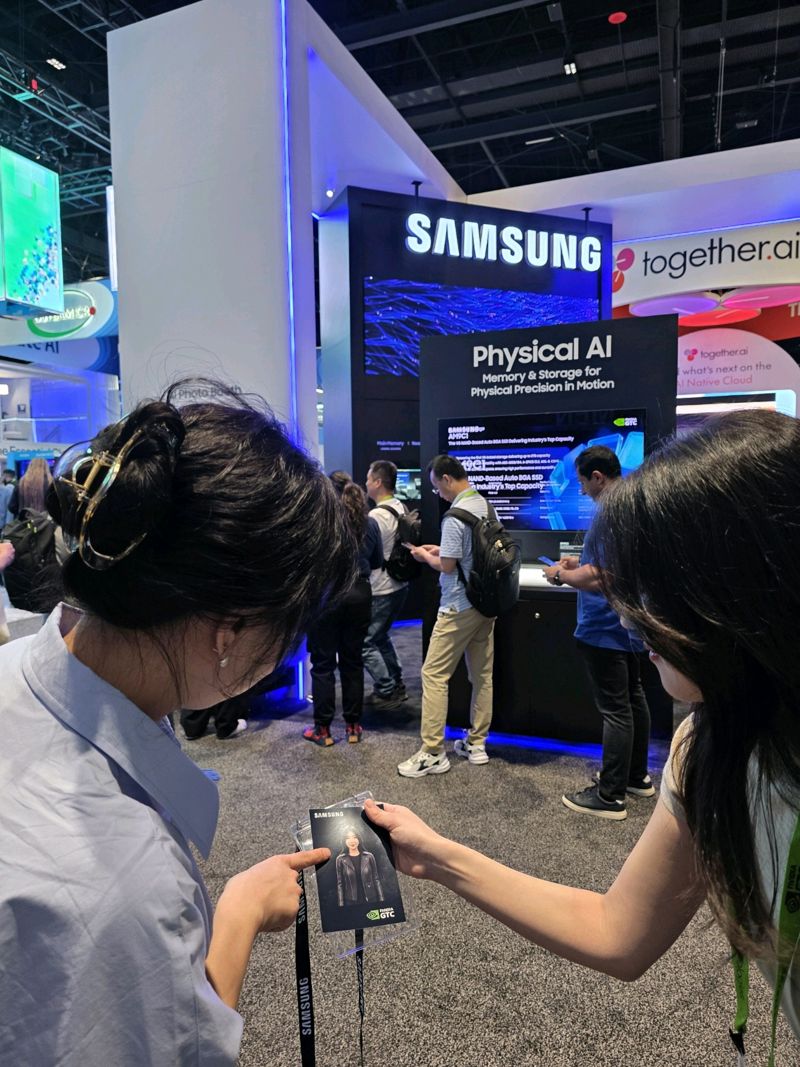
Meanwhile, in the Game Zone, visitors could take photos with an AI-powered camera and instantly receive printouts transformed to show them wearing Jensen Huang’s trademark leather jacket, an interactive event that generated high participation and enthusiastic responses.
A Samsung Electronics representative stated, "Through this GTC exhibition, we demonstrated on site our next-generation memory technology leadership and our solid partnership within the global AI ecosystem as a core partner of Nvidia."
soup@fnnews.com Im Su-bin Reporter