Knowledge Services Trade Balance in Deficit, but Seen as 'Investment for the Future'
- Input
- 2026-03-19 12:00:00
- Updated
- 2026-03-19 12:00:00
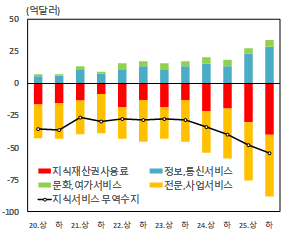
However, the Bank of Korea (BOK) explained that this was mainly because companies purchased property rights and Research and Development (R&D) services needed to produce and then export advanced technologies such as semiconductors.
In effect, the deficit represents investment costs for the future.
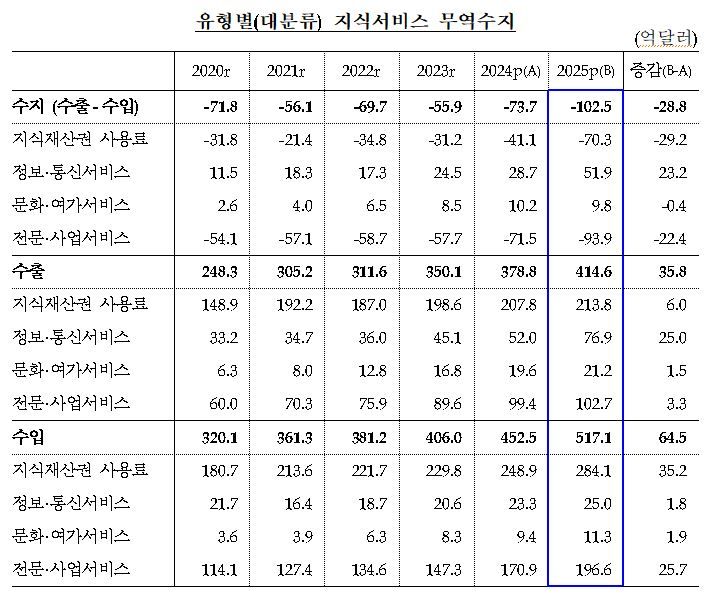
According to the "2025 Knowledge Services Trade Statistics" released by the BOK on the 19th, the knowledge services trade balance posted a provisional deficit of 10.25 billion dollars last year.
Exports came to 41.46 billion dollars, while imports reached 51.71 billion dollars.
The deficit widened by nearly 40% from the previous year's 7.37 billion dollars and marked the fourth-largest shortfall since statistics began in 2010.
By type, there was a surplus in information and communications services (5.19 billion dollars) and Cultural and Leisure Services (980 million dollars).
The former logged its largest surplus since records began, driven by a sharp increase in exports from the electrical and electronics manufacturing industry.
The latter benefited from continued growth in exports of public performance and exhibition-related services, including revenues from the success of K-content and K-pop concerts, which have risen for four consecutive years.
In contrast, Professional and Business Services (a deficit of 9.39 billion dollars) and royalties for the use of intellectual property rights (a deficit of 7.03 billion dollars) were in the red.
Within royalties for the use of intellectual property rights, R&D-based rights (a deficit of 2.6 billion dollars) and Computer and Mobile Software (a deficit of 4.2 billion dollars) both showed deficits.
These widened from a year earlier due to increased patent royalty payments to overseas firms and higher purchases through global app stores.
Park Sung-gon, head of the Balance of Payments Statistics Team at Economic Statistics Department 1 of the BOK, stated, "Despite the strong performance in information and communications services, the trade balance turned to a deficit because imports of R&D-related royalties for the use of intellectual property rights and Professional and Business Services such as legal, accounting, and advertising grew more than exports."
He explained, "This is an inevitable development, as it is essential for domestic companies to expand production and investment and to strengthen their global competitiveness."
Park went on to say, "To produce or export knowledge services, you need to import services, turn them into value-added products, and then export or consume them again." He added, "Because Korea's export basket has recently become centered on advanced technologies such as semiconductors and smartphones, there are many cases where industrial property rights and R&D services must be brought in." By industry, there was a surplus in the Information and communications industry (2.43 billion dollars) and automobiles (570 million dollars), while deficits were recorded in digital intermediation platforms (5.79 billion dollars), other services (3.9 billion dollars), and the manufacturing industry (3.4 billion dollars). By type of institution, mid-sized company (a surplus of 1.98 billion dollars), small enterprise (280 million dollars), micro enterprise (210 million dollars), and individuals and others (840 million dollars) all recorded surpluses. Large corporation (a deficit of 6.72 billion dollars) and mid-sized enterprises (a deficit of 1.05 billion dollars) were in deficit. In particular, digital intermediation platforms alone posted a deficit of 5.79 billion dollars. By region, only Asia (a surplus of 6.9 billion dollars) and Latin America (410 million dollars) were in surplus. North America (a deficit of 7.72 billion dollars), Europe (a deficit of 3.69 billion dollars), and the Middle East (a deficit of 220 million dollars) all recorded deficits. Transactions classified as "Nationality not specified," which include multiple nationalities routed through digital intermediation platforms, also showed a deficit of 5.79 billion dollars. An analysis of knowledge services trade between residents in the ICT services industry—defined under the Integrated ICT Classification of the Ministry of Science and ICT—and non-residents showed that last year's knowledge services trade balance for the information and communications technology (ICT) industry recorded a surplus of 2.34 billion dollars. Exports reached 12.67 billion dollars, while imports stood at 10.33 billion dollars. There were deficits in Information service activities (1.32 billion dollars) and packaged software (1.08 billion dollars), while the Game software development and production industry (3.97 billion dollars) and digital content (1.1 billion dollars) recorded surpluses. According to the content industry special classification statistics of the Ministry of Culture, Sports and Tourism (MCST), the content industry knowledge services trade balance posted a surplus of 4.41 billion dollars. Exports amounted to 11.29 billion dollars, far exceeding imports of 6.89 billion dollars. The knowledge and information industry (a deficit of 1.85 billion dollars) and the advertising industry (a deficit of 360 million dollars) were in the red, while the game industry (a surplus of 4.13 billion dollars), music industry (1.28 billion dollars), and broadcasting and video industry (670 million dollars) all recorded surpluses. Under the special classification statistics for intellectual property, last year's trade balance in Intellectual Property Right (IPR) recorded a deficit of 3.13 billion dollars. Exports totaled 30.08 billion dollars, but imports surpassed this at 33.21 billion dollars. There was a surplus in Copyright (520 million dollars), while industrial property rights posted a deficit of 3.46 billion dollars.
[email protected] Kim Tae-il Reporter