[Editorial] As the energy security crisis deepens, Korea must focus on securing supply chains
- Input
- 2026-03-18 18:34:00
- Updated
- 2026-03-18 18:34:00
International oil prices and raw material prices continue to surge. On the 17th (local time), the futures price of Brent Crude Oil, the global benchmark, jumped more than 3 percent from the previous session to exceed 103 dollars per barrel. Brent Crude Oil has now stayed above 100 dollars for four consecutive days. West Texas Intermediate crude oil (WTI) also rose nearly 3 percent, closing at 96 dollars. There have been reports that some countries’ oil tankers have begun to pass through the Strait of Hormuz on a limited basis, but this is not enough to turn the situation around. Oil-producing countries in the Middle East, whose exports are blocked, are cutting production, leaving oil prices on an inevitably unstable trajectory.
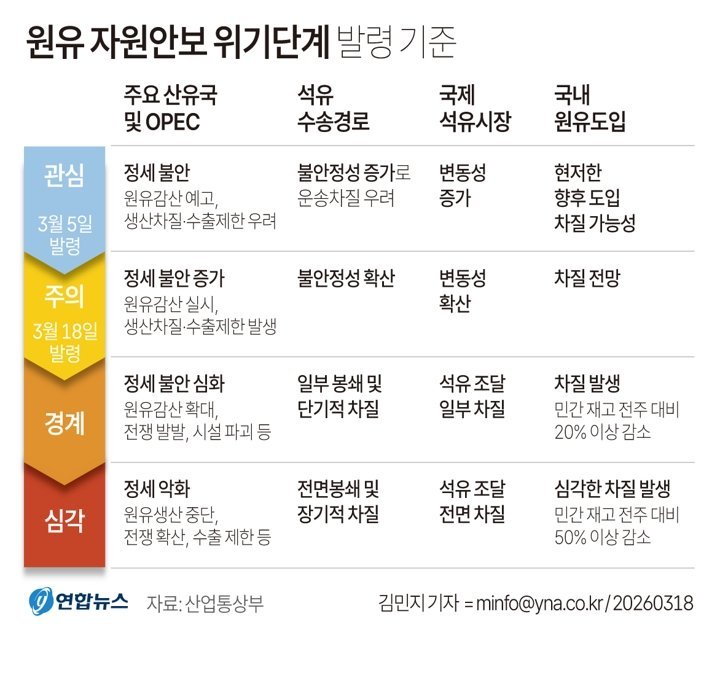
On the 18th, the government raised its resource security alert level for crude oil from "attention" to "caution." It also announced plans to strengthen support for supply chains, including temporarily designating Naphtha, which is in acute shortage, as an economic security item. Naphtha, often called the "rice of industry," is a key feedstock for producing basic petrochemical products such as Ethylene and Propylene. If stocks of Naphtha and Ethylene run dry, warning lights will start flashing for Korea’s core manufacturing engines, including semiconductors and automobiles.
Naphtha, like crude oil, is heavily dependent on the Middle East. Sixty percent of the Naphtha imported into Korea passes through the Strait of Hormuz. The remaining 40 percent is produced by domestic oil refining companies, but shipments of crude oil from the Middle East are also being disrupted, leaving on-site operations in a nerve-racking, day-by-day struggle. The government must immediately deploy every available policy tool to strengthen its response capacity.
It is fortunate that Korea has finalized a deal to import an additional 18 million barrels of crude oil from the United Arab Emirates (UAE). Kang Hoon-sik, Chief of Staff to the President of the Republic of Korea, disclosed this agreement upon returning from a visit to the UAE as a special envoy for strategic economic cooperation. Under the deal, the two countries agreed that three UAE-flagged vessels will deliver 6 million barrels and six Korean-flagged vessels will carry 12 million barrels of crude oil. Adding the previously pledged 6 million barrels, Korea will now be able to import a total of 24 million barrels from the UAE.
Korea is effectively in a state of emergency over energy security. It is only natural that the government must actively work on the ground to secure new supply channels. Looking ahead, it should expand the operation of nuclear power plants, which are free from transport risks, and push more aggressively for energy-saving measures. More fundamentally, Korea must move quickly to devise reforms that break its heavy dependence on energy and resources from specific countries. Diversifying crude oil and raw material supply chains, which are now overly concentrated on the Middle East and China, is an urgent task.
According to the Korea Institute for International Economic Policy (KIEP), all of the Bromine used in domestic semiconductor processes is sourced from the Middle East. Bromine is a key material used in semiconductor wafer etching. Seventy percent of the Helium used in wafer cooling processes also comes from the Middle East. For 41 strategic materials used in rechargeable batteries, chemicals and other sectors, more than 70 percent of imports originate in the Middle East. The share of Chinese supplies in core minerals such as rare-earth elements (REE) and Graphite also remains overwhelming. The supply chain crisis is not a temporary shock but a structural problem. Korea must urgently explore a wide range of options to secure its supply chains before the damage becomes even greater.