Lee: "Revitalizing the capital market will ease real estate concentration... South Korea’s geopolitical risk is overstated"
- Input
- 2026-03-18 15:05:37
- Updated
- 2026-03-18 15:05:37
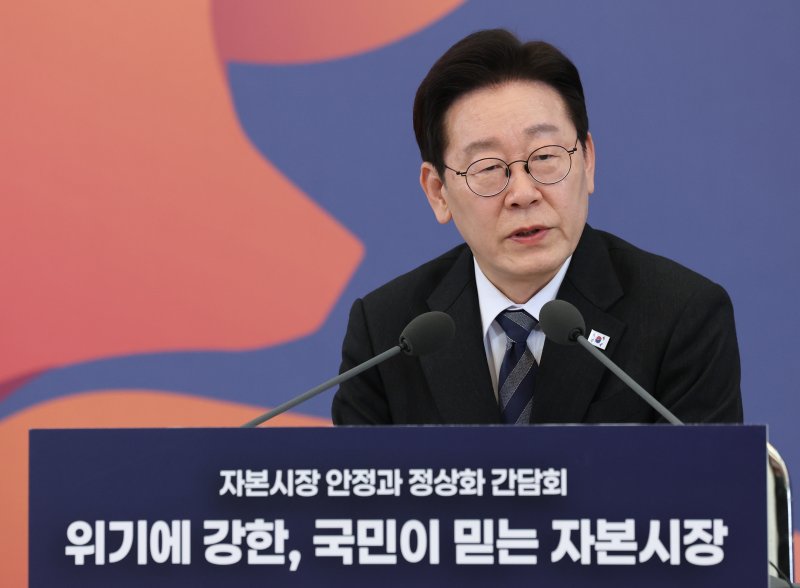
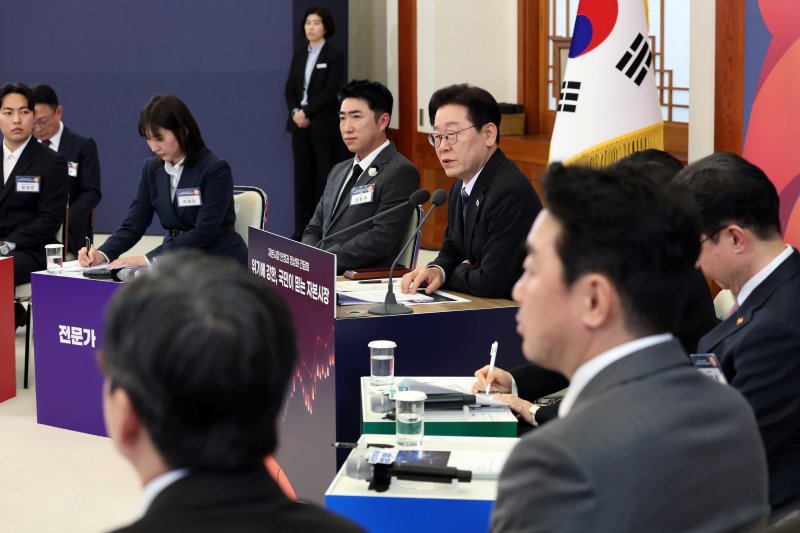
According to The Financial News, President Lee Jae Myung of South Korea said on the 18th, "I believe that normalizing and revitalizing the capital market is truly a crucial factor for the economy of the Republic of Korea (South Korea) and for industrial development. And I also think that it could significantly ease the problems stemming from the excessive concentration of wealth in real estate, which I have recently been paying particular attention to."
Regarding the geopolitical risk that has long weighed on the capital market, he argued, "In fact, it is greatly exaggerated compared with reality. The political sphere has unfairly exploited this issue."
At the Meeting for Capital Market Stability and Normalization held that day at Cheong Wa Dae, Lee said, "In the end, shifting toward productive finance is a very high priority in terms of national policy."
Lee went on, "South Korea faces many policy challenges, but the most important among them is the issue of people’s livelihoods, and at the core of that is the economy."
He particularly pointed to real estate, saying, "What matters most is building an economy that can grow continuously, and a society in which all members of our nation can share in the fruits of that growth. Through this, we can strengthen the foundation for sustained growth and create a virtuous-cycle economy."
Lee noted, "If you look at the details, a very large share of our citizens’ assets is concentrated in real estate. This has driven up housing prices in the Seoul metropolitan area and increased corporate production costs, which in turn undermines corporate productivity."
Speaking about the recent stock market, Lee said, "Last year, the index climbed from the 2,500–2,600 range to the mid‐6,000s almost without pause or correction. I felt very uneasy about that, but it also seems that we may now be going through a period of consolidation triggered by a certain event."
He stressed, "We must of course overcome national crises, but domestically, this is precisely the time when we should resolve the necessary tasks and implement the needed policy measures. That is how we prepare for a new beginning."
Lee cited factors behind the so‐called Korea discount, including corporate governance, a lack of transparency and fairness in the market, uncertainty in industrial and economic policy, and geopolitical risk.
However, he emphasized, "Depending on what we do, we do not have to accept a Korea discount. We can more than achieve a fair valuation and even realize a Korea Premium."
He added, "In fact, the issue of geopolitical risk is far more exaggerated than people think. Politicians have unfairly exploited it, amplifying unnecessary tension and anxiety," and continued, "With just a bit of effort, we can fully resolve this problem."
He went on, "Take all‐out war as an example. Even if one side were to claim victory, both sides would inevitably suffer enormous destruction and loss of life. In most cases, no one truly wants such an outcome; it is merely overstated in rhetoric."
Lee also said, "Of course we must eliminate risks, and recent wars have heightened anxiety. But South Korea’s defense capabilities are at a world‐class level," adding, "We are ranked fifth in the world in terms of conventional military strength, and we possess a massive defense industry."
He continued, "Economic power is the foundation of national defense, and in economic terms we are overwhelmingly strong to a degree that is almost beyond comparison. Objectively speaking, there is little to worry about. Geopolitical risk is significantly overstated," and added, "With a bit of effort, we can resolve all of these issues. The same goes for industrial and economic policy—we can improve it as much as we choose to." Looking ahead, he pointed to market transparency and fairness as key areas of concern. Lee said, "I often say that stock price manipulation should completely ruin those who engage in it, and we must make that a reality," adding, "If someone manipulates stock prices, we will confiscate all the funds mobilized, including the principal. With the Financial Supervisory Service (FSS) increasing its enforcement personnel, this issue will not be difficult to address." Lee said, "There are already many improvement tasks that have been identified," and added, "For example, we should clean up unsound financial products. Some are already listed and traded, yet a portion is carved out again to create new products. The problem of such duplicate listings is one example." Lee also remarked, "Some people ask why, when they sell a stock today, they do not receive the money until the day after tomorrow," and suggested, "If necessary, we could consider this as one of the agenda items for possible adjustment."
cjk@fnnews.com Choi Jong-geun, Sung Seok-woo Reporter