The curse of a 'hot spot'? In this transformed neighborhood, not just anyone can afford to live there now
- Input
- 2026-03-19 06:00:00
- Updated
- 2026-03-19 06:00:00
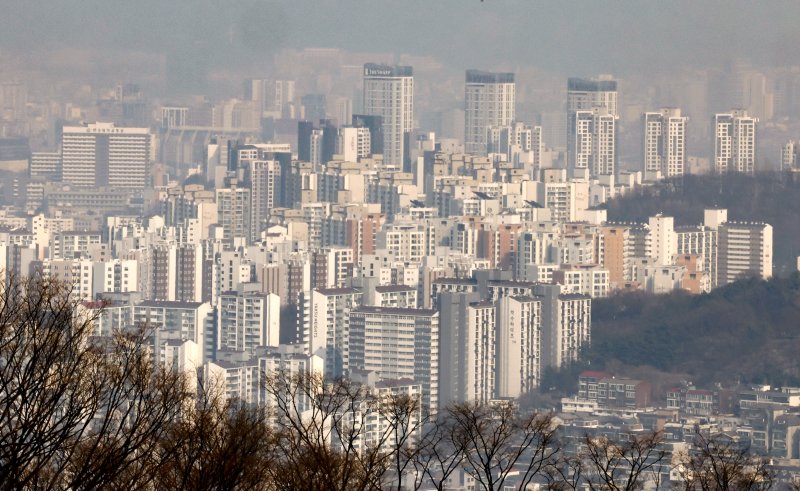
According to Financial News, jeonse and monthly rent prices in Seongdong District have risen more sharply than anywhere else in Seoul over the past five years, turning the area into an emerging prime residential zone. Analysts note that the share of high-end monthly rentals is also expanding quickly, suggesting that rental demand once concentrated in the Gangnam area is now spreading to Seongdong District and the Northeastern Han River Area.
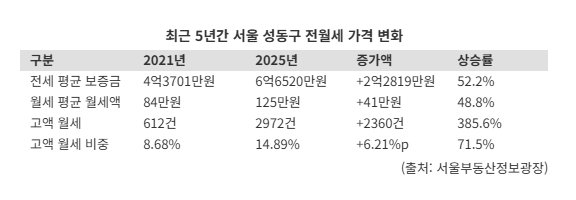
A full review by Financial News on the 18th of jeonse and monthly rent data for all types of housing in Seoul (apartments, row houses, multi-family units, officetels, and others) over the last five years found that the average jeonse deposit in Seongdong District climbed from 437.01 million won in 2021 to 665.2 million won in 2025. This is a 52.2% increase, or 228.19 million won, the steepest rise among all districts in Seoul. Citywide, the average jeonse deposit rose 31.5% during the same period.
Over the same period, Songpa District followed with its average jeonse deposit rising from 437.06 million won to 651.9 million won, up 49.2% (214.84 million won). It was trailed by Gangdong District at 47.2%, Mapo District at 45.6%, and Dongjak District at 44.2%. In Gangnam District, the average jeonse deposit increased from 635.37 million won to 810.4 million won, a 27.5% rise (175.03 million won), while Seocho District saw a 28.9% increase from 607.71 million won to 783.5 million won.
Seongdong District has also recorded one of the highest growth rates in monthly rents, not just jeonse deposits. Average monthly rent there rose from 840,000 won in 2021 to 1.25 million won in 2025, a 48.8% increase (410,000 won), ranking first among all districts. Yongsan District came next, with average monthly rent climbing from 850,000 won to 1.24 million won, up 45.9%. It was followed by Gangnam District at 45.5%, Songpa District at 43.5%, and Mapo District at 43.5%.
In particular, the share of high-end monthly rentals of 2 million won or more has surged. The number of such high-priced monthly rent contracts in Seongdong District jumped from 612 in 2021 to 2,972 in 2025, an increase of about 386%. The district’s share of Seoul’s total high-end monthly rentals rose by 71.5%.
The sharp rise in jeonse and monthly rents in Seongdong District is seen as the result of several factors: its strong accessibility to Gangnam District, steadily rising sale prices, and an overall decline in available rental listings. In particular, sale prices in the district spiked once after it was re-designated as a land transaction permit zone in March last year, triggering a so-called balloon effect. Expectations surrounding redevelopment projects, including the Seongsu Strategic Redevelopment Zone, are also supporting prices.
Data on officially assessed values released the previous day by the Ministry of Land, Infrastructure and Transport show that Seongdong District recorded a 29.04% increase, the highest among Seoul’s 25 districts. Given that official appraisals are linked to market prices, this indicates that home prices in Seongdong District have risen significantly. At the complex level, the officially assessed value this year for an 84-square-meter unit in Seoul Forest Riverview Xi in Haengdang-dong, Seongdong District, is 1.769 billion won, up 27.8% from 1.384 billion won a year earlier.
Ko Junseok, a professor at the Sangnam Institute of Management, Yonsei University, said, "Seongdong District has more older buildings than new ones, and it has the largest number of apartments priced between 1.5 billion and 2.5 billion won. Recently, buying interest has concentrated there, pushing up sale prices." He added, "The rise in jeonse and monthly rents is likely to lead to further increases in sale prices."
[email protected] Choi Ah-young Reporter