Kang Hoon-sik makes secret visit to UAE amid war: "Total of 24 million barrels of crude oil secured"
- Input
- 2026-03-18 14:00:41
- Updated
- 2026-03-18 14:00:41
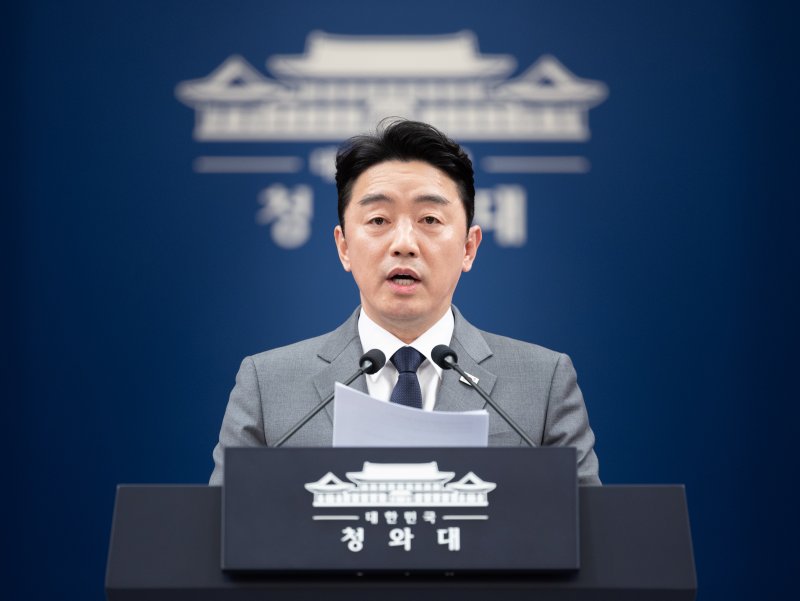
According to The Financial News, Kang Hoon-sik, Chief of Staff to the President of the Republic of Korea, stated on the 18th, "In the midst of a global emergency in crude oil supply and demand, the United Arab Emirates (UAE) has pledged to give Korea top priority in crude oil supplies." As tensions in the Middle East push up international oil prices, Kang was urgently dispatched to the region as President Lee Jae-myung of South Korea’s Presidential Special Envoy for Strategic Economic Cooperation and succeeded in securing additional crude oil. Behind this outcome, observers say, was Kang’s decision to visit the area despite the risks, at a time when safety could not be guaranteed due to attacks by the Islamic Republic of Iran.
■ Cheong Wa Dae: "UAE pledges top-priority crude oil supply to Korea"
At a briefing held that day at the Chunchugwan press center at Cheong Wa Dae (the Blue House) on the results of his visit to the UAE as Presidential Special Envoy for Strategic Economic Cooperation, Kang said, "The UAE side made it clear that 'there will be no country that receives crude oil before Korea; Korea will be the number one priority in crude oil supply,'" quoting their pledge.The Strait of Hormuz is effectively under blockade at present. As 70% of the crude oil imported by Korea passes through the Strait of Hormuz, it is urgent to secure alternative supply routes that do not rely on the strait in order to overcome the current energy supply crisis.
In response, Kang said, "I met with United Arab Emirates (UAE) President Mohamed bin Zayed Al Nahyan, Khaldoon Khalifa Al Mubarak, the UAE’s special envoy in charge of Korea and head of the Executive Affairs Authority, and Sultan Ahmed Al Jaber, Minister of Industry and Advanced Technology (MOIAT) and chief executive officer (CEO) of Abu Dhabi National Oil Company (ADNOC). We agreed that, depending on developments in the Middle East, Korea will be able to make emergency purchases of crude oil from the UAE at any time."
Providing details, Kang explained, "Through various supply channels, we have finalized the emergency import of a total of 18 million barrels of crude oil. Specifically, three UAE-flagged vessels will deliver 6 million barrels, and an additional 12 million barrels will be supplied via six Korea-flagged vessels, for a total shipment of 18 million barrels." He added, "In addition, one vessel loaded with naphtha is currently en route to Korea." He went on, "If we include the 6 million barrels previously supplied, Korea will have urgently imported a total of 24 million barrels from the UAE."
The two countries also agreed to strengthen cooperation not only for short-term supply and demand, but also for the long term, in order to prepare for potential disruptions to the energy supply chain. Kang said, "We agreed to conclude a memorandum of understanding on oil supply chain cooperation (MOU), which includes exploring alternative crude oil supply routes between the two countries, and we plan to sign it in the near future."
With these measures, Cheong Wa Dae believes that the most critical phase of the crude oil supply crisis has been overcome. In a Q&A session with reporters, Kang said, "What I can say about crude oil supply at this point is that we have avoided the worst-case scenario. We can be certain that Korea will not face a situation in which it becomes practically impossible to secure crude oil supplies."
Regarding the prices domestic companies will have to pay when importing crude oil, he noted, "Prices related to energy supply and demand will be set in line with market prices." He stressed, however, "I must reiterate that the current situation is one in which supply is not available even at those market prices." He added, "A supplementary budget is under discussion, and I expect that the outcomes of those discussions will eventually be made public."
■ Secret envoy mission to UAE carried out through wartime conditions
Kang made a secret visit to the UAE and managed to ease the strain on crude oil procurement. As local conditions, including airport closures, changed by the hour, he reportedly completed the trip on an almost four-day schedule with virtually no overnight rest.Kang paid a courtesy call on UAE President Mohamed bin Zayed Al Nahyan and delivered a personal letter from President Lee Jae-myung. The letter conveyed deep concern over the recent situation in the Middle East and expressed special condolences and solidarity with the people of the UAE.
Regarding why the UAE agreed to allocate crude oil to Korea on a top-priority basis, Kang said, "The President of the UAE mentioned this about three times. Judging from his repeated expressions of gratitude to the Republic of Korea for sending a special envoy in a time of war, and to the chief of staff who carried out the mission, and from the fact that he even used the phrase 'a friend who helps in difficult times is a true friend,' I speculate that this sentiment formed the backdrop to the decision."
Kang had originally been scheduled to return on the afternoon of the 17th, but his arrival was delayed due to flight disruptions caused by drone attacks, according to reports.
Kang recounted, "Just before arriving in the UAE, we departed for Dubai, but Dubai International Airport was closed, so we had to find an alternative airport." He continued, "After landing at the alternative airport, we waited on the plane for about five hours. When departing, our flight was canceled due to drone attacks the previous day, so we could not leave from Dubai International Airport and had no choice but to depart from Abu Dhabi instead. There was no direct flight to Korea, so it took extra time to return via a third country."
He was also asked whether defense exports had been discussed during the visit to the UAE. Kang replied, "It is true that many countries in the Middle East are requesting defensive weapons from Korea’s defense industry, particularly systems that intercept missiles." However, he added, "I do not think it is appropriate to keep linking this issue of crude oil supply with defense industry matters," declining to go into further detail.
Kang further said that the Strait of Hormuz itself was not on the agenda during this visit to the UAE. When asked about a U.S. request to send warships to the Strait of Hormuz, he responded, "There has been no formal request from the U.S. side so far. What we see in the news is actually moving at a faster pace. It is not an appropriate time for us to give an immediate answer," indicating a cautious stance.
cjk@fnnews.com Choi Jong-geun, Sung Seok-woo Reporter