Ruling Party and Government Speed Up Legislation to Boost Housing Supply and Tackle Jeonse Fraud
- Input
- 2026-03-18 12:38:53
- Updated
- 2026-03-18 12:38:53
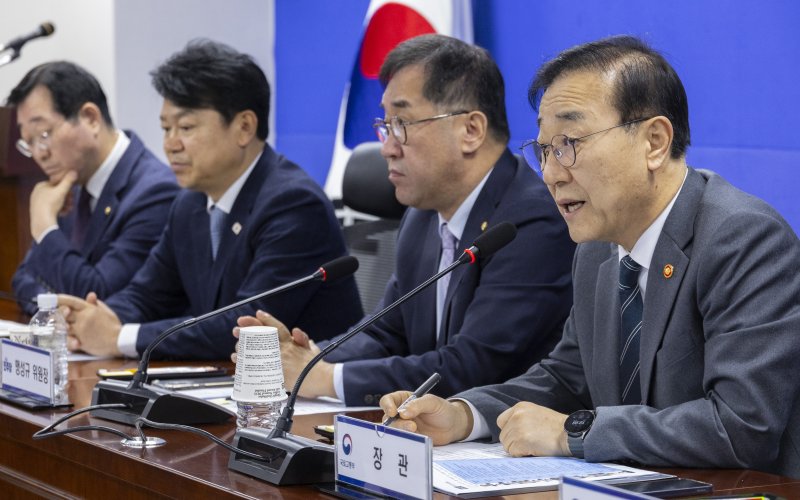
[Financial News] The Democratic Party of Korea and the Ministry of Land, Infrastructure and Transport agreed on the 18th to fast-track various bills needed to expand housing supply, in line with the government’s real estate measures. They also plan to continue follow-up discussions on the advance payment rate for compensation deposits for victims of jeonse fraud.
The ruling party and the government held a consultative meeting at the National Assembly that day and shared the view that livelihood-related bills should be handled with a sense of urgency. At the meeting, the Ministry of Land, Infrastructure and Transport (MOLIT) reported around 30 legislative tasks to the party.
Among them, the ruling party and the government will first push ahead with housing supply bills that are follow-up measures to the September 7 Housing Supply Expansion Plan announced last year. These include the Special Act on Public Housing, the Special Act on Mixed-use Development of Aging Public Office Buildings, the Special Act on Complex Development of School Sites, the Yongsan Park Act, the Act on the Maintenance and Improvement of Urban Areas and Dwelling Conditions for Residents, and the Act on the Management and Promotion of Real Estate Development Business. They intend to pass these bills as quickly as possible to ensure stable progress in housing supply.
They also discussed a range of legislative tasks aimed at protecting low-income residents and vulnerable housing groups. Priority bills include the Special Act on Support for Victims of Jeonse Fraud, amendments to the Housing Act to tighten entry requirements for regional housing cooperatives, and revisions to the Act on the Private Rental Housing. In particular, for the Special Act on Support for Victims of Jeonse Fraud, they agreed to continue talks on the rate at which the government will advance compensation deposits. Two options are reportedly on the table: 40%, and 50% to provide a higher level of protection.
In addition, they plan to accelerate work on the Act on Maintenance of Vacant Buildings and the Special Act on the Construction of Administrative City to improve local living conditions; the Act on the Management of Buildings and the Special Act on the Maintenance of Specified Buildings to enhance fire safety in aging apartment complexes; and the Special Act on Construction Safety to strengthen safety at construction sites.
MOLIT also reportedly briefed the party on the need to revise the Act on the Development of Taxi Transportation Business to improve working conditions for corporate taxi drivers, to amend the Aviation Safety Act to align the aviation safety oversight system with international standards, and to update the Airport Facilities Act.
The Democratic Party of Korea plans to pass the roughly 30 bills mentioned at the meeting during the first half of the 22nd National Assembly. The first half of the 22nd National Assembly runs through May.
The problem is the stalled bill review process. The Subcommittee on Land and Infrastructure Legislation, which reviews bills needed for the government’s housing supply policy, has not met since December 9 last year. The subcommittee is currently chaired by Kwon Young-jin of the People Power Party (PPP).
The Democratic Party of Korea says it will do its best to persuade the PPP, but also maintains that it may have no choice but to resort to "extraordinary measures" if persuasion fails. In that case, it is prepared to bypass the bill review subcommittee and bring the relevant bills directly to the full committee for a vote.
[email protected] Kim Hyeong-gu Reporter