Why Has the Gold Price Barely Moved Despite the War in Iran?
- Input
- 2026-03-18 13:58:20
- Updated
- 2026-03-18 13:58:20
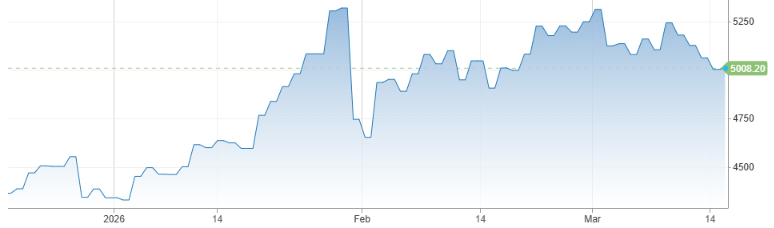
According to Financial News, despite the war in the Middle East triggered by attacks on Iran by the United States of America (U.S.) and Israel, the price of gold, a leading safe-haven asset, has remained surprisingly calm, drawing close attention from markets.
Since the war broke out on February 28 (local time), the Islamic Revolutionary Guard Corps (IRGC) declared a blockade of the Strait of Hormuz, through which 20% of the world’s oil and gas shipments pass. As a result, international crude prices surged past 100 United States dollars (USD) per barrel.
While global stock markets have been unable to escape a downward trend amid rising uncertainty, gold has been holding around 5,000 USD per ounce (31.1 grams).
As of the 17th, the spot price of gold stood at 5,001.36 USD per ounce, little changed from the previous day. April delivery gold futures also inched up just 0.1% to 5,005.20 USD.
This stands in stark contrast to the surge in gold prices during the war in Ukraine.
At that time, when Western countries imposed sanctions on Russia, many central banks around the world went into panic. Some, including the People's Bank of China (PBC), bought large amounts of gold to reduce their reliance on the USD.
James Meadway, a member of the Progressive Economy Forum, told Al Jazeera in an interview that traders now expect the Federal Reserve System (Fed) to halt interest rate cuts and possibly raise rates again to deal with rising U.S. inflation.
Because of this, he said, "the appeal of dollar assets has increased, while the appeal of gold, which pays no interest, has relatively diminished."
Meadway also argued that the sharp rise in gold prices earlier this year, even before the current war, is another reason the market is not reacting strongly to the conflict in Iran. Rebecca Christie of the Bruegel think tank noted that as the value of the dollar rises, it is becoming an alternative safe-haven asset, adding, "With higher oil prices expected to fuel inflation, the dollar will likely look even more attractive."
Christie pointed out that because gold is traded in a dollar that has already strengthened, it will be difficult for even highly interested investors to push gold prices much higher.
She added that gold has become a speculative asset and that, given the current global environment, central bank and other gold investors are being unsettled by its volatility.
Christie also said the main reason there is no fresh surge in gold prices now is that "they have already risen quite a lot."
Looking ahead, Meadway cited two key factors that will determine the direction of gold prices: whether the next Chair of the Federal Reserve, expected to take office in May, will send a clear signal of rate cuts despite inflationary pressures, and how long the current war involving Iran will last.
He said there is some expectation that the war could end sooner than many fear, but warned, "If it drags on and the damage spreads, gold will regain its appeal."
jjyoon@fnnews.com Yoon Jae-joon Reporter