Koo Yun-cheol: "We will provide 1.5 trillion won in support to companies hit by supply chain disruptions and deploy policy tools without delay"
- Input
- 2026-03-18 09:28:25
- Updated
- 2026-03-18 09:28:25
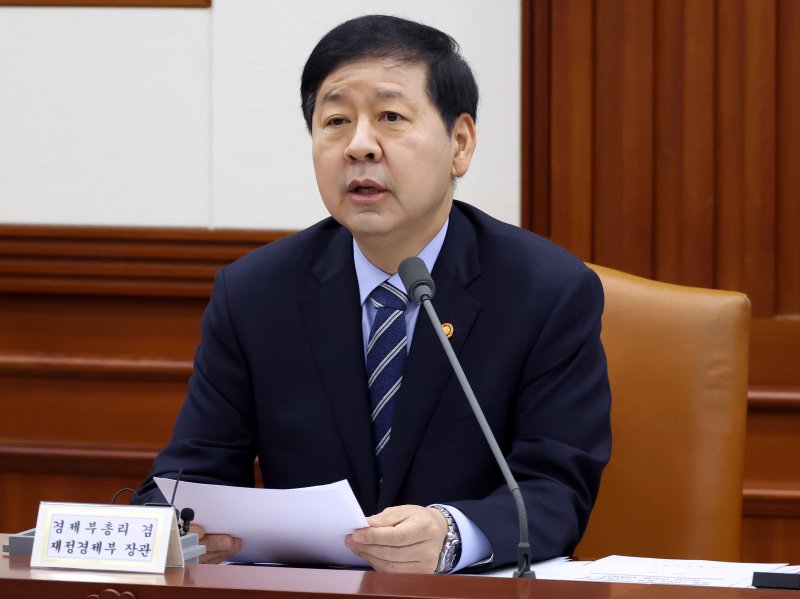
According to The Financial News, Deputy Prime Minister and Minister of Finance and Economy Koo Yun-cheol said on the 18th that, in preparation for a prolonged war situation in the Middle East, "we will expand financial support to 1.5 trillion won for companies suffering supply chain damage." To this end, the government will create a special support program within the Supply Chain Stabilization Fund dedicated to responding to damage related to the Middle East.
In addition, under the Framework Act on Supply Chain Stabilization Support for Economic Security, Naphtha, whose supply chain risk has increased due to high dependence on specific countries, will be temporarily designated as an economic security item.
Presiding over the 2nd meeting of the Emergency Economic Council and the 8th meeting of the Supply Chain Stabilization Committee at Government Complex Seoul on the same day, Koo stated, "Following the oil price cap system, we will promptly deploy all available policy tools, including the designation of economic security items."
The government discussed trends in the supply and demand of items with high dependence on the Middle East and measures to support supply chain stabilization, as well as a joint emergency response strategy for the economy in light of the situation in the Middle East.
First, the government will temporarily designate Naphtha as an economic security item and implement proactive measures such as securing alternative import sources and restricting exports.
Through the Supply Chain Stabilization Fund, the government decided to immediately provide 1.5 trillion won in financing to companies affected by the Middle East situation. This will include support for the cost difference of alternative imports and emergency operating funds.
Companies that handle economic security items with high dependence on the Middle East will also be offered a preferential interest rate of up to 2.3 percentage points.
At the same time, the government plans to swiftly draw up a supplementary budget bill to ease the burden on households and industry.
It will also make every effort to ensure the stable implementation of the oil price cap system on petroleum products, which has been in effect since the 13th.
Koo said, "Since the supply prices of oil refining companies have fallen significantly after the introduction of the price cap, retail fuel prices at gas stations must also be lowered further without delay."
The government has set the maximum supply prices for oil refining companies at 1,724 won per liter for regular gasoline, 1,713 won for Diesel, and 1,320 won for indoor kerosene. It will reset the maximum prices on the 27th, two weeks after implementation.
Gasoline prices are on a downward trend, but the decline has not been large. The price of gasoline rose to 1,907 won per liter on the 10th, and since the price cap took effect, it has been fluctuating in the 1,830-won range.
The government will continuously monitor trends in petroleum product prices and strictly crack down on unfair practices such as hoarding and refusal to sell through on-site inspections and a reporting center.
It will also make every effort to manage energy supply and demand, including securing additional alternative supply sources.
If necessary, the government is considering a range of demand management measures, including vehicle use restrictions. It also plans to pursue demand reduction measures such as limiting export volumes of oil refining companies, flexibly operating caps on coal-fired power generation, increasing the utilization rate of nuclear power plants, and expanding Renewable Energy.
The supplementary budget will be drawn up quickly and will be used to reduce logistics and fuel cost burdens, stabilize livelihoods for small business owners and farmers and fishers, and support small and medium-sized enterprises affected by the crisis.
Koo added, "To ease polarization, we will provide meticulous support by accurately targeting vulnerable groups, regions, and other sectors facing difficulties."
The government will also accelerate the Rapid Commercialisation Support for AI Application Products AX-Sprint Project. It plans to select a total of 246 AI-based innovative products and provide about 750 billion won in support so that they can be launched in the market within one to two years.
[email protected] Jung Sang-geun Reporter