"This Was Taken From a Satellite, Not an Airplane" – Jamsil Main Stadium Seen From Space
- Input
- 2026-03-18 06:00:00
- Updated
- 2026-03-18 06:00:00
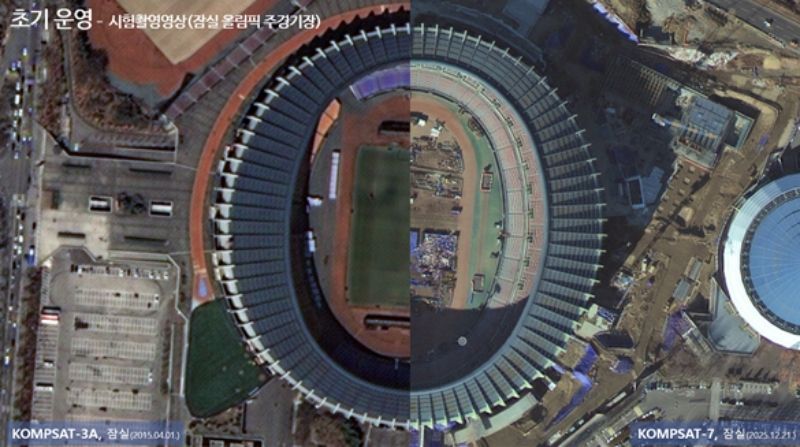
[Financial News] Highly detailed images of Seoul Olympic Stadium in Jamsil and the surrounding Lotte World Tower area have been released, clear enough to distinguish individual vehicles and roads. The images were taken from space by KOMPSAT-7 (Korean Multi-Purpose Satellite-7), a high-resolution Earth observation optical satellite developed by Korea, and by Next-Generation Medium-Sized Satellite-3.
The Korea AeroSpace Administration (KASA) announced on the 17th that it had released the first images captured by the two satellites, along with their initial operational results, marking a significant leap in Korea's Earth observation satellite capabilities.
Next-Generation Medium-Sized Satellite-3 was placed into orbit on November 27 last year aboard the fourth launch of Nuri (KSLV-II). KOMPSAT-7 (Korean Multi-Purpose Satellite-7) was launched on December 2 the same year (Korea time) from the Guiana Space Centre, using the European Space Agency (ESA)'s Vega-C launch vehicle.
The test images released by KASA during this initial operations phase include views of Seoul Olympic Stadium in Jamsil and Lotte World Tower, captured by KOMPSAT-7. KOMPSAT-7 is the culmination of technology built up since KOMPSAT-1 (Arirang-1), launched in 1999, and boasts ultra-high-resolution observation capability of 0.3 meters or better, allowing it to distinguish even types of vehicles on the ground.
In fact, when compared with images taken by Korea Multi-Purpose Satellite-3A, a 55-centimeter-resolution satellite launched in 2015, the roof lines of the main stadium appear much sharper and clearer in the KOMPSAT-7 imagery. The shapes of surrounding buildings and cars are also rendered with noticeably greater clarity.
Next-Generation Medium-Sized Satellite-3 was developed under a model in which a space-specialized private company led the satellite development, while the government and research institutes provided support. It serves as a "comprehensive space laboratory," carrying out missions that include Earth observation and measurements of the space environment.
In this announcement, KASA also released basic space environment data obtained through high-resolution aurora observations by the Republic of Korea Imaging Test of Aurora and Airglow (ROKITS) of the Korea Astronomy and Space Science Institute (KASI), and space plasma and magnetic field observations by IAMMAP of the Korea Advanced Institute of Science and Technology (KAIST), as well as data from space biology experiments conducted with the BioCabinet of Hallym University.
KASA stated, "The successful orbital insertion and initial operation of these two satellites prove that the Republic of Korea has secured world-class Earth observation capabilities," adding, "At the same time, this is a key achievement showing that the shift from a government-led to a private sector-led space industry ecosystem is now fully underway."
[email protected] Hee-sun Kim Reporter