Editorial: Let’s Run Toward a Second Golden Age for Shipbuilding and Marine Industries
- Input
- 2026-03-17 18:28:40
- Updated
- 2026-03-17 18:28:40
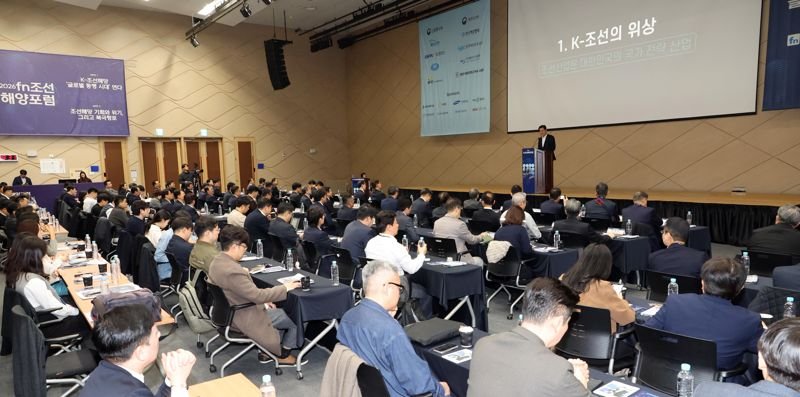
Leadership in shipbuilding becomes even stronger when it is linked to dominance over the broader maritime domain. A country that controls sea transport and key port hubs is poised to emerge as the ultimate winner in the global shipbuilding and marine arena. The "2026 fn Shipbuilding & Marine Forum" held by Financial News on the 17th was organized to explore ways to maximize Korea’s competitiveness in shipbuilding and marine industries amid a rapidly changing global logistics landscape.
Lee Sang-kyun, chair of the Korea Offshore & Shipbuilding Association (KOSHIPA) and vice chair and CEO of HD Hyundai Heavy Industries, remarked, "Only countries that are prepared can survive in the shipbuilding industry," and proposed a "Team Korea" framework in which the government, shipbuilding, and marine sectors move in unison. Participants stressed that "the power to defend our seas is the power to defend our nation" and urged the government to provide strategic support. They also pointed to reforming industrial infrastructure to generate synergies with artificial intelligence (AI) as a key task. Lee noted, "Shipbuilding is transforming into a high-tech industry where AI and robots converge with eco-friendly fuels and new materials," making public–private cooperation more essential than ever for a successful AI-driven transformation of the sector.
Korea’s shipbuilding industry possesses world-class technologies envied across the globe, but there is no room for complacency. Above all, China’s low-price orders and rapid technological catch-up pose major risks. According to the Korea Shipowners' Association, China’s share of the global shipbuilding market was only about 5% in 2000, but since 2023 it has surpassed half of the world total. Its share in bulk carriers and container ships is approaching 70%. China is effectively sweeping up orders for basic ship types worldwide. Korea still holds an edge in high value-added vessels such as Liquefied Natural Gas (LNG) carriers, yet it is now being chased hard by China. To expand production bases and secure an overwhelming technological lead, corporate perseverance must be matched by strong government backing.
Korea’s shipping industry once ranked among the world’s leaders, boasting the seventh-largest carrier, but it is no longer what it used to be. Having missed the global trend toward larger shipping companies, it endured some of its worst years during the post–global financial crisis downturn in shipping. The sector laid the groundwork for a comeback during the post-COVID-19 shipping boom, yet there is still a long way to go. One mid-sized Korean shipping company, Sinokor Merchant Marine, has drawn attention as an unexpected beneficiary of the recent Middle East crisis. Just before the outbreak of conflict, it purchased a large number of Very Large Crude Oil Carriers (VLCCs). With the Strait of Hormuz remaining effectively blocked, Sinokor Merchant Marine’s VLCCs are serving as floating oil storage tanks in the Persian Gulf, reportedly generating huge profits. It is noteworthy that foreign media have highlighted the foresight of a Korean shipping company. Such ingenuity and foresight need to spread across the entire shipping industry.
Korean shipping companies must continue to place bold orders for new vessels with a long-term view of the future, while Korea’s shipbuilders need a systematic order-taking system grounded in the government’s sophisticated strategies. In short, the two sectors must operate as "one team." The need for policy finance—such as low-interest financing, tax incentives, and export subsidies—goes without saying. These tools also explain how China’s shipbuilding and marine industries have grown so rapidly. A robust shipbuilding and marine ecosystem can reinvigorate regional economies and serve as a breakthrough for escaping low growth.